
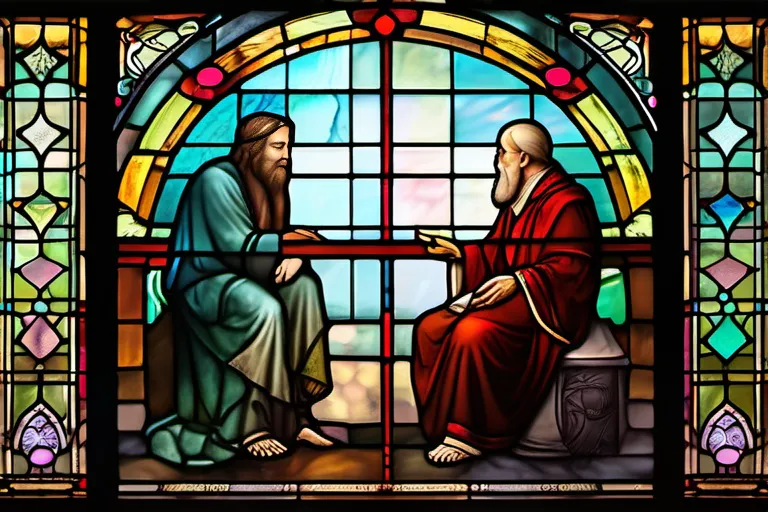
Religion and philosophy overlap when people ask about reality, knowledge, goodness, suffering and how to live. Their relationship can involve cooperation, criticism and disagreement. Religious thinkers use philosophical arguments, while philosophers examine religious claims and the meanings of faith, revelation and spiritual practice.
They are not identical activities. Religion also includes worship, ritual, community and inherited ways of life. Philosophy gives particular attention to concepts, reasons and arguments. The relationship becomes clearer through specific thinkers and questions than through a simple opposition between “faith” and “reason.”
Shared questions do not require one method
The Stanford Encyclopedia of Philosophy’s account of philosophy of religion includes questions about ultimate reality, religious concepts and alternative worldviews. Its scope extends beyond asking whether a particular conception of God is true.
Several kinds of question can arise:
- Reality: What exists, and what would it mean to call something divine or ultimate?
- Knowledge: What could justify a belief, and what role might experience or testimony play?
- Ethics: What makes an action right, and how should people respond to suffering?
- Meaning: How do beliefs, practices and commitments affect an account of a worthwhile life?
Religious traditions may approach these questions through scripture, interpretation, practice and argument together. Philosophical examination asks how an answer is formulated and supported. A person need not belong to a tradition in order to study its reasoning, just as belonging to one does not exclude critical reflection.
Plato: asking what piety means
In Euthyphro, Plato presents Socrates questioning someone who claims expertise about piety. Giving an example of a pious action does not satisfy Socrates; he asks what makes pious actions pious.
A central question concerns the relationship between divine approval and the quality being approved. Is something pious because the gods love it, or do they love it because it is pious? The distinction asks whether approval explains goodness or responds to it.
The dialogue illustrates philosophical inquiry working on a religious concept from within an ancient religious setting. Its questions remain influential in debates about morality and divine command, but they should not be treated as if every later tradition has the same account of God, the gods or moral goodness.
Aquinas: reason and revelation have different roles
Thomas Aquinas addresses the relationship directly at the beginning of the Summa Theologiae. In the first article, he asks whether a form of sacred teaching is needed in addition to philosophical inquiry.
His answer is that revelation is necessary for salvation because the human end in God exceeds what reason can grasp on its own. He also argues that even truths accessible to reason would otherwise be known by relatively few people, with difficulty and the possibility of error.
This is a Christian theological argument that uses reasoning to distinguish kinds of knowledge. It is not a rejection of philosophy, nor a claim that philosophy independently proves every article of faith. Readers may accept or challenge its premises, but understanding the distinction is essential to assessing the position fairly.
Ibn Rushd: philosophy within Islamic inquiry
Ibn Rushd, also known in Latin as Averroes, provides another important model. The Stanford account of his work describes his commitment to demonstration and his conviction that philosophy should have a central place in religious inquiry. His Decisive Treatise argues for the value of philosophy within Islam.
He was also a physician and judge, and his writings extend across logic, metaphysics, medicine and religious law. Those different activities should not be collapsed into one undifferentiated form of reasoning: the subject and audience matter to how a question is addressed.
His example challenges the assumption that philosophical reasoning and religious commitment must belong to entirely separate kinds of person. It also represents a particular intellectual project within Muslim history, rather than the single position of every Muslim scholar.
Maimonides: words and understanding must be distinguished
Maimonides’ Guide for the Perplexed, part I, chapter 50, discusses what it means to hold a belief. He distinguishes saying words from apprehending what they mean and being convinced of what is understood.
The discussion occurs within his treatment of divine unity and attributes. It illustrates how philosophical analysis can examine the content of a religious confession: merely repeating a statement does not establish that its meaning has been understood consistently.
This is a Jewish philosophical and theological approach to belief, not an account of all Jewish practice. Its wider significance is the demand for conceptual clarity. An apparent agreement between two statements may conceal different meanings, while a disagreement can concern the concepts being used as much as the words themselves.
Buddhist inquiry can question which questions matter
The Buddhist Cula-Malunkyovada Sutta, MN 63, examines the demand for answers to certain speculative questions before undertaking religious training. It uses the image of a man wounded by a poisoned arrow who refuses treatment until he knows numerous details about the attacker and the weapon.
The point concerns priorities: the person may die while waiting for answers that do not remove the immediate problem. The discourse connects its own priorities with the cessation of suffering.
This does not show that Buddhism has no philosophy or that every difficult question is forbidden. It shows a religious text reasoning about which inquiries serve its goal. The example also broadens the discussion beyond models centred entirely on a creator God and revealed doctrine.
Hume: philosophical criticism of religious explanations
Philosophy can also challenge claims made about the divine. In part X of David Hume’s Dialogues Concerning Natural Religion, the characters discuss suffering and the moral attributes of God. Philo questions how the condition of living beings supports inferences to unlimited power and goodness.
The issue is not merely that suffering feels distressing. It concerns whether the world provides the evidence needed for a particular theological conclusion. An answer must address the relationship between the evidence and the attributes being inferred.
Because Hume writes a dialogue, the arguments should be read in relation to the speakers and their exchanges. A challenging passage is not a substitute for every argument elsewhere in the work or for later responses to the problem of evil.
Why the relationship continues to matter
These examples reveal several possibilities. Philosophy can clarify a confession, support a theological argument, question an inference or examine the aims of a practice. Religious commitments can also shape which questions a thinker regards as urgent and what sources they consider authoritative.
Neither cooperation nor conflict guarantees an answer in advance. A religious claim does not become philosophically convincing merely because it is sincerely held. A criticism does not succeed merely because it is expressed sceptically. The relevant task is to understand the position and assess the reasons offered for or against it.
Conclusion
Religion and philosophy have a continuing relationship because questions about truth, goodness and human life cross the boundaries between them. Their interaction has produced both influential syntheses and searching criticism.
Plato, Aquinas, Ibn Rushd, Maimonides, Buddhist discourse and Hume illustrate different forms of that interaction. Attention to their actual questions and methods produces a richer understanding than assuming that religion supplies unquestioned answers while philosophy alone asks questions.
Published by Ralf. About our editorial process.



