
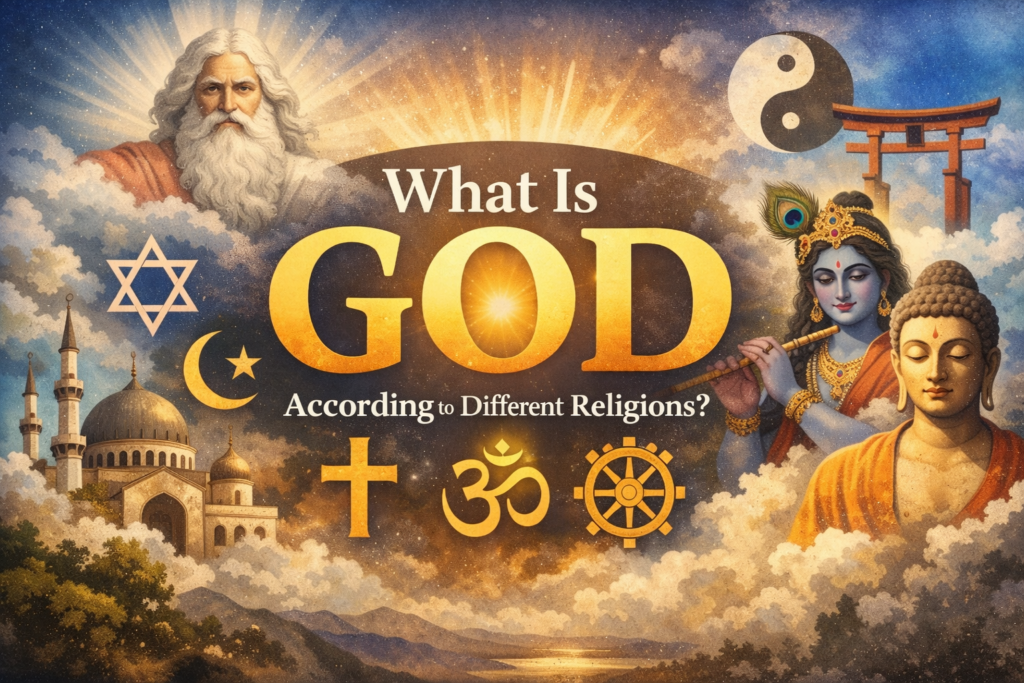
Religions do not share a single definition of God. Judaism, Christianity, Islam and Sikhism affirm one God, while differing in significant teachings. Hindu traditions include several understandings of deity and ultimate reality. Buddhism generally does not teach an eternal creator, and the Dao is not simply another name for a personal creator God. These are starting points for comparison, not complete descriptions of every believer.
God in Judaism: oneness and covenant
A central Jewish affirmation appears in Deuteronomy 6:4, the opening of the Shema. It expresses God’s oneness and Israel’s relationship to God. Jewish teachings about God are developed through scripture, interpretation, worship and ethical life.
Religious identity and personal belief are not identical: Jewish people can differ in observance, theology and their understanding of revelation. For the scriptural setting, see what the Torah is.
God in Christianity: the Trinity
Catholic, Orthodox and most Protestant traditions confess one God as Father, Son and Holy Spirit. The doctrine concerns three persons, not three separate gods. The Catholic Catechism, paragraphs 253–255, explains that distinction from a Catholic perspective.
The Trinity is also a point of difference from Judaism and Islam. Not all groups identifying as Christian accept the same trinitarian doctrine; a careful comparison should name the tradition being described.
God in Islam: tawhid
Tawhid refers to God’s oneness. Quran 112, Surah al-Ikhlas, affirms that God is one and without an equal, and rejects the idea that God begets or is begotten. “Allah” is the Arabic word for God, rather than the name of an additional deity alongside God.
This differs from Christian accounts of the Son and the Trinity, even though both traditions describe themselves as monotheistic. Comparing their use of “one God” requires looking at the associated teachings, not just counting the word “one.”
God in Sikhism: divine oneness
Sikh teaching centers on the One, often expressed through Ik Onkar. The Sikh Coalition’s explanation of Sikh beliefs connects divine presence with human equality, devotion, truthful living and service.
This is a community explanation of its own tradition. Shared belief in one God does not make Sikhism interchangeable with Christianity, Judaism or Islam; each has its own scriptures, history and practices.
Hindu traditions: deities and Brahman
Hindu traditions cannot be reduced to a single formula about how many gods exist. Worship may center on Vishnu, Shiva, Devi or another deity. Philosophical schools also differ about the relationship between divine reality, the world and the self.
Harvard’s Pluralism Project essay Many Gods and One introduces this diversity. Brahman, a term for ultimate reality in many Hindu philosophies, should not be confused with Brahma, a deity. It is too sweeping to claim that every Hindu understands every personal deity merely as an interchangeable form of an impersonal absolute.
Our guide to Hindu gods and goddesses explains several common names and their contexts.
Buddhism: no eternal creator, but religious devotion
Buddhist traditions generally do not ground liberation in an eternal creator God. Many nevertheless describe gods, heavenly realms, buddhas and bodhisattvas, and include prayer and devotional practice.
Nyanaponika Thera’s Theravada essay on the God-idea distinguishes a creator from impermanent heavenly beings. The Pure Land sutras provide a different Buddhist context in which devotion to Amitabha Buddha matters. Neither example supports treating Buddhism as simply a belief in nothing.
Daoism: the Dao and divine beings
The Dao, often translated as the Way, is not straightforwardly equivalent to a personal creator God. But describing Daoism as only an impersonal philosophy omits its religious communities, rituals and deities. The Pluralism Project’s Daoism overview shows that broader religious history.
Do all these traditions mean the same God?
There is no neutral one-sentence answer accepted by all communities. People may argue for a shared ultimate reality, for different understandings of a common referent, or for incompatible claims. Those are theological and philosophical positions, not conclusions established merely by translating several words as “God.”
A useful comparison asks who is speaking, what the term means in that setting, which text or practice supports the description, and where members disagree. Respectful coexistence does not require pretending that differences have disappeared. This introduction is selective; it does not represent every religion or combine distinct Indigenous traditions into one theology.
Conclusion
A comparison of God across religions depends on more than a shared English word or the number of deities named. Oneness, Trinity, Brahman, Buddhahood and the Dao belong to different systems of thought and practice. Understanding those systems in their own settings makes their points of contact and disagreement clearer. A selective introduction can orient the reader, while leaving room for the internal diversity that no short description of a religion can exhaust.
Reviewed and substantially revised on 1 November 2026. Sources identify religious self-descriptions and scholarly context; this article does not decide which belief is true. See our editorial approach and AI transparency.
Published by Ralf. About our editorial process.




1 thought on “What Is God in Different Religions? Beliefs and Key Differences”