
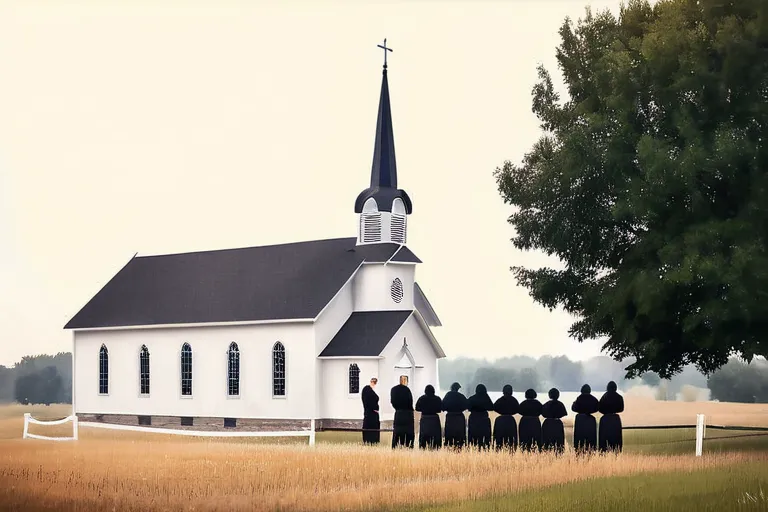
Mennonites are Christians in the Anabaptist tradition. Common emphases include following Jesus in daily life, baptism on confession of faith, reading the Bible within the church community, peacemaking and mutual care. Mennonite churches are diverse. Distinctive dress, horse-drawn transport and avoidance of modern technology describe some communities, not every Mennonite.
Where do Mennonites come from?
Mennonite churches have roots in the sixteenth-century Anabaptist movement associated with the Reformation. The name refers to Menno Simons, an influential early leader. It does not mean that all Mennonite churches today belong to one centrally governed denomination.
Mennonite Church USA’s FAQ about Mennonites introduces that history and explains the relationship with other Anabaptist communities. Shared historical roots do not make every branch identical.
God, Jesus and the Bible
The Mennonite World Conference’s Shared Convictions describes God as Father, Son and Holy Spirit and centers Christian life on Jesus’s life, teaching, death and resurrection. Its statement also identifies the Bible as authority for faith and life, interpreted together under the guidance of the Holy Spirit.
This is a shared statement within a worldwide communion, rather than a complete description of every person using the Mennonite name. It helps identify central commitments without assuming that local churches agree on every interpretation.
Why is baptism important?
Anabaptist traditions emphasize baptism following a personal confession of faith, rather than baptism as an infant. “Believer’s baptism” is more precise than assuming that all candidates must have reached the same adult age.
Mennonite Church USA’s account of its beliefs connects baptism with a commitment to follow Jesus in community. It also describes worship, discernment, reconciliation and participation in the church’s life. Baptism is therefore understood as more than a marker of family ancestry.
Peace, service and mutual care
The World Conference statement calls members to peacemaking, love of enemies, justice and sharing with those in need. Nonviolence is an important theme of Mennonite discipleship. It concerns how believers understand following Jesus, not merely a preference for avoiding uncomfortable conversations.
Churches can express these commitments through congregational support, service and work for reconciliation. An individual church’s actual projects should be checked rather than supplied with invented examples or assumed outcomes. Nor does a peace commitment mean that every member or institution has always lived up to it.
Are Mennonites the same as the Amish?
No. Mennonites and Amish share Anabaptist roots, but are distinct communities with differences in church discipline and ways of life. The split associated with Jakob Ammann in 1693 is discussed in the Mennonite Church USA FAQ linked above.
Do not use the image of an Amish buggy as a shortcut for Mennonite identity. Some Mennonites follow plain dress and restrictive technology practices, while others drive cars, use digital technology and dress like their neighbors.
Do all Mennonites have the same rules?
No. A local congregation’s affiliation matters. Mennonite Church USA explicitly notes in its FAQ about that denomination that its members are not distinguished by a particular clothing style or appearance. That description should not be extended to every conservative or Old Order community.
Questions about ministry, worship, clothing, technology or marriage therefore need a named church context. A visitor can check a congregation’s statement of faith and ask how its commitments are practiced locally, rather than relying on a stereotype.
Reading the sources
The sources above are official Mennonite self-descriptions. They explain shared teaching and one denomination’s perspective; they are not an independent assessment of all Mennonite history or every member’s experience. For the wider issue of variation inside traditions, see why religions differ.
A concrete example of service beyond a congregation
Mennonite Central Committee’s mission statement identifies it as a worldwide ministry of Anabaptist churches responding to human need and working for peace and justice. Its combination of relief, development and peace work gives an institutional example of how service can extend beyond a Sunday gathering.
MCC’s kits and comforters program also shows a practical form of participation: people prepare material supplies for distribution through its work. This is an example of an organized program, not a claim that every Mennonite participates or that a particular quantity of supplies proves a lasting outcome. MCC is a ministry with its own organization, rather than the governing body of all Mennonite churches.
Conclusion
Mennonite identity is rooted in an Anabaptist understanding of Christian discipleship: faith expressed through baptism, community, peace and service. These shared emphases do not produce one universal style of clothing, technology use or church government. Reading a congregation’s commitments alongside its wider affiliation gives a clearer account than relying on an Amish stereotype. Concrete service work can illustrate a religious ideal while still requiring its own evidence about practice and results.
Reviewed and substantially revised on 1 November 2026. Denominational statements are identified and not treated as universal local rules. See our editorial approach and AI transparency.
Published by Ralf. About our editorial process.



