
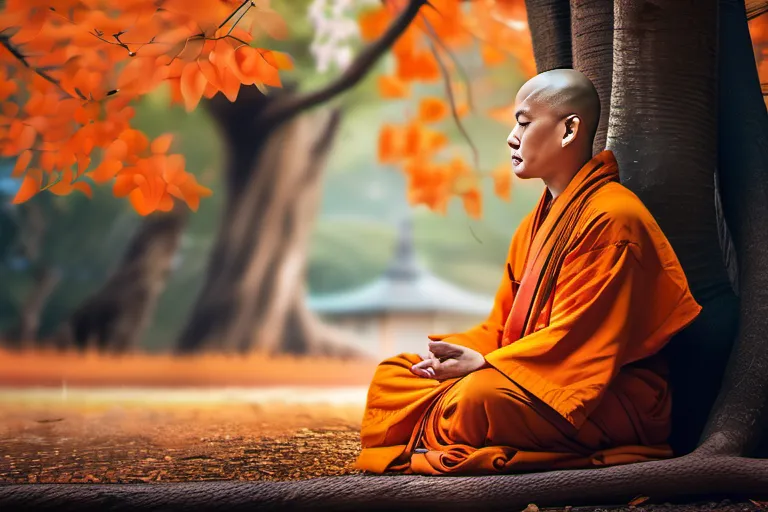
Orange or saffron robes identify some Buddhist monastic communities, especially in Theravada settings, but they are not worn by every Buddhist or every monk. Robe colors and forms differ across traditions. The significance involves monastic identity, simple material needs and a community’s discipline, rather than one universal meaning attached to orange.
Why do monastics wear distinctive robes?
The Tibetan Nuns Project’s account of monastic robes explains their role as a visible sign distinguishing ordained communities from lay people. It also describes the variety of colors and garments that developed within Buddhist traditions.
The robe therefore belongs to a system of religious training and community identity. Its significance cannot be established through color alone, and wearing a similar shade of ordinary clothing does not make someone ordained.
What practical purpose does a robe serve?
In Thanissaro Bhikkhu’s Buddhist Monastic Code discussion of cloth requisites, robe-cloth is one of the basic material supports for monastic life, alongside food, shelter and medicine. The discussion emphasizes using these supports for training rather than treating possessions as ends in themselves.
The cited texts also identify ordinary purposes: covering the body and protecting it from heat, cold and environmental discomfort. Robes should not be explained only as mystical symbols while their material function is ignored.
Why the saffron and ochre colors?
BuddhaNet’s overview of monastic robes describes dyed cloth and the prevalence of saffron and ochre shades in the traditions it discusses. It also explains the triple robe as a set of garments, rather than necessarily one single piece worn in every situation.
“Saffron-colored” describes an appearance; it is not a guarantee that a modern robe was dyed with the expensive saffron spice. The actual cloth, dyes and permitted forms need to be understood within the community that uses them.
Do all monks wear orange?
No. The Tibetan Nuns Project describes maroon or burgundy robes in Tibetan communities and other colors in East Asian traditions. At Amaravati, a Theravada monastery, the published explanation distinguishes ochre-clad monks, brown-clad nuns and white-clad postulants or novices within its own community.
That example also shows why a country’s name or a broad label such as “Buddhist” is not always enough to identify a particular person’s status from a photograph.
Does a color indicate spiritual attainment?
A robe can indicate membership or a role within an identified institution, but a color is not independent evidence of enlightenment, moral perfection or teaching qualification. To understand an unfamiliar garment, identify the tradition, the occasion and the person’s actual role.
Our explanation of the responsibilities of Buddhist monks gives examples of training, teaching and community work beyond the visible clothing.
What does the “triple robe” actually include?
BuddhaNet’s overview identifies three pieces in the traditional set: a lower garment or waistcloth, an upper robe and an outer robe. Its account distinguishes the outer garment’s additional layer and use in colder conditions. This gives a more concrete picture than imagining every monk wrapped in one identical orange sheet.
The same account discusses cloth cut in a pattern associated with the fields of Magadha. Form, seams and layers are therefore part of the robe’s history alongside its color. The account describes a particular textual and monastic tradition; modern Tibetan and East Asian garments need their own explanations.
How do cloth and possessions relate to training?
The Monastic Code’s chapter on cloth discusses gifts of fabric and the ways donors direct them, alongside the proper use of material requisites. This places clothing within relationships of support between a monastic community and lay donors. Having simple material needs still requires cloth to be obtained, prepared and used.
Its emphasis on contentment concerns a practitioner’s relationship to possessions. A robe can be carefully maintained and useful without being valued chiefly as fashionable display. That helps explain why monastic clothing has both a practical function and a disciplinary setting, rather than only a symbolic color.
Conclusion
Orange robes belong to some Buddhist monastic settings within a much wider variety of colors and garments. Their meaning involves ordination, discipline and the material supports of religious training as well as visual identity. The triple robe’s separate pieces and the rules governing cloth make that context more concrete. Identifying a community and garment explains more than color alone, which cannot establish spiritual attainment or a universal Buddhist dress code.
Reviewed and substantially revised on 1 November 2026. Named Buddhist educational and monastic sources are linked above; local examples are not presented as universal rules. See our editorial approach and AI transparency.
Published by Ralf. About our editorial process.



