
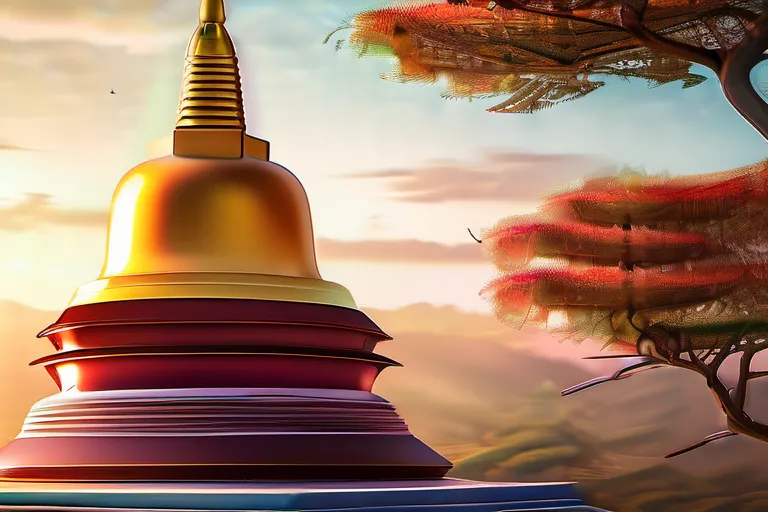
A Buddhist stupa is a sacred monument associated with relics, remembrance and devotion. Some stupas are monumental pilgrimage sites; others are small objects placed on altars. Their forms and meanings vary across regions, but they connect Buddhist teaching with material places and acts of reverence.
Understanding a stupa requires more than identifying a dome and a spire. Its contents, history, imagery and surrounding paths can explain how people use it. Religious interpretations of a monument also need to be distinguished from archaeological evidence about its construction.
How did stupas become part of Buddhist tradition?
The Metropolitan Museum of Art’s account of a Tibetan stupa connects the form with ancient Indian funerary mounds and their adaptation as repositories for Buddhist relics. The Tibetan name chorten refers to a form of this wider tradition.
The Buddhist Mahaparinibbana Sutta, Digha Nikaya 16, supplies a textual example. Its closing narrative describes the division of the Buddha’s cremation relics into eight portions and the building of stupas over them. It also describes monuments associated with the urn and remaining ashes.
This is a religious narrative about the Buddha’s death and its commemoration. It should not be turned into an independently established construction date for every early monument. It also makes clear why attributing the very first Buddhist stupa to Emperor Ashoka oversimplifies the tradition’s own account.
What might a stupa contain?
Relics are central to many stupas, but the category is broader than one kind of bodily remain. The Smithsonian National Museum of Asian Art’s Encountering the Buddha exhibition labels discuss relics, written teachings and the relationship between honoring them and reflecting on the Buddha’s qualities.
The labels distinguish monuments large enough to become pilgrimage destinations from small reliquaries for altars. They also identify the belief that relics confer blessings. This is evidence about religious meaning, rather than scientific verification of a particular relic’s identity or power.
A further example comes from the Rubin Museum’s exhibition on Buddhist relics. Its account of the 1898 excavation at Piprahwa describes five reliquaries, including one with an inscription claiming an association with the Buddha’s remains. The discovery, the inscription’s claim and a devotee’s understanding of its significance are connected but distinct kinds of information.
What are the main architectural parts?
LACMA’s description of a second-century votive stupa identifies a general arrangement whose details can differ:
- Base: a circular or square foundation.
- Anda: the rounded or hemispherical body.
- Harmika: the quadrangular element above the dome.
- Central mast and chattra: a finial with honorific parasols or umbrella-like forms.
The dome is therefore not called the harmika. Nor should the parasols be explained merely as devices giving visitors shade. Their placement and honorific function belong to the monument’s architectural and symbolic language.
Large sites may also include railings, gateways and paths. These elements organize approach and movement as well as making the monument visually distinctive. A diagram based on one Indian stupa, however, should not be assumed to describe every regional example.
Why do worshippers walk around a stupa?
Circumambulation, often called pradakshina, is an act of moving around a sacred focus. The Musée Guimet’s discussion of a stupa relief connects its orientation with the practice of moving around a stupa while keeping the monument to the right.
This helps explain why pathways matter. The surrounding space is not simply unused ground left over after construction; it can be part of religious action. Movement, images and the monument’s position need to be understood together.
Guimet makes the point through a relief depicting the Great Departure, the story of Siddhartha leaving palace life in search of awakening. The object provides an example of how narrative imagery could be encountered in relation to a devotional route, rather than only viewed as an isolated museum picture.
What does Sanchi reveal about historical development?
UNESCO’s account of the Buddhist monuments at Sanchi attributes the site’s beginnings as a sacred center to Ashoka in the third century BCE. It describes a brick stupa that was later enlarged and given a stone facing, paths, staircases and railings.
The gateways and other additions belong to further phases. The present monument therefore embodies contributions across time. Describing its entire visible form as one original third-century construction would lose that history.
Sanchi also includes temples, monasteries, pillars and additional stupas. These relationships show a religious landscape, rather than one freestanding object without a community around it. UNESCO notes the artistic importance of the gateways and their narrative and symbolic decoration.
The site illustrates a broader principle for reading monuments: the date associated with a foundation is not necessarily the date of every surface, sculpture or architectural feature visible today.
How does Borobudur use the stupa form?
UNESCO’s description of Borobudur dates the Central Javanese monument to the eighth and ninth centuries. Its design combines square terraces, three circular platforms and a monumental stupa at the top.
The circular platforms contain 72 openwork stupas, each associated with a Buddha statue. That figure refers to those stupas and their images; it should not be used as a count of every Buddha image across the whole complex.
UNESCO interprets the vertical organization in relation to Buddhist cosmology: the spheres of desire, form and formlessness. Here, movement through architectural levels is part of a much larger symbolic design. It should not be generalized into a claim that every stupa has terraces visitors ascend.
The same source records major restoration in the twentieth century. Borobudur’s history thus includes construction, religious interpretation and conservation. Appreciating the monument involves all three.
Does every shape have one universal meaning?
No single explanation should be imposed on every stupa. Particular traditions and objects can encode specific ideas through geometric forms, while meanings and arrangements differ.
The Seattle Art Museum’s rock-crystal reliquary provides a concrete example. Its label relates five shapes to five elements: the square base to earth, the sphere to water, the pyramid to fire, the hemisphere to wind and the upper jewel to space.
That is a description of this object’s symbolic form. It does not justify identifying every rounded stupa body everywhere with earth. The example shows how a precise object-based explanation can be more informative than a broad statement that all stupas symbolize the same thing in exactly the same way.
What does a living pilgrimage site look like?
The Smithsonian exhibition documentation includes a film recorded at Ruwanwelisaya Stupa in Sri Lanka in December 2016. It follows worship during a monthly full-moon festival and describes lamps, monastic visitors and other devotional activity.
The site is presented through people’s actions and the meanings they attach to relics, alongside the monument itself. This gives a more concrete understanding of religious practice than imagining a stupa only as a silent object for tourists to photograph.
The local administration of Boudhanath in Kathmandu likewise identifies it as an important Buddhist pilgrimage center. A monument can be both part of an internationally recognized heritage landscape and a place with continuing religious significance for particular communities.
How can visitors or readers interpret a stupa more carefully?
Several questions make observation more useful: What is known about the site’s construction phases? Does its tradition identify particular relics or commemorated events? Where do people move, stop and make offerings? Which symbolic explanation comes from this community, and which comes from a general guide?
Those questions connect architecture with evidence and living practice. They also help distinguish a traditional account from an excavated finding, a later reconstruction or a museum interpretation. Respecting local arrangements and worshippers follows from recognizing that the monument has a religious use as well as historical interest.
Conclusion
A stupa connects Buddhist memory, relics, devotion and architecture. Sanchi shows development across generations; Borobudur gives the form a distinctive monumental and cosmological arrangement; small reliquaries and living pilgrimage sites demonstrate its wider range. Understanding the parts, pathways and sources of a particular example reveals more than one universal symbolic formula. It allows the stupa to be seen as an object with a history and as a focus of meaningful religious practice.
Reviewed and substantially revised on 2 November 2026. Museum research, UNESCO site histories and Buddhist textual traditions are identified in context; symbolic interpretations are tied to particular examples. See our editorial approach and AI transparency.
Published by Ralf. About our editorial process.



