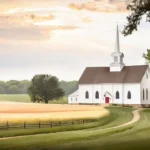
The Amana Church Society is the religious community associated with the Amana Colonies in Iowa and the Community of True Inspiration. Its roots are in a German Christian renewal movement, while the Iowa colonies developed in the nineteenth century. In 1932, communal economic life was reorganized, with the church continuing separately from the business corporation, Amana Society, Inc. The church, the historic settlements and the businesses are related but distinct.
Where did the community come from?
The Amana Colonies visitor bureau’s history of the seven villages traces the Inspirationist tradition to Germany in 1714. In the 1840s, members moved to New York in search of religious freedom, before establishing their Iowa settlements in the 1850s.
The Inspirationist movement, the migration to New York and the settlement in Iowa are different stages of the history. They should be dated separately.
What were the Amana Colonies?
The seven Iowa villages are Amana, East Amana, High Amana, Middle Amana, South Amana, West Amana and Homestead. The visitor bureau identifies these actual settlements; similarly named towns elsewhere should not be substituted for them.
The National Park Service’s account of communal Amana describes a community in which work, resources, worship and village institutions were organized together. Communal kitchens and local trades were part of this social and economic arrangement.
Communal organization here means more than neighbors voluntarily helping one another. It was a particular system of property, work and provision. That historical arrangement should not be assumed to describe the personal finances of present-day residents.
What is the Community of True Inspiration?
“True Inspiration” names the religious tradition in which the community developed. Its worship includes scripture, hymns and testimonies associated with its spiritual heritage. The religious importance of those testimonies is part of the community’s understanding of inspiration.
The Amana Church’s current website continues to identify it as the Community of True Inspiration and publishes information about teaching, prayer and worship. This is a living congregation, not simply a label for a historical attraction.
What changed in 1932?
The National Park Service’s account of the “Great Change” explains the decision to retain the church while moving the business enterprises into Amana Society, Inc. Social and economic strains contributed to the reorganization.
The corporation’s own history provides a business perspective on that development. Neither ending communal economics nor reorganizing businesses meant that the religious community disappeared.
The distinction also prevents confusion between the church’s teaching, a resident’s private life, a company product and a visitor attraction. Those are not four names for the same organization.
How is Amana different from Amish communities?
Amana and Amish are not interchangeable names. The Amana story concerns the Inspirationist tradition and its communal settlements. The Amish belong to the Anabaptist family and have a different history and organization.
Old buildings, German heritage or a reputation for craftsmanship do not establish that two communities are the same religion. Our introduction to Mennonites explains the separate Anabaptist context in which Amish history is usually discussed.
What should a visitor check?
Use the visitor bureau for heritage sites and the church’s own notices for worship. Check current opening arrangements directly rather than assuming that every historic building is open or that a church service is a staged demonstration.
Historic interpretation can explain the communal past, while a visit to a present congregation concerns current religious life. A tourist experience cannot by itself represent all members’ beliefs.
What did communal life mean for daily work and meals?
The National Park Service describes elders assigning work according to community needs and individual skills. Members received housing and necessities rather than ordinary wages, along with an allowance for purchases at the general store. Communal kitchens served groups of roughly thirty to forty people. These arrangements connected domestic life and work with the community’s shared economy.
The Great Change altered that structure without requiring the church to disappear. NPS records the decision on 1 June 1932 to keep the religious community and establish the joint-stock company for business. Seeing the earlier daily arrangements makes the scale of that decision clearer: it changed the way livelihoods were organized while religious continuity remained possible.
What shows the church’s continuing religious life?
The church’s notices for the week of 1 November 2026 list Sunday school, combined communion services and a Saturday teaching service, with a study of the Psalms. Those dated notices provide a concrete view of worship and learning within the present community. They also show activity taking place both in person and through an online teaching service.
A historical account of communal kitchens cannot establish today’s worship arrangements, just as a current notice cannot explain the whole Inspirationist tradition. Using both types of source makes it possible to describe a continuing church alongside the heritage of its earlier social system. For attendance, consult the latest notices rather than relying on this dated example.
Conclusion
The Amana Church Society’s history combines an Inspirationist faith with a particular experiment in communal life. The Great Change of 1932 separated the economic system from the continuing religious community, making that distinction essential to understanding Amana today. Historic villages, businesses and worship each tell part of the story. Reading them together shows both institutional change and religious continuity without confusing Amana with the separate Amish tradition.
Reviewed and substantially revised on 1 November 2026. Church, settlement history and business organization are distinguished, with current worship information linked separately. See our editorial approach and AI transparency.
Published by Ralf. About our editorial process.