
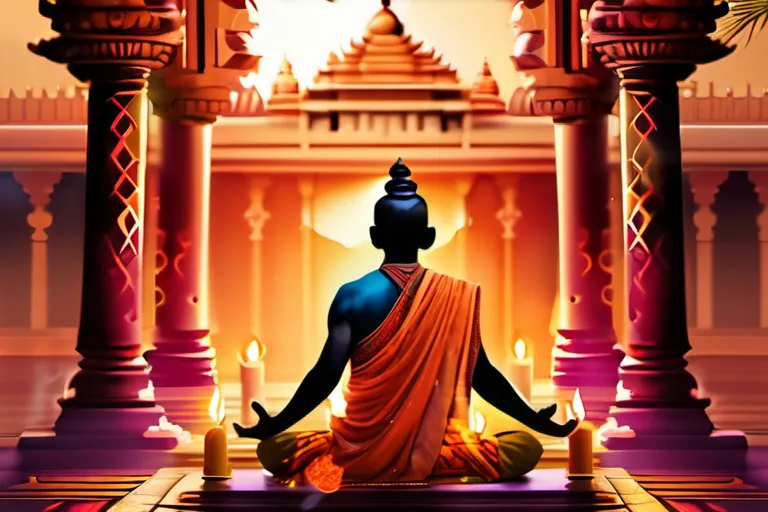
A Hindu priest conducts religious rituals and helps a community carry out worship and life-cycle ceremonies. Depending on the role and tradition, this can include temple puja, offerings, recitation, fire rituals, weddings and funeral rites. Hinduism has no single worldwide priesthood with one universal hierarchy. A temple priest, family ritual specialist, guru and renunciant are not interchangeable roles.
What does a temple priest do?
A temple priest may care for a shrine and its deity’s image, prepare offerings, recite prescribed texts and conduct the daily worship sequence. The particular duties depend on the temple’s tradition and ritual manuals.
The Smithsonian’s guide to temple worship illustrates a Shiva setting with bathing or anointing of the linga, lamps, bells and offerings. It is a concrete example rather than a complete description of every temple’s ritual.
Worshippers may bring offerings, observe or participate in ways appropriate to that community. The priest’s specialized ritual role does not mean that a Hindu can pray only through a priest.
Which ceremonies take place outside temples?
Priests can also serve families at homes or other locations. The Australian Council of Hindu Clergy describes its work in birth, marriage and funeral ceremonies, festivals and community teaching. Its members come from several regional backgrounds, illustrating the variety of practice within a diaspora setting.
The council’s introductions to samskaras and pujas and yajnas provide examples of ritual services. Those pages describe that organization’s understanding and services; they are not a universal calendar of obligations for every Hindu family.
Pujari, purohita, pandit and guru
The Hindu American Foundation’s religious worker definitions distinguish several roles. Terminology varies by language and community. Pujari commonly refers to someone who performs puja; purohita often concerns a priest serving a household or conducting family rites. Pandit emphasizes learning and can be used for a learned ritual specialist. It is useful to ask how a title is being used locally.
A guru is a teacher in a relationship of spiritual instruction, while swami is a title associated with renunciant or religious teaching traditions. A person can hold more than one role, but one title does not establish all the others. They are not successive ranks in a single global chain of command.
Himalayan Academy’s explanation of Hindu religious life distinguishes the devotee’s relationship with the divine from the roles of a priest or spiritual teacher. Its Shaiva perspective should be identified when comparing it with other communities.
How does someone learn priestly duties?
Training can involve memorization, pronunciation, ritual sequences and the texts relevant to a particular lineage or temple. A qualification should be evaluated in relation to the duties concerned rather than assumed from a title alone.
UNESCO’s account of Vedic chanting documents the careful oral methods used to preserve recitation. This helps explain the importance of sound and disciplined learning without implying that every priest performs the same Vedic repertoire.
Who can serve, and who sets the rules?
Requirements concerning family tradition, training, initiation and appointment differ between institutions. A description of one temple should not be turned into a worldwide rule about every priest or every Hindu community.
For a specific ceremony, ask which tradition the priest follows, what preparation is expected, who may participate and how the meaning will be explained. If language is a concern, ask whether instructions and explanations are available in a language the participants understand.
How should a visitor approach the ritual?
Observe the host’s guidance and ask before entering restricted shrine areas or handling ritual objects. A priest can explain a ceremony, but visitors need not pretend to understand it or make an unfamiliar commitment.
Our guide to darshan, puja and temple visits explains the worship setting. The role of a priest is best understood alongside the particular practice and community being served.
Why can two ritual services require different preparation?
The Australian Council of Hindu Clergy distinguishes a general puja, involving offerings without a fire ceremony, from yajnas that include fire offerings. Its account of Satya Narayana puja also identifies Vishnu and Lakshmi and describes preparation for that particular rite. These examples show why knowing that a priest “performs ceremonies” is only a starting point.
The specialist needs to know which rite is requested, the relevant prayers and materials, and the participants’ role. For a family, that makes an explanation of the specific ceremony more useful than assuming every Hindu service follows a single script. The council’s descriptions concern its own ritual practice and devotional purposes.
Conclusion
A Hindu priest’s work brings learned ritual practice into the life of a temple, household or community. Titles, training and responsibilities gain meaning in those settings; they do not form one global clerical hierarchy. A daily shrine service, a family ceremony and spiritual teaching can involve distinct roles even when one person undertakes several. Understanding the actual ceremony and the tradition being served gives the clearest account of what the priest contributes.
Reviewed and substantially revised on 1 November 2026. Regional titles and named community examples are not treated as a single universal clergy structure. See our editorial approach and AI transparency.
Published by Ralf. About our editorial process.



