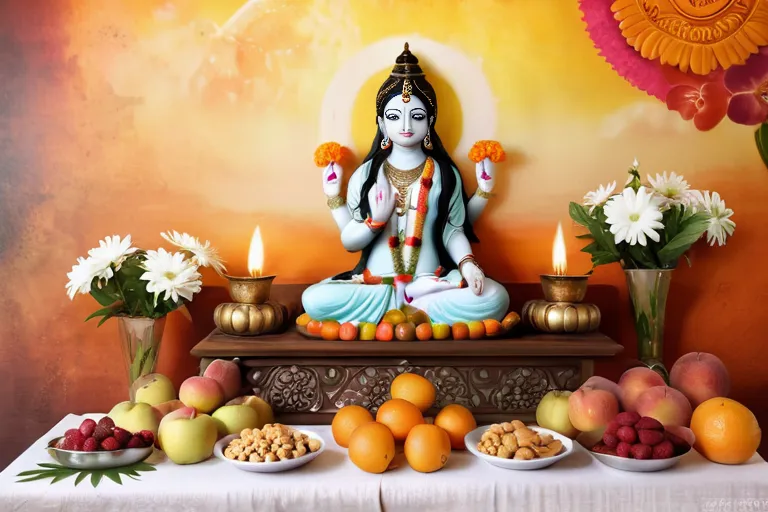
Hindus offer food to deities as an act of devotion, hospitality and gratitude. In many worship settings, the offering is then received as prasad: food understood as blessed through its relationship with the deity. This is a religious understanding of giving and receiving, rather than a claim that a divine being needs calories. Practices and permitted offerings vary between traditions, temples and households.
What happens in a food offering?
Food may be prepared and placed before a deity’s sacred image as part of puja, alongside other offerings. It can subsequently be returned or distributed to worshippers. The sequence and accompanying prayers depend on the practice.
The Smithsonian’s guide to how puja is performed describes the connection between seeing the deity, making offerings and receiving blessed food. This explains why a dish in a ritual setting has a meaning beyond its ordinary use as a meal.
What do naivedya and prasad mean?
Naivedya commonly refers to food presented to the deity. Prasad or prasada refers to grace or favor and, in this setting, to the offering received back as blessed. The Hindu American Foundation’s puja guide identifies naivedya among the offerings. The terms describe related moments and meanings rather than two unrelated kinds of food.
Himalayan Academy’s guide to visiting a Hindu temple describes receiving prasada after worship, including food and other blessed substances. Its Shaiva setting is one example; other communities can have different ritual details.
A scriptural example: Bhagavad Gita 9.26
In Bhagavad Gita 9.26, Krishna speaks of accepting a simple offering made with devotion, with examples including a leaf, flower, fruit or water. The emphasis on devotion helps explain why an offering is not judged only by its price.
The linked translation and commentary are by A. C. Bhaktivedanta Swami Prabhupada in a Vaishnava tradition. They should be identified as that interpretation, rather than treated as a complete account of every Hindu food practice.
Why is the deity treated as a guest or honored presence?
In worship, offerings can express care and reverence toward the deity. Temple service may include a rhythm of presentation, rest and renewed access to the shrine. These actions make sense within the community’s understanding of divine presence.
For example, the BAPS mandir in Ahmedabad’s information identifies periods when darshan is closed during the offering of the deity’s meal. This is a concrete practice in that community, not a timetable every temple follows.
Do all Hindus offer the same foods?
No. Foods, ingredients and preparation rules depend on the deity, lineage, temple and occasion. A Vaishnava commentary’s expectations should not be silently extended to every Hindu tradition. Likewise, one family’s custom is not a worldwide requirement.
If preparing something for a temple, ask what it accepts before cooking or purchasing an offering. Check its rules about ingredients, packaging, where offerings should be placed and who handles them. A generic internet list may not fit the local practice.
Is prasad the same as buying food?
Not in its religious meaning. Receiving prasad concerns participation in the relationship expressed through worship. Food may also be prepared or distributed through a temple’s wider community activities, but a visitor should not assume that every meal on the premises has the same ritual status.
Nor should offerings be described as payments that guarantee wealth, healing or a desired event. A community may explain blessings in religious terms; that does not establish a measurable promise for every person making an offering.
What should a visitor do?
Follow the hosts’ instructions for presenting and receiving offerings. Ask if you do not understand the practice or need to know what a food contains. Respecting a ceremony does not require pretending to share a belief or consuming something you do not wish to eat.
For the wider setting, see Hindu temple practices and the role of a Hindu priest.
How does a simple offering express devotion?
Bhagavad Gita 9.26 places the worshipper’s devotion alongside very modest examples of what can be offered. A leaf, flower, fruit or water does not require an elaborate banquet. In the linked Vaishnava interpretation, this supports attention to the person’s devotional intention rather than the financial value of the gift.
The distinction has a practical consequence for understanding temple worship: visible abundance alone cannot tell an observer what an offering means to those making it. A small household offering and a more elaborate temple presentation can each belong to a devotional practice, while differing in preparation, ritual responsibilities and distribution. Their meaning needs the surrounding tradition as well as a description of the food.
Conclusion
Food offerings express devotion through a connected movement of giving to the deity and receiving what is understood as blessed. The distinction between naivedya and prasad helps explain why the food’s ritual relationship matters alongside its ingredients. Texts, temples and households give that relationship different forms. Seeing the practice within its devotional setting makes it more meaningful than treating an offering as either an ordinary purchase or a guaranteed transaction for a desired result.
Reviewed and substantially revised on 1 November 2026. Devotional meanings and named community practices are distinguished from universal rules or promises of results. See our editorial approach and AI transparency.
Published by Ralf. About our editorial process.