
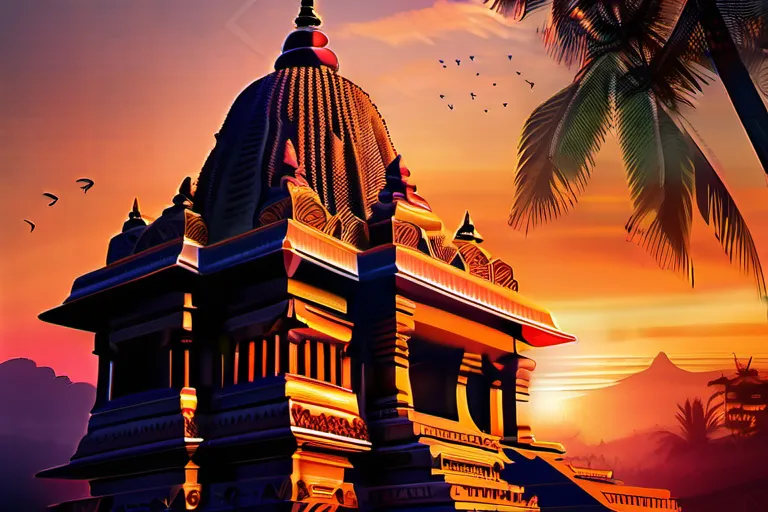
A Hindu temple is commonly called a mandir. Other names are used in different languages and regions, including kovil or koil in Tamil usage and devalaya. There is no single local word that every Hindu community uses.
The building is a place of worship, but its significance is not exhausted by its name. Images of deities, ritual, sacred space, architecture and community activity work together. A small neighbourhood mandir and a large historical temple complex may fulfil related religious purposes without having an identical plan.
Mandir and regional names
BAPS describes a mandir as a Hindu place of worship and a setting for religious learning, festivals and service. The word is also used in the names of Hindu temples outside India.
Regional vocabulary remains important. For example, the Tamil Nadu government’s description of the Namagiri Amman Temple refers to the Narasimha Swamy kovil. The terms belong to the language and naming practices of the place.
A temple may also be identified primarily by its deity or a traditional proper name. Learning that name can be more informative than expecting every sign to use the same generic word.
The temple as a divine dwelling
Harvard’s Pluralism Project explains temples and their images as places where divine presence is focused. In this understanding, the temple is a sacred dwelling and a setting for an encounter with the deity.
The image, or murti, is consequently not understood by devotees simply as decoration. Its religious role is connected with the deity’s presence and the worship offered there.
This account does not mean that Hindus think the divine exists only inside a building. It explains why a particular consecrated place can have special importance even when divine presence is understood more widely.
The inner sanctuary: garbhagriha
The garbhagriha, literally the womb-house or womb-chamber, is the inner sanctuary associated with the principal sacred image. It is the concentrated ritual centre of many temples, not the outermost enclosure.
The architectural vocabulary is introduced in NCERT’s chapter on temple architecture and sculpture. Its account places the shrine at the heart of the building and distinguishes it from the hall used by worshippers.
Access and visibility can be organised differently at different temples. A devotee’s encounter with the deity does not necessarily require entering the sanctuary itself. The arrangement of doors, halls and sightlines can make the image visible while maintaining a distinction between ritual spaces.
Mandapa, shrine and gateway are different elements
A mandapa is a hall or pavilion associated with the temple. It can accommodate worshippers and activities connected with worship. In larger complexes, more than one hall may occur between an entrance and the principal shrine.
The tower above a shrine must also be distinguished from a tower marking a gateway. A gopuram is a gateway tower particularly associated with South Indian temple complexes; it is not another word for the entire temple or for every tower.
These terms make a temple plan easier to understand. A gateway controls an approach, a hall provides space for gathering, and a sanctuary houses the principal focus of worship. Their relationship is more informative than treating the whole complex as one undifferentiated sacred room.
Regional styles and the shapes of towers
Architectural surveys commonly distinguish Nagara traditions associated with northern India and Dravida traditions associated with the south. Curving shrine towers are characteristic of many Nagara examples, while many southern shrine towers have a stepped, pyramidal form.
The term vimana is used in descriptions of southern shrine architecture. It should not be confused automatically with the gopuram at the entrance. NCERT also discusses the term Vesara and the difficulty of classifying all regional developments within a simple north–south division.
These are broad art-historical categories. They do not imply that every temple in a region has one fixed appearance. Buildings can be enlarged, rebuilt and adapted over long periods, producing complexes whose parts come from different phases.
The Chola temples: a concrete architectural comparison
The Great Living Chola Temples World Heritage property includes the Brihadisvara temples at Thanjavur and Gangaikondacholisvaram and the Airavatesvara Temple at Darasuram. These are major eleventh- and twelfth-century examples in Tamil Nadu.
UNESCO’s description contrasts the upward-curving movement of the Gangaikondacholisvaram vimana with the straighter form at Thanjavur. This demonstrates variation even among buildings grouped within a related historical tradition.
The examples also connect architecture with sculpture, painting and bronze casting. A temple’s cultural history includes the images and crafts associated with its worship, not only the external outline visible in a photograph.
Ellora: a temple carved from rock
The Kailasa Temple at Ellora provides a different example. UNESCO identifies it as Cave 16 within a wider ensemble containing Buddhist, Hindu and Jain monuments.
Its achievement lies partly in rendering forms associated with constructed architecture through the excavation of rock. The temple is not simply a natural cavern in which an image happened to be placed.
One prominent sculpture depicts Ravana attempting to lift Mount Kailasa, Shiva’s abode. This gives a specific example of narrative imagery connecting the building with religious stories.
The coexistence of different religious monuments at Ellora also makes precise identification necessary. Being a rock-cut sacred space at that site does not automatically make every cave a Hindu temple.
Darshan: seeing and being seen
Darshan concerns the devotional sight of the deity. Worshippers may approach a shrine to see the murti and experience the encounter as a blessing.
BAPS’s explanation of darshan describes more than ordinary sightseeing: it includes devotion, attention and the desire for a glimpse of the divine form.
This helps explain why opening a shrine or revealing an image can matter so deeply within worship. The significant event is not only observing an artwork; it is the relationship expressed through the act of seeing.
The practice also need not be restricted to a large public temple. The same BAPS account describes devotion before images in domestic and everyday settings. Public temple worship is one important setting within a wider religious life.
Puja, arti and offerings
Puja is an act of honouring or worship. Its form varies, but it can involve words, gestures, images and offerings. The Hindu American Foundation’s puja guide includes flowers, incense, light and food among the possible offerings.
The guide also describes sharing prasadam, items received after worship and understood in relation to divine grace. Food therefore has a ritual context that differs from ordinary eating in an area where it may be prohibited.
In arti or aarti, a lighted wick is moved before the sacred image while prayer is sung. BAPS interprets this through the relationship between light and spiritual understanding.
Such explanations should be connected with the practice and tradition described. They do not require claiming that every temple follows the same timetable or that every worshipper experiences an identical emotional effect.
Festivals and temporary sacred spaces
Festivals can extend worship beyond the regular arrangement of a permanent shrine. UNESCO’s account of Durga Puja in Kolkata describes the making of clay images and a celebration linking ritual, artisanship and community participation.
Its documentation also shows decorated pandals, temporary festival pavilions. These are not simply another name for every permanent temple building.
The example reveals how religious space can be created for a particular celebration. Worship, artistic production and neighbourhood organisation come together, while the material and spatial form differs from that of a longstanding stone temple.
Temples as places of community activity
Temples can also support teaching, music, cultural programmes and service. BAPS’s account of its mandirs describes activities for children and adults, language learning and opportunities to develop artistic skills.
This is a concrete institutional example, not a guarantee that every Hindu temple offers the same programmes. The range of activities depends on the community, resources and history of the institution.
It also shows why a temple can matter to people beyond the duration of a single ritual. Teaching and shared activity help transmit a tradition across generations and connect religious practice with community life.
Visiting: follow the temple’s own guidance
Rules for visitors should be checked at the particular temple. The Neasden Temple’s visitor guidance, for example, specifies clothing requirements, removal of footwear, restrictions on indoor photography and rules concerning food and drink.
Those are rules of that institution. They should not be converted into an identical worldwide policy covering every temple or every part of a complex.
A useful approach is to distinguish the entrance, worship spaces, sanctuary and any community facilities, then follow the instructions given for each. Local guidance also resolves questions about head coverings, access and permitted photography more reliably than a generic checklist.
Conclusion
A Hindu temple is commonly called a mandir, with regional terms such as kovil also in use. Its religious focus often lies in the murti and the inner sanctuary, while halls, towers, gateways and enclosures shape the approach to worship.
Understanding those elements alongside darshan, puja, festivals and community activity explains more than a name alone. The Chola temples, Ellora and contemporary mandirs also demonstrate why Hindu temples should be approached through their particular histories and traditions, rather than one universal architectural plan or set of visitor rules.
Published by Ralf. About our editorial process.



