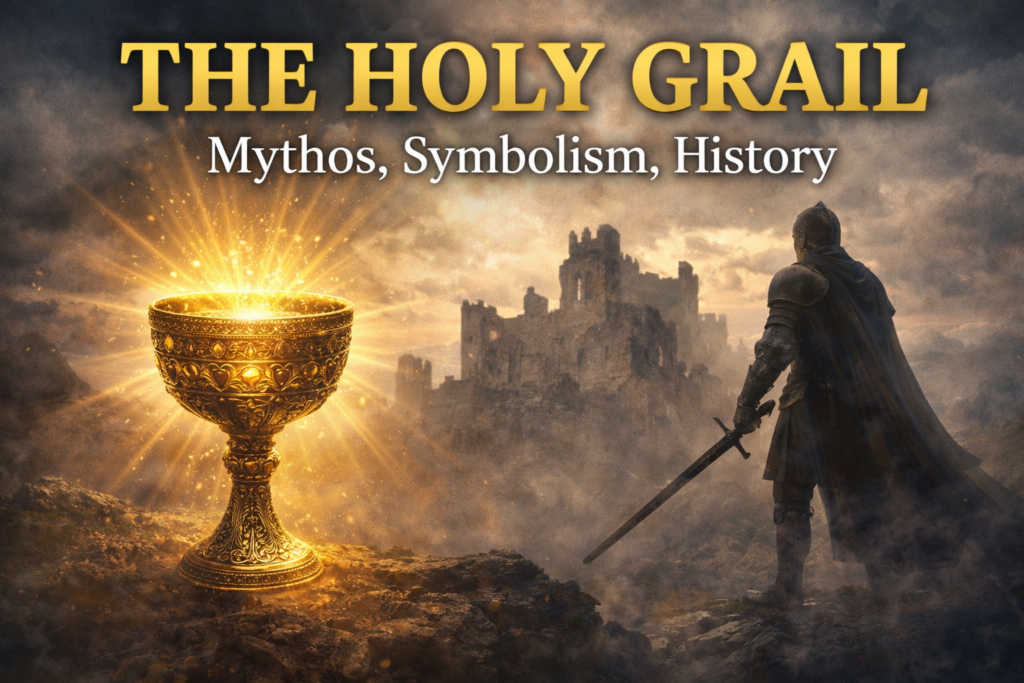
Throughout history, few stories have gripped the Western imagination like the quest for the Holy Grail. More than a legendary vessel, the Grail has become a flexible symbol—of grace, longing, purity, and transformation—shaped by each era that retells it. In this article, we explore how the Grail enters medieval literature, how its meanings multiply, and why it continues to resonate today.
The Origins and Early Texts
The Holy Grail first emerges in medieval romance as a mystery rather than a clearly defined relic. One of the earliest literary appearances is in Chrétien de Troyes’ Perceval, ou le Conte du Graal (c. 1190), where the grail is an enigmatic vessel encountered in a charged, ritual-like scene. Chrétien offers powerful imagery but withholds definitive explanation—an ambiguity that invited later writers to expand, reinterpret, and “complete” what he left open.
Building on that foundation, Wolfram von Eschenbach’s Parzival (c. 1200–1210) reimagines the Grail within a more overtly mystical framework. In Wolfram’s telling, the Grail’s significance is not limited to institutional doctrine; it becomes a sign of spiritual calling and inner transformation, tied to a community and an ethic as much as to an object.
Other influential continuations and reworkings—such as Robert de Boron’s Grail poems (including Joseph d’Arimathie) and the later French prose cycles—link the Grail more explicitly to Christian sacred history and to the moral testing of knights. Across these texts, the Grail can function as relic, revelation, moral mirror, and catalyst: a narrative device that turns adventure outward while pressing the protagonist inward.
Taken together, these early traditions show the Grail as deliberately multivalent. Its power lies in how it gathers anxieties and hopes—about virtue, failure, redemption, and the cost of spiritual ambition—into a single, luminous goal that is never simply “won,” but earned, misunderstood, or deferred.
These medieval depictions set the stage for later centuries, where writers and artists increasingly treat the Grail less as a historical object and more as a symbolic language for desire, identity, and meaning.
Symbolism and Interpretations
The Holy Grail endures because it can carry many meanings at once. In medieval romance, it is closely tied to chivalry: the Grail quest tests not only bravery but the inner life—humility, restraint, compassion, and truthfulness. Knights are measured by what they serve and what they are willing to relinquish.
Within Christian interpretation, the Grail is often associated with divine grace and sacramental themes. In some traditions it is linked to the chalice of the Last Supper, making it a symbol of communion, healing, and salvation. Yet even when framed in Christian terms, the quest frequently reads as an existential drama: the struggle to align one’s life with a higher good.
Esoteric readings add further layers. The Grail can appear as an image of transformation—an “inner vessel” that must be purified to receive wisdom. In this sense, the Grail is less a prize than a process: a shift in perception, an awakening, a reordering of the self.
Because the Grail is a symbol more than a fixed artifact, it also travels well across cultures and eras. Modern scholarship has explored how Grail stories reflect power, belonging, and exclusion—sometimes reading the quest as a drama of authority, sometimes as a critique of it. In newer interpretations, the Grail can represent liberation, agency, or the recovery of voices sidelined in older heroic traditions.
Literary Influence
The Grail legend has proven endlessly adaptable, resurfacing wherever artists want a language for yearning and moral tension. Medieval sources such as the Arthurian cycles and Malory’s Le Morte d’Arthur shaped the “classic” quest structure—an ideal pursued through trials that expose inner flaws as much as outer dangers.
In the nineteenth century, Grail themes reappear in Romantic and Pre-Raphaelite reimaginings, where medieval imagery becomes a stage for psychological intensity and ethical struggle. Writers often treat the Grail less as a church relic and more as a symbol of purity under pressure—of ideals confronted by human limits.
Modern literature continues that shift. Grail motifs frequently appear in works concerned with fragmentation, spiritual drought, and cultural disillusionment, where the “quest” becomes a metaphor for searching for coherence in a broken world. Across these retellings, the Grail persists as a durable structure for stories about value—what we worship, what we sacrifice, and what we call “holy.”
Archaeological Discoveries and Historical Context
Despite centuries of speculation, no verified “Holy Grail” has been identified, and the legend itself is best understood as a literary and cultural development rather than a single recoverable artifact. That said, the medieval obsession with relics, pilgrimage, and sacred objects provides an important backdrop for why a story about a holy vessel could feel both plausible and compelling to its audiences.
Archaeology does, however, illuminate the broader world of ritual vessels—cups, bowls, and libation implements used in religious settings across the ancient Mediterranean and Europe. Such objects often carried symbolic associations with renewal, covenant, and divine provision, themes that later resonate strongly in Christian storytelling and medieval imagination.
Places like Rosslyn Chapel, among others, became attached to Grail folklore largely through later legend-making, romantic nationalism, and modern popular culture. These sites matter less as “evidence” and more as examples of how Grail narratives generate geographical magnets—real locations onto which communities project mystery, identity, and sacred intrigue.
In this sense, the “history” of the Grail is not the history of an object found, but the history of a search: how societies use sacred symbolism to express hopes, fears, and political or spiritual aspirations.
Psychological and Philosophical Perspectives
The Grail’s lasting pull becomes clearer when viewed through psychology and philosophy. In psychoanalytic readings, the Grail may function as a condensed image of desire: a promise of completion, safety, or ultimate reconciliation—always pursued, rarely possessed. As a vessel, it can symbolize nurture and lack at once: the shape of what is missing, and the dream of what might fill it.
Joseph Campbell’s “hero’s journey” framework also fits the Grail tradition well. The quest is outwardly adventurous but inwardly developmental: the hero leaves the familiar, confronts trials, receives insight, and returns changed. Grail stories dramatize the idea that meaning is not acquired cheaply; it emerges through endurance, humility, and a willingness to be transformed.
From a Jungian angle, the Grail can be read as an archetype of wholeness—an image of integration that draws the seeker toward healing. Figures like the wounded king and the barren land mirror inner states: a life out of balance, a psyche in need of restoration. The quest then becomes a symbolic process of re-centering, where the “Grail” names the possibility of renewal.
Across these perspectives, the point is not whether the Grail exists materially, but why the pattern endures: it speaks to the human need to move from fracture toward coherence, from longing toward meaning.
Modern Cultural Reflections
Modern culture continues to recycle and reinvent the Grail because it remains a remarkably usable metaphor. Comedy reclaims it, too—most famously in Monty Python and the Holy Grail, which punctures heroic grandeur with absurdity while still preserving the quest’s underlying rhythm of obsession, hardship, and misdirection.
Contemporary novels often treat the Grail as a tool for re-centering neglected perspectives, reworking Arthurian material through lenses such as gender, power, and mythic spirituality. Works like Marion Zimmer Bradley’s The Mists of Avalon exemplify how the legend can be reframed to question inherited authority and expand whose experiences count as “legendary.”
Games and interactive media frequently borrow the Grail structure—an ultimate artifact pursued through branching trials—to place ethical choice at the center of play. In these versions, “the Grail” often stands less for a relic than for consequence: what the player becomes through the pursuit.
Across film, literature, art, and games, the Holy Grail persists because it can signify both satire and sincerity—both the ridiculousness of human obsession and the dignity of human striving.
Conclusions
The Holy Grail is not merely a medieval curiosity; it is a cultural instrument for thinking about desire, virtue, and transformation. Whether framed as relic, metaphor, or psychological horizon, it continues to invite the same question across centuries: what, in our lives, is worth the quest?
Throughout history, few stories have gripped the Western imagination like the quest for the Holy Grail. More than a legendary vessel, the Grail has become a flexible symbol—of grace, longing, purity, and transformation—shaped by each era that retells it. In this article, we explore how the Grail enters medieval literature, how its meanings multiply, and why it continues to resonate today.
The Origins and Early Texts
The Holy Grail first emerges in medieval romance as a mystery rather than a clearly defined relic. One of the earliest literary appearances is in Chrétien de Troyes’ Perceval, ou le Conte du Graal (c. 1190), where the grail is an enigmatic vessel encountered in a charged, ritual-like scene. Chrétien offers powerful imagery but withholds definitive explanation—an ambiguity that invited later writers to expand, reinterpret, and “complete” what he left open.
Building on that foundation, Wolfram von Eschenbach’s Parzival (c. 1200–1210) reimagines the Grail within a more overtly mystical framework. In Wolfram’s telling, the Grail’s significance is not limited to institutional doctrine; it becomes a sign of spiritual calling and inner transformation, tied to a community and an ethic as much as to an object.
Other influential continuations and reworkings—such as Robert de Boron’s Grail poems (including Joseph d’Arimathie) and the later French prose cycles—link the Grail more explicitly to Christian sacred history and to the moral testing of knights. Across these texts, the Grail can function as relic, revelation, moral mirror, and catalyst: a narrative device that turns adventure outward while pressing the protagonist inward.
Taken together, these early traditions show the Grail as deliberately multivalent. Its power lies in how it gathers anxieties and hopes—about virtue, failure, redemption, and the cost of spiritual ambition—into a single, luminous goal that is never simply “won,” but earned, misunderstood, or deferred.
These medieval depictions set the stage for later centuries, where writers and artists increasingly treat the Grail less as a historical object and more as a symbolic language for desire, identity, and meaning.
Symbolism and Interpretations
The Holy Grail endures because it can carry many meanings at once. In medieval romance, it is closely tied to chivalry: the Grail quest tests not only bravery but the inner life—humility, restraint, compassion, and truthfulness. Knights are measured by what they serve and what they are willing to relinquish.
Within Christian interpretation, the Grail is often associated with divine grace and sacramental themes. In some traditions it is linked to the chalice of the Last Supper, making it a symbol of communion, healing, and salvation. Yet even when framed in Christian terms, the quest frequently reads as an existential drama: the struggle to align one’s life with a higher good.
Esoteric readings add further layers. The Grail can appear as an image of transformation—an “inner vessel” that must be purified to receive wisdom. In this sense, the Grail is less a prize than a process: a shift in perception, an awakening, a reordering of the self.
Because the Grail is a symbol more than a fixed artifact, it also travels well across cultures and eras. Modern scholarship has explored how Grail stories reflect power, belonging, and exclusion—sometimes reading the quest as a drama of authority, sometimes as a critique of it. In newer interpretations, the Grail can represent liberation, agency, or the recovery of voices sidelined in older heroic traditions.
As the legend moved forward, artists and writers repeatedly adapted—and sometimes subverted—these meanings to speak to their own moment.
Literary Influence
The Grail legend has proven endlessly adaptable, resurfacing wherever artists want a language for yearning and moral tension. Medieval sources such as the Arthurian cycles and Malory’s Le Morte d’Arthur shaped the “classic” quest structure—an ideal pursued through trials that expose inner flaws as much as outer dangers.
In the nineteenth century, Grail themes reappear in Romantic and Pre-Raphaelite reimaginings, where medieval imagery becomes a stage for psychological intensity and ethical struggle. Writers often treat the Grail less as a church relic and more as a symbol of purity under pressure—of ideals confronted by human limits.
Modern literature continues that shift. Grail motifs frequently appear in works concerned with fragmentation, spiritual drought, and cultural disillusionment, where the “quest” becomes a metaphor for searching for coherence in a broken world. Across these retellings, the Grail persists as a durable structure for stories about value—what we worship, what we sacrifice, and what we call “holy.”
Archaeological Discoveries and Historical Context
Despite centuries of speculation, no verified “Holy Grail” has been identified, and the legend itself is best understood as a literary and cultural development rather than a single recoverable artifact. That said, the medieval obsession with relics, pilgrimage, and sacred objects provides an important backdrop for why a story about a holy vessel could feel both plausible and compelling to its audiences.
Archaeology does, however, illuminate the broader world of ritual vessels—cups, bowls, and libation implements used in religious settings across the ancient Mediterranean and Europe. Such objects often carried symbolic associations with renewal, covenant, and divine provision, themes that later resonate strongly in Christian storytelling and medieval imagination.
Places like Rosslyn Chapel, among others, became attached to Grail folklore largely through later legend-making, romantic nationalism, and modern popular culture. These sites matter less as “evidence” and more as examples of how Grail narratives generate geographical magnets—real locations onto which communities project mystery, identity, and sacred intrigue.
In this sense, the “history” of the Grail is not the history of an object found, but the history of a search: how societies use sacred symbolism to express hopes, fears, and political or spiritual aspirations.
Psychological and Philosophical Perspectives
The Grail’s lasting pull becomes clearer when viewed through psychology and philosophy. In psychoanalytic readings, the Grail may function as a condensed image of desire: a promise of completion, safety, or ultimate reconciliation—always pursued, rarely possessed. As a vessel, it can symbolize nurture and lack at once: the shape of what is missing, and the dream of what might fill it.
Joseph Campbell’s “hero’s journey” framework also fits the Grail tradition well. The quest is outwardly adventurous but inwardly developmental: the hero leaves the familiar, confronts trials, receives insight, and returns changed. Grail stories dramatize the idea that meaning is not acquired cheaply; it emerges through endurance, humility, and a willingness to be transformed.
From a Jungian angle, the Grail can be read as an archetype of wholeness—an image of integration that draws the seeker toward healing. Figures like the wounded king and the barren land mirror inner states: a life out of balance, a psyche in need of restoration. The quest then becomes a symbolic process of re-centering, where the “Grail” names the possibility of renewal.
Across these perspectives, the point is not whether the Grail exists materially, but why the pattern endures: it speaks to the human need to move from fracture toward coherence, from longing toward meaning.
Modern Cultural Reflections
Modern culture continues to recycle and reinvent the Grail because it remains a remarkably usable metaphor. Comedy reclaims it, too—most famously in Monty Python and the Holy Grail, which punctures heroic grandeur with absurdity while still preserving the quest’s underlying rhythm of obsession, hardship, and misdirection.
Contemporary novels often treat the Grail as a tool for re-centering neglected perspectives, reworking Arthurian material through lenses such as gender, power, and mythic spirituality. Works like Marion Zimmer Bradley’s The Mists of Avalon exemplify how the legend can be reframed to question inherited authority and expand whose experiences count as “legendary.”
Games and interactive media frequently borrow the Grail structure—an ultimate artifact pursued through branching trials—to place ethical choice at the center of play. In these versions, “the Grail” often stands less for a relic than for consequence: what the player becomes through the pursuit.
Across film, literature, art, and games, the Holy Grail persists because it can signify both satire and sincerity—both the ridiculousness of human obsession and the dignity of human striving.
Conclusions
The Holy Grail is not merely a medieval curiosity; it is a cultural instrument for thinking about desire, virtue, and transformation. Whether framed as relic, metaphor, or psychological horizon, it continues to invite the same question across centuries: what, in our lives, is worth the quest?