
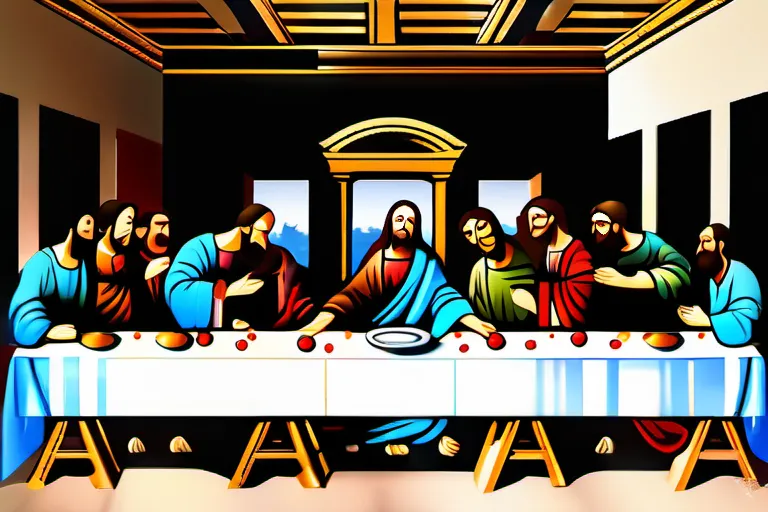
Leonardo da Vinci’s The Last Supper is a mural in the dining hall of the Dominican convent of Santa Maria delle Grazie in Milan. Painted in the 1490s and completed by 1498, it turns a familiar Christian subject into a concentrated drama of gesture, expression and shared reaction.
Its importance involves several connected questions: which moment Leonardo depicts, how the composition directs attention, why his technique proved fragile and how surviving drawings and copies help us understand a damaged work. The painting is an interpretation of a biblical narrative within a Renaissance setting, rather than a literal visual record of the ancient meal.
A work made for a particular place
The Museo del Cenacolo Vinciano dates the work to the period between 1494 and early 1498. Milan’s official tourism account identifies Ludovico Sforza, known as Ludovico il Moro, as its patron.
The refectory was a communal dining room. That setting gave a painting of Christ at supper a particular relationship with the room’s ordinary use: a religious meal was represented where the friars themselves ate. The work belongs to the architecture and history of that space, not simply to the category of movable paintings later collected by museums.
The refectory also contains Donato Montorfano’s Crucifixion on its south wall. Considering the two works together helps restore the religious context of the room. Leonardo’s mural is part of a larger visual setting concerned with Christ’s passion.
The biblical moment: an announcement of betrayal
In John 13:21, Jesus announces that one of those present will betray him. The Gospel then describes the disciples’ uncertainty and Peter’s effort to learn whom Jesus means. Leonardo’s image explores the shock of that announcement through a gathering of distinct reactions.
The meal also has a wider Christian significance. Mark 14:22–25 recounts Jesus giving bread and the cup to his disciples and interpreting them in relation to his body, blood and coming death. These passages help explain why a supper scene could carry several related meanings: fellowship, betrayal and the anticipation of sacrifice.
Recognising that context does not require assigning a hidden code to every object. A particular visual interpretation should be supported by the image, its sources and the history of its making.
How the composition directs the eye
Milan’s account explains how Leonardo’s perspective places Christ at the centre and makes the painted room appear to extend the refectory. Architectural lines and the arrangement of the table connect the figures with the space the viewer occupies.
The effect is both orderly and unsettled. The central figure gives the scene a strong point of focus, while the apostles’ movements send attention outward into clusters of conversation. The viewer can follow the overall structure and then examine how individual people respond within it.
This is one reason the picture rewards looking at relationships rather than isolated symbols. A hand, a turned head or a leaning body makes sense partly through the neighbouring figures and the announcement to which they react.
Reading the apostles’ gestures
The museum’s account of the composition identifies the apostles and discusses their gestures. Peter leans toward John and holds a knife; Judas is close to that group, drawing back while holding a small bag. He remains among the people sharing the table.
Elsewhere, Thomas raises a finger, James the Greater spreads his arms and Philip brings his hands toward his chest. At the right end of the composition, Matthew turns toward Simon and Judas Thaddeus while gesturing back toward Christ. The differences create a network of appeals, questions and attempts to understand what has been said.
The museum interprets Christ’s outline as a stable triangular form amid this movement. Such an account explains observable choices in the composition. It is more precise than treating every apostle as a simple illustration of one universal emotion or assuming that all gestures can be decoded independently of the scene.
Drawings show a process of invention
The National Gallery’s 2011 exhibition guide describes surviving preparatory material, including compositional sketches, studies from life and idealised heads. It presents the project as a process of developing distinct characters within an ordered whole.
A study for Saint Philip, for example, explores the inclination of the head and the modelling of light. Such evidence makes Leonardo’s attention to expression concrete. The effect was developed through observation and revision, rather than arriving as a fully formed arrangement in a single moment.
Preparatory drawings also help distinguish documented artistic decisions from later speculation about Leonardo’s private intentions. They do not answer every interpretive question, but they provide material evidence for how the work took shape.
Why the painting is so fragile
The museum’s conservation account explains that Leonardo worked on a dry surface with a white preparatory layer. His pigments remained on the surface instead of being absorbed into wet plaster as in traditional fresco painting. The result was particularly vulnerable.
Environmental conditions and the unstable technique contributed to deterioration soon after completion. Later interventions also altered the image. This history matters because the surface visible today has passed through loss, repair and efforts to distinguish surviving original material from additions.
The museum identifies the major conservation campaign associated with Pinin Brambilla Barcilon and notes its completion in 1999. It also explains current attention to the refectory’s environment and controlled access. Preserving the mural involves caring for its surroundings as well as its painted surface.
Early copies preserve important evidence
The Royal Academy’s educational account of its early copy dates that work to about 1515–1520 and attributes it to Giampietrino and Giovanni Antonio Boltraffio. It explains that the copy preserves details no longer visible in the original, including Christ’s feet and the overturned salt cellar near Judas.
The National Gallery’s exhibition guide also identifies the importance of the full-scale copy during modern restoration. A copy is therefore more than a substitute for someone unable to see the mural: it is a historical witness to aspects of an earlier appearance.
Copies still need interpretation as works made by other hands. Their value lies in comparison with surviving paint, drawings and other evidence, rather than assuming they reproduce every feature of Leonardo’s work without change.
Why its setting and survival matter
UNESCO’s World Heritage listing recognises the church and Dominican convent together with The Last Supper. Its assessment places the mural within an architectural complex and acknowledges its importance in the history of painting.
That relationship helps explain why the work cannot be understood only through a small reproduction. Scale, architecture and the original dining-room setting contribute to its effect. At the same time, its damaged surface and conservation history are part of what survives, rather than incidental obstacles to an otherwise untouched image.
Conclusion
Leonardo’s Last Supper gives a biblical announcement a carefully constructed visual form. Its central focus, connected groups and varied gestures turn the apostles’ reactions into a shared human drama within a Christian setting.
Understanding the work also means attending to its materials and history. Drawings reveal preparation, early copies preserve lost details and conservation explains the fragile image visible today. Together, those sources offer a clearer account of the mural’s achievement and survival than unsupported stories about hidden symbols or its restoration.
Published by Ralf. About our editorial process.



