
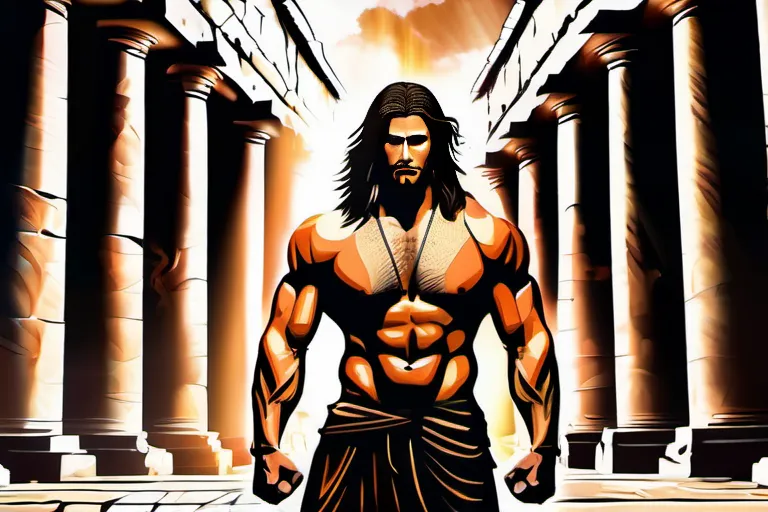
Christians read Samson as a man called by God whose extraordinary strength coexists with serious failures of judgment. His story in Judges 13–16 concerns Israel under Philistine domination, a disputed vocation, escalating revenge, betrayal, and a destructive final victory. It raises a difficult question: how can someone serve a divine purpose while remaining morally unreliable?
There is no single Christian interpretation that settles every episode. A careful reading distinguishes what Judges narrates, what the New Testament says about Samson, and the ethical conclusions Christians draw from those texts. Admiring his strength does not require treating every decision as exemplary.
Where Samson belongs in the Bible
Samson is one of the judges of Israel. In this setting, a judge is a leader associated with deliverance, rather than simply an official conducting trials. The USCCB introduction to Judges places these narratives between Joshua and the monarchy and identifies a recurring pattern of unfaithfulness, oppression, distress, and deliverance. That setting matters: Samson’s adventures belong to a larger account of a troubled community, not an isolated collection of feats.
Judges is also theological storytelling. It evaluates power, worship, and leadership through Israel’s relationship with God. Reading it as Scripture involves attending to that evaluation; it does not turn every action performed by a major character into a command. A person can be central to the narrative without being its consistent moral example.
A calling announced before birth
In Judges 13, an angel announces Samson’s birth to Manoah’s unnamed wife, who has been unable to have children. The child is to be consecrated to God from the womb, with no razor touching his head. His mother receives instructions concerning drink and food. The announcement says he will begin Israel’s deliverance from the Philistines, leaving the promised task larger than his individual career.
The mother is an active, perceptive participant. She receives the announcement and later reassures Manoah when he fears their encounter with the divine will prove fatal. The chapter does not present her as a passive background figure.
The term Nazirite concerns consecration, not residence in Nazareth. Numbers 6:1–8 describes a vow available to men and women, involving abstention from grape products, uncut hair, and avoidance of defilement through the dead, including close relatives. Samson’s announced dedication before birth differs from the ordinary voluntary vow described there.
For Christian interpretation, this establishes a distinction between calling and achievement. Samson receives a vocation before he can choose or accomplish anything. Receiving a gift does not supply the wisdom needed to exercise it. That distinction also cautions readers against assuming that visible ability proves sound character.
Strength, marriage, and the beginnings of revenge
In Judges 14, Samson seeks a Philistine woman in Timnah despite his parents’ objections. The narrator connects this encounter with a divine purpose against the Philistines. Samson kills a lion through the Spirit’s empowerment and later makes a wedding riddle from the honey he finds in its carcass.
The woman is threatened with the burning of her father’s household unless she obtains the answer. After she discloses it, Samson kills thirty men in Ashkelon to provide the garments owed over the wager. He returns to his father’s home, and his wife is given to a companion.
The episode resists a simple lesson about a deceitful woman ruining a good man. Coercion, male rivalry, anger, and Samson’s own lethal response all belong to it. Nor does the narrator’s reference to God’s purpose settle the moral quality of each participant’s conduct. Christian readers have to hold providence and responsibility together without making one erase the other.
Deliverance amid an escalating cycle
Judges 15 develops a chain of retaliation. Samson burns Philistine crops; the Philistines burn his wife and her father; further killing follows. Men of Judah bind Samson to hand him over because they fear their rulers. When the Spirit empowers him, he breaks free and kills a thousand men with a donkey’s jawbone.
Afterward, thirst makes his vulnerability unmistakable. Samson appeals to God, receives water, and revives. The chapter also records his twenty years as a judge.
This contrast between spectacular ability and ordinary bodily need is theologically significant. Samson cannot sustain his own life merely by possessing exceptional power. Yet dependence on God should not make the human losses disappear from interpretation. The repeated logic of answering injury with further injury is part of the story’s tragedy.
Delilah, the haircut, and captivity
Judges 16 first describes Samson carrying away Gaza’s city gates after visiting a prostitute. Those gates are not the pillars of the final scene. Later he loves Delilah, whom Philistine rulers offer money to discover his weakness. She is distinct from both the woman in Gaza and his Timnite wife; the chapter does not explicitly identify Delilah as his wife.
After three misleading answers about how he could be restrained, Samson reveals his consecration. Delilah summons a man to shave him while he sleeps. His strength leaves; the narrator explains that the Lord has departed, though Samson does not recognize it. The Philistines blind him and imprison him at Gaza, where he grinds.
The American Bible Society’s presentation of Judges 16:4–22 connects the episode with earlier references to the Lord’s empowerment. The hair has significance as the visible sign of a consecrated life. Treating it as an independent magical power misses the narrator’s explicit reference to God. Equally, the account does not say that imprisonment leaves his extraordinary strength intact.
The Reformed ministry Ligonier reads the repeated trials as evidence of foolishness and arrogance. A warning about presumption follows from this discrepancy between confidence and reality. Repeated escape can encourage the belief that consequences will never arrive. The story also calls for care in discussing trust: Delilah’s betrayal does not justify blaming women collectively or treating every intimate relationship as a threat.
The final prayer and its moral difficulty
At a celebration for Dagon, Samson is brought out for entertainment. Positioned between supporting pillars, he asks God for strength and revenge for his eyes. He pushes the pillars, bringing the building down upon himself and those inside. The narrator says he kills more people in death than during his life.
This ending includes renewed prayer, but the text does not record an explicit confession or a detailed account of inward repentance. Calling it a complete moral transformation claims more than the passage supplies. Nor does renewed hair growth, mentioned earlier, independently establish restored strength: the final appeal is addressed to God.
Christians can recognize a renewed acknowledgment of dependence while remaining troubled by revenge and mass killing. These responses need not cancel each other. The ending belongs to an ancient narrative of conflict; it does not by itself authorize a modern reader to seek a violent death, injure enemies, or describe destruction as spiritual self-improvement.
Why Hebrews remembers Samson
Hebrews 11:32–34 includes Samson among figures remembered for faith, alongside Gideon, Barak, Jephthah, David, Samuel, and the prophets. Its collective language describes weakness becoming strength and victories achieved through faith. Samson is therefore not excluded from Christian reflection merely because his life is deeply compromised.
However, inclusion in that list is not a separate endorsement of every event in his biography. Hebrews does not explain the temple collapse or instruct Christians to repeat it. Its compressed reference needs to be read alongside the fuller narrative and other Christian ethical teaching.
For example, Romans 12:17–21 tells its readers to reject personal vengeance, pursue peace where possible, and meet an enemy’s hunger with food. That passage gives concrete substance to the distinction between remembering a flawed figure’s faith and copying his retaliation.
Conclusion
Samson’s story challenges the assumption that extraordinary gifts guarantee mature judgment. His calling is real within the biblical narrative, but so are coercion, recklessness, suffering, and the costs of revenge. His dependence on God emerges most clearly where physical power proves insufficient.
A useful Christian reading therefore asks two questions together: where does Samson acknowledge the source of his strength, and where does his conduct damage others? Hebrews permits Christians to remember his faith; the wider ethical context prevents that remembrance from becoming approval of everything he does. Keeping both questions open preserves the depth of a difficult story.
Published by Ralf. About our editorial process.



