
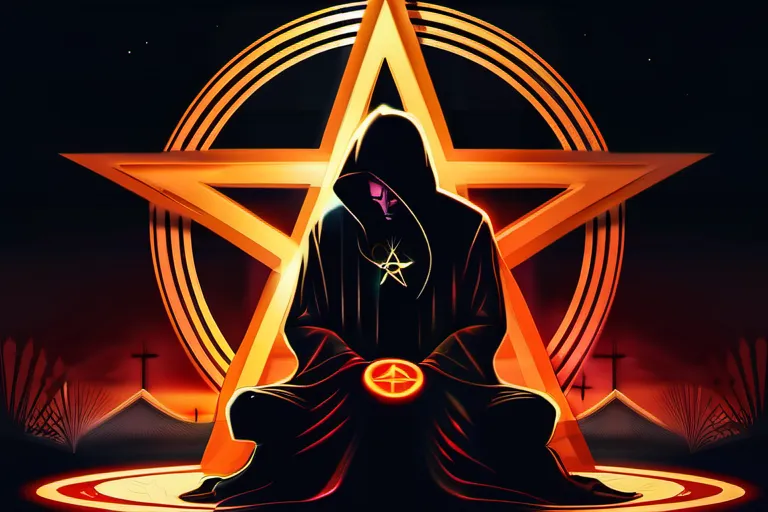
Theistic Satanism refers to approaches in which Satan is understood as a real spiritual or metaphysical being, rather than only a literary symbol. It is not one centrally governed denomination with a universally shared creed. It must also be distinguished from prominent organizations that call themselves Satanist while explicitly rejecting supernatural belief.
What does “theistic” distinguish?
Religious-studies scholar Joseph P. Laycock’s introduction to Satanism distinguishes a symbolic understanding of Satan from theistic interpretations of a metaphysical reality. He cautions that the latter need not mean imagining Satan as a god, or understanding Satan as evil in the same way a Christian opponent would.
The term therefore identifies a broad difference in how Satan is understood. It does not establish one account of creation, a single ritual system or an identical moral philosophy for everyone using the label.
Is the Church of Satan theistic?
No. The Church of Satan’s own FAQ describes its outlook as atheist. It disputes applying its understanding of Satanism to worshippers of a supernatural devil.
That is the organization’s own boundary claim. An overview should report it accurately without treating the organization as the sole authority entitled to determine every scholarly or self-applied use of the word Satanism.
What about The Satanic Temple?
The Satanic Temple’s FAQ likewise describes its religion as non-theistic and non-supernaturalist, and states that it does not promote belief in a personal Satan. It is a separate organization from the Church of Satan.
Neither organization’s name is evidence that it represents theistic Satanism. Before attributing a belief to a named group, check its own statement rather than inferring its theology from the word “Satanic.”
How should claims about beliefs and rituals be assessed?
Distinguish a specific practitioner’s account from a claim about an entire category. A first-person account may establish what its author believes or does; it does not establish that all theistic Satanists follow the same practice.
Laycock also distinguishes intentional religious identification from accusations used against an opponent. Calling someone Satanic does not, by itself, show that they identify with Satanism or participate in a Satanist community.
Does the label establish anything about criminal behavior?
No religious label can replace evidence about a particular act. A claim about wrongdoing needs independently assessable facts about what occurred and who was involved. A theological description, a dramatic image or an accusation is not enough to establish it.
Likewise, treating every unfamiliar ritual as proof of the same belief system erases the very distinctions the sources make. Questions about a person’s religious identity and questions about specific conduct need separate evidence.
Why does the distinction matter?
It prevents two opposite errors: assuming that all Satanists believe in a literal supernatural Satan, and assuming that every person who does must share the beliefs of a non-theistic organization. Accurate comparison begins with identified sources, clear definitions and the limits of what each source establishes.
How did modern religious Satanism develop?
In their historical introduction to Satanism: A Reader, scholars Per Faxneld and Johan Nilsson distinguish modern, openly adopted religious identities from earlier accusations and strands of Satanic thought. They connect the possibility of openly identifying with Satanism to changes in Christianity’s social and legal authority.
Their account places recognizable religious systems around the turn of the twentieth century, while acknowledging earlier literary and intellectual developments. This is different from assuming that stories about medieval devil-worship document an unbroken denomination continuing to the present.
A historical example: Ben Kadosh’s Luciferian manifesto
Johan Nilsson’s study of Carl William Hansen, who wrote as Ben Kadosh, examines the 1906 manifesto Den ny morgens gry. Hansen was involved in Danish Masonic and occult environments. The work’s interest in Lucifer, Pan and a universal life-force belonged to that setting.
Nilsson describes the manifesto as unusually explicit in its argument for a cult of the Devil represented partly by Lucifer. This provides a specific example of positive religious reinterpretation, rather than an accusation made by an opponent. It also shows why the ideas need to be read in their own context: the author’s cosmology cannot simply be replaced by a conventional Christian account of an evil tempter.
One historical text does not supply the creed of every contemporary theistic Satanist. Its value is more precise: it demonstrates how an identified author articulated a particular religious position at a particular time.
Why do scholars compare different kinds of source?
The Oxford source reader places poetry, religious polemics, ritual texts and organizational explanations alongside one another. Each kind of material answers a different question. A poem can reveal an interpretation of Satan without proving that its author organized a congregation. A ritual text describes a practice or ideal without demonstrating how often every reader performed it.
An organization’s FAQ is especially useful for identifying what that organization publicly claims about itself. That is why the Church of Satan’s and The Satanic Temple’s statements above matter, even though neither provides a definition that every other practitioner or scholar must accept.
What would establish a particular theistic position?
A substantive account needs more than the label. It should identify what the source says exists, how Satan or Lucifer is understood, and what kind of relationship or practice the author describes. If the source is silent on one of those questions, an overview should leave that point open rather than fill it with a familiar stereotype.
This approach makes comparison possible without inventing uniformity. Two people can both regard Satan as real while differing about divine status, moral character or religious practice. Shared vocabulary alone does not establish agreement on those questions.
Conclusion
Theistic Satanism is a broad category for religious interpretations that treat Satan as a reality rather than only a symbol. Historical examples and contemporary self-descriptions need to be examined individually. Distinguishing those sources from accusations, literary imagery and explicitly non-theistic organizations produces a more informative account than assuming either one universal creed or one universal meaning of “Satanist.”
Reviewed and substantially revised on 1 November 2026. Scholarly definitions, organizational self-descriptions and editorial guidance about evidence are distinguished above. See our editorial approach and AI transparency.
Published by Ralf. About our editorial process.



