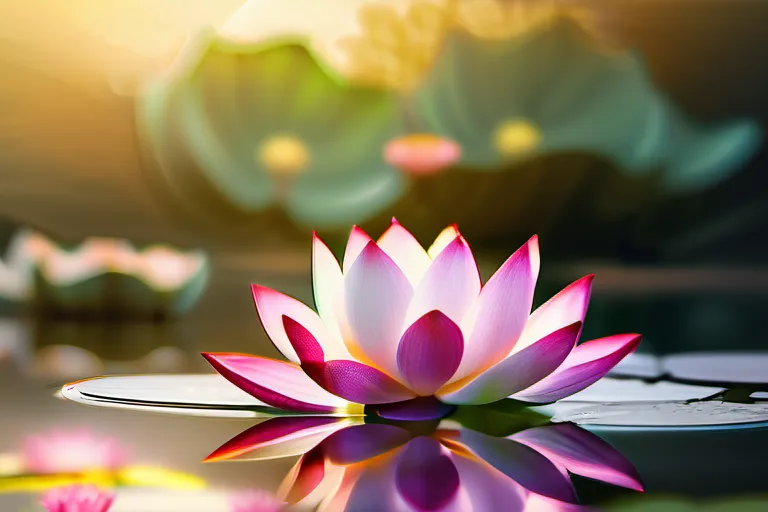
The lotus is significant in Buddhism through several related uses: as a metaphor for awakening, an attribute of particular Buddhist figures, an image of hoped-for rebirth, and a form used in festivals. Its meaning becomes clearer when a particular text, artwork, or practice is identified.
The familiar association with purity has a scriptural basis. Buddhist sources connect the image with wisdom, freedom from attachment, compassion, and particular religious aspirations. Different examples show how those meanings are expressed.
A Lotus Unsmeared by Water
In the Doṇa Sutta, Anguttara Nikaya 4.36, the Buddha compares himself with a lotus born and grown in water that rises above it and remains unsmeared. The comparison belongs to a discussion of awakening and the ending of the conditions that sustain further becoming.
The image concerns a relationship with the world: the awakened one has lived within it while overcoming the attachments that define ordinary existence. The flower gives a visible form to a religious claim about liberation.
The passage also mentions different colored lotuses within the same comparison. Its point is the flower’s relationship to the water. Reading that immediate context helps explain which feature of an image a particular teaching emphasizes.
Wisdom in an Unpromising Setting
Dhammapada 58–59 uses another setting: a lotus blooming near a roadside rubbish heap. The verses compare the flower with a disciple of the Buddha distinguished by wisdom.
Here the image draws attention to the contrast between the surroundings and what grows there. Within the text, it praises the development of wisdom amid ignorance. The same chapter, in verses 51–52, compares words put into practice with a fragrant flower, and words without action with one lacking fragrance. Floral images thus also help express the relationship between teaching and conduct.
Together, these two passages help explain the association between lotus and purity. They concern the qualities of awakening and wisdom. Attending to those terms preserves the connection with Buddhist teaching, alongside the flower’s broader appeal as an image of hope.
The Lotus in the Name of a Scripture
The Lotus Sutra, known in Sanskrit as the Saddharmapuṇḍarīka-sūtra, is an influential Mahayana scripture. BDK America’s presentation of its English edition identifies the One Vehicle as a central concept and describes the work’s use of verse and parables and its influence on Japanese Buddhist schools.
This gives the lotus another place within Buddhist tradition: the name of a major religious text with its own teachings and history of interpretation. The title links the flower with a scripture whose meaning is explored through reading and practice in particular communities.
Avalokiteshvara as the Lotus Bearer
A seventh-century Avalokiteshvara Padmapani from the Swat Valley in the Metropolitan Museum of Art provides a concrete artistic example. The bronze figure, inlaid with silver and copper, represents Avalokiteshvara in the form called the lotus bearer.
The museum identifies the lotus in his left hand and a small image of the Buddha Amitabha above his head as identifying features. It explains Avalokiteshvara through Buddhist compassion. The flower here is part of recognizing a particular bodhisattva and understanding the image’s religious identity.
The details matter together. A lotus, a hand gesture, an associated Buddha, and the figure’s posture help place the object within its iconographic setting. The flower’s significance emerges through that combination.
Lotus Buds and Rebirth in the Pure Land
A different use appears in the seventeenth-century Japanese Western Paradise, or Taima Mandala, in the Denver Art Museum. The painting uses ink, color, and gold on silk and places Amida Buddha at the center of a richly described paradise.
The museum draws attention to small figures within opening lotus buds on the lakes. It interprets them as references to the rebirth of devoted practitioners into the Western Paradise. Here the lotus belongs to Pure Land religious hope, giving rebirth a visible form within a depicted sacred realm.
This is a particular devotional and artistic context. The bud containing a figure helps explain what the flower is doing in the composition. Its relationship with Amida, surrounding bodhisattvas, and the paradise setting makes that interpretation possible.
Lotus Lanterns in Korea
UNESCO’s account of Yeondeunghoe, the Korean lantern lighting festival, describes streets hung with lotus lanterns and a procession of participants carrying handmade lights. It relates the festival to the approach of Buddha’s birthday and records its inscription on the intangible cultural heritage list in 2020.
The account explains lighting through the symbolism of illuminating minds and communities with the Buddha’s wisdom. It also describes knowledge and skills transmitted through temples, communities, and organized educational activities. Making a lantern is therefore part of a living practice involving craft, participation, and religious meaning.
UNESCO characterizes the celebration as open to all, with a history rooted in a Buddhist ritual. The lotus shape is carried into public space through an identifiable festival tradition, adding a social and ceremonial use to the textual and artistic examples.
Understanding the Image in Context
These examples offer useful questions for looking at a lotus image. Is the flower held by a named figure, supporting a figure, opening around someone, or made into an object used in a festival? Are there inscriptions, other attributes, or a known ritual setting?
In the Doṇa Sutta, the important feature is remaining unsmeared by water. In the Padmapani sculpture, the held flower helps identify a bodhisattva. In the Taima Mandala, figures in buds express rebirth. Understanding each use starts with the source’s details and the tradition in which they have meaning.
Conclusion
The lotus has significance in Buddhism through specific teachings, images, and practices. Scriptural comparisons connect it with awakening and wisdom; a bodhisattva’s attribute relates it to compassion; Pure Land painting uses it to depict hoped-for rebirth; Korean lantern traditions carry it into communal celebration. Reading those examples in context reveals a rich range of meanings. The flower’s importance is expressed through what Buddhist texts say, what particular artworks show, and how communities use it.
Published by Ralf. About our editorial process.