
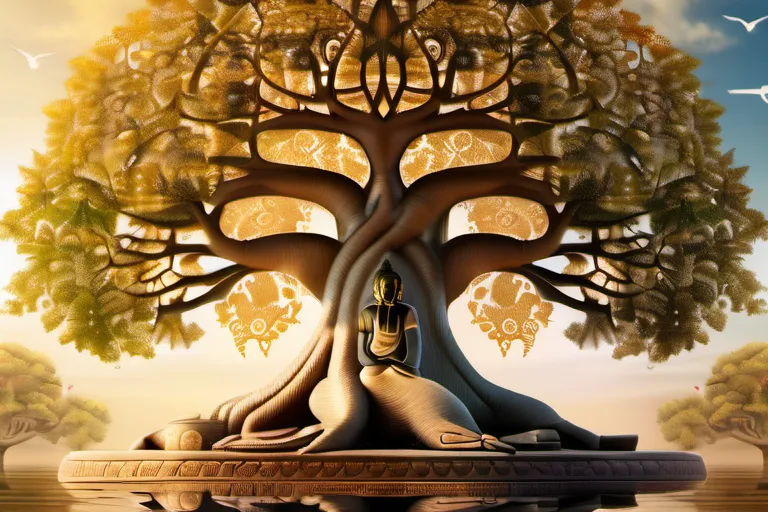
The Bodhi Tree matters in Buddhism because Buddhist tradition places Siddhartha Gautama’s awakening beneath it at Bodh Gaya in India. It gives a physical focus to the memory of his becoming the Buddha: a place associated with meditation, liberating insight, and the teaching that followed. Its significance also extends through sacred trees, pilgrimage, ritual, and art in other Buddhist communities.
Several things need to be distinguished: the tree in the awakening narrative, the living tree at Bodh Gaya today, trees connected through religious traditions of descent, and artistic representations. Each helps explain how Buddhists remember the awakening, but each has a different kind of history.
What Kind of Tree Is It?
The Bodhi Tree is associated with Ficus religiosa, commonly called the sacred fig or peepal. The Royal Horticultural Society’s plant profile describes its heart-shaped leaves with long tapering tips. This recognizable leaf shape helps explain why a single leaf can evoke the tree in religious imagery.
The botanical species can grow in many places. A particular tree’s religious importance, however, depends on its association with the Buddha, a sacred site, or a community’s received tradition. Knowing the species answers a botanical question; understanding a Bodhi tree’s place in worship also requires its religious and local context.
The Tree in Buddhist Scripture
The word bodhi means awakening. In Udana 1.1, the Bodhi Sutta, the newly awakened Buddha stays at the foot of the tree near Uruvela and the Nerañjara River. The text describes seven days in a single seated meditation, enjoying release, followed by attention to dependent arising: how suffering comes about through conditions.
The sequence is important. This passage describes meditation after awakening. It places the tree within a narrative about understanding suffering and liberation, rather than simply endurance beneath a plant. It also gives a specific textual example of the association between the tree, meditation, and insight.
The religious meaning of awakening becomes clearer alongside the Discourse on Setting the Wheel of Dhamma in Motion, Samyutta Nikaya 56.11. That discourse presents suffering, its origin in craving, its cessation, and the path leading to cessation. The path includes ethical conduct, right understanding, and mental cultivation. Within this framework, the tree recalls a liberating realization and a way of practice that reaches into speech, action, and livelihood.
Mara and the Earth-Touching Gesture
Buddhist art often presents the awakening through the story of Mara’s attempt to interrupt the Buddha-to-be. A twelfth-century plaque from Bihar or West Bengal in the Metropolitan Museum of Art shows this episode at the center of scenes from the Buddha’s life.
The museum explains that Mara sends temptations and armies, and Siddhartha responds by touching the earth with his right hand, calling the earth to witness his right to attain awakening. This gesture, called bhumisparsha mudra, helps viewers recognize the episode. The plaque is evidence of how the religious narrative was represented centuries later; the supernatural events belong to the Buddhist story it depicts.
Such imagery gives the awakening a visual language: a seated figure, a tree, the earth-touching hand, and surrounding challengers. Understanding those elements makes the scene more specific than a general image of peaceful meditation.
The Sacred Landscape at Bodh Gaya
UNESCO’s account of the Mahabodhi Temple Complex identifies Bodh Gaya as a major sacred site associated with the Buddha’s awakening. It describes an earlier temple connected with Emperor Ashoka in the third century BCE and dates the standing temple to the fifth or sixth century CE.
The living Bodhi tree stands west of the main temple. UNESCO cautiously describes it as a supposed direct descendant of the original. Nearby is the Vajrasana, or Diamond Throne, a stone platform marking the place of meditation. Other locations in and around the complex commemorate the weeks associated with the awakening narrative.
This arrangement makes the setting a sacred landscape of tree, monument, and remembered events. The living tree’s religious continuity is understood through the site’s tradition of descent; it should not be confused with a claim that one unchanged trunk has survived from the Buddha’s lifetime.
A Sri Lankan Tradition of Descent
The sacred tree at Anuradhapura, Sri Lanka, shows how the Bodhi Tree’s significance traveled. UNESCO’s description of the Sacred City of Anuradhapura relates its foundation to a cutting from the tree of awakening, brought in the third century BCE by Sanghamitta, associated with the establishment of an order of Buddhist nuns.
For devotees, the Jaya Sri Maha Bodhi therefore connects Sri Lankan religious life with the awakening site in India. The relationship involves a tradition about a living descendant, a sacred place, and the people who maintain its worship. It also gives Sanghamitta a significant place in the remembered transmission of Buddhism to the island.
Offerings, Festivals, and Caretakers
Sri Lanka’s national inventory entry on rituals and offerings at the Jaya Sri Maha Bodhi provides concrete examples of living practice. It records offerings of flowers, oil lamps, incense, and food, together with devotional recitation. It describes an offering from the first rice harvest and a procession commemorating Sanghamitta’s bringing of the sapling.
The inventory also identifies monks who lead recitations, lay custodians who assist with offerings and ritual tasks, and the transmission of knowledge to younger practitioners. The tradition depends on coordinated work as well as individual devotion. It joins farming calendars, ceremonial roles, oral knowledge, and a particular sacred place.
Some devotees seek blessings for health, family matters, or other concerns. These are religious hopes and practices described by the inventory. They do not establish guaranteed outcomes. Nor should these specific Sri Lankan customs be assumed to describe every community that venerates a Bodhi tree.
The Tree in Buddhist Art beyond India
An eighth-century pottery wall plaque from Nara, Japan, in the British Museum depicts the Buddha seated before the Tree of Enlightenment, with attendants and celestial figures. The museum connects this kind of temple decoration with Chinese models.
Placed beside the Indian plaque’s dramatic awakening scene, this example shows another way the tree’s association could be carried into a religious setting. Materials and compositions vary, while the link between tree and awakening remains recognizable. A representation allows that memory to be present far from Bodh Gaya.
Conclusion
The Bodhi Tree is significant as the tree of the Buddha’s awakening, a focus of pilgrimage, and a religious presence carried through descendant-tree traditions and images. Canonical passages explain its association with release and insight; sacred sites preserve particular histories; rituals show how communities continue the relationship. Reading these forms of evidence together gives a fuller understanding of the tree’s importance while keeping religious narrative, botanical identity, and documented history distinct.
Published by Ralf. About our editorial process.



