

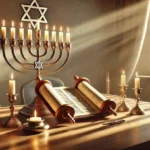
A menorah is a lampstand. The seven-light menorah known from the Jerusalem Temple also became a recognizable image on objects with very different purposes. A Roman glass bowl carries two of them, a Byzantine medallion shows one, and an eighteenth-century Hanukkah lamp borrows features from the biblical design. These examples explain why counting the lights and looking at the object that carries them both matter. Exodus 25:31–40 · Metropolitan Museum of Art, Roman bowl fragments · Israel Museum, Hoard from the Foot of the Temple Mount · The Jewish Museum, Hanukkah lamp F 1423
What makes the biblical lampstand recognizable
Exodus describes a lampstand of hammered gold for the portable sanctuary. Three branches extend from each side of the central shaft, and the design holds seven lamps in all. The cups and other details draw on the shapes of almond blossoms. A later artist can preserve the outline, borrow the plant decoration or do both. The description gives us features to look for without assigning a fixed meaning to each branch. Exodus 25:31–40
Temple imagery on glass and gold
A Roman gold-glass bowl in the Metropolitan Museum of Art, dated 300–350 CE, survives in fragments. It shows two menorot alongside an open ark with rolled scrolls. A ram’s horn and a citron also appear, and part of a banquet scene is visible below. The images bring several parts of Jewish religious life together on a vessel. The two lampstands form part of that composition and give no count of how many stood in a particular sanctuary. Metropolitan Museum of Art, Roman bowl fragments
A Byzantine hoard found at the foot of the Temple Mount included coins, jewellery and a gold medallion with a seven-branched menorah. Here the emblem is on a much smaller surface. Its shape was distinct enough to travel from a full-sized lampstand to a portable object. The Israel Museum leaves the precise function of the finds open. The medallion preserves an image whose use remains uncertain. Israel Museum, Hoard from the Foot of the Temple Mount
A Hanukkah lamp can echo the Temple design
Hanukkah uses eight festival lights and a helper light called the shamash. The festival commemorates the rededication of the Temple, and the oil miracle explains the eight nights in rabbinic tradition. An Eastern European synagogue lamp with a 1752/53 inscription shows how the two designs can meet. It stands about 1.6 metres tall, and its arms carry buds and flowers that the Jewish Museum relates to Exodus. The decoration recalls the sanctuary menorah while the lamp serves the Hanukkah ritual. Harley Swedler’s modern priva/SEE takes a different approach: separate pieces accommodate the increasing number of lights over the eight nights. The Jewish Museum, Hanukkah lamp F 1423 · The Jewish Museum, priva/SEE
The menorah in a state emblem
The official emblem of Israel places a seven-branched menorah between olive branches on a shield. Its lampstand resembles the one depicted in the Roman triumphal procession on the Arch of Titus. The same motif here identifies a modern state. The presidential standard uses related symbols in a square design. These two public uses can be distinguished by looking at the whole design as well as the lampstand at its centre. Israel Central Bureau of Statistics, State emblem · Office of the President of Israel, Presidential Standard
Conclusion
The outline of the Temple menorah has travelled across materials and settings, from a sanctuary description to glass, jewellery and a state emblem. A Hanukkah lamp can recall the older design through its decoration while holding a different number of lights for a different occasion. To understand a menorah image, look at the branches, the details around them and the purpose of the object that bears it.
Published by Ralf. About our editorial process.



