
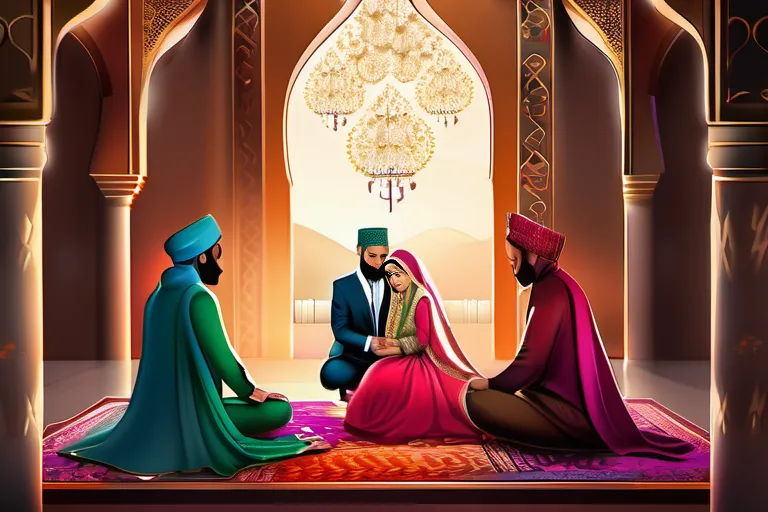
 The Arabic term nikah refers to marriage and is often used in English for the Muslim marriage contract or the ceremony in which it is concluded. The Qur’an speaks about companionship and mercy between spouses. It also addresses obligations such as the marital gift, or mahr. The ceremony, the reception and the state’s recognition of the marriage each raise different questions. Qur’an 30:21 · Qur’an 4:4
Companionship and consent
Qur’an 30:21 describes the comfort spouses find in one another and places compassion and mercy between them. The verse speaks of these qualities as a sign of God. A different kind of source, the hadith collection Sahih al-Bukhari, preserves an account in which Khansa bint Khidam objected to a marriage her father arranged. She took the matter to Muhammad, who declared the marriage invalid. The report gives a concrete example of a woman’s own wishes carrying weight in a marriage decision involving her family. Qur’an 30:21 · Sahih al-Bukhari 5138
What the mahr is for
Qur’an 4:4 directs that the marital gift be given to the woman entering the marriage. The verse also addresses what happens if she willingly gives up part of it. Some English translations use the word dowry, so the direction of the gift matters. In this passage, the bride is the recipient. A report in Sahih al-Bukhari gives one historical example, in which Abd al-Rahman ibn Awf tells Muhammad that he gave an amount of gold measured against the weight of a date stone. The report describes a particular marriage. It supplies neither a general property division nor a universal amount. Qur’an 4:4 · Sahih al-Bukhari 5155
Witnesses, solemnization and the wedding feast
Singapore’s Registry of Muslim Marriages provides a concrete example of how a marriage is solemnized. Its guide asks the couple to arrange two witnesses, record the maskahwin, the Malay term for the marital gift, and make arrangements with a solemnizer. The guide also addresses when a wali, a marriage guardian, is involved. These details belong to the Singapore process. The wedding feast, or walimah, has a different purpose. In the report about Abd al-Rahman’s marriage, Muhammad blesses him and urges him to give a wedding banquet. Singapore Registry of Muslim Marriages guide · Sahih al-Bukhari 5155
Religious ceremony and state recognition
State recognition depends on the jurisdiction and the circumstances of the ceremony. In England and Wales, government guidance for religious weddings describes using a registered religious building and having an authorized person or registrar attend to sign the marriage schedule. That distinction matters when the word nikah is used for a ceremony. The word identifies a Muslim marriage practice, while the venue and registration procedures help determine its civil effect in that jurisdiction. GOV.UK guidance for marriage ceremonies in England and Wales
Reconciliation and separation in the Qur’an
Qur’an 4:35 describes appointing a mediator from each family when a separation is feared. Qur’an 2:229 addresses separation and limits on recovering the marital gift. A nearby verse forbids keeping a spouse in the marriage in order to harm her as the waiting period nears its end. Read together, these passages address reconciliation, financial conduct and the treatment of a spouse at the point of separation. The administrative process for divorce is a separate question governed by the relevant jurisdiction. Qur’an 4:35 · Qur’an 2:229 · Qur’an 2:231
Conclusion
Muslim marriage brings together a religious ideal of companionship, concrete commitments such as the mahr, and a ceremony whose form can reflect the community in which it takes place. The examples from hadith and the Qur’an explain the religious significance of consent and fair treatment. The Singapore and England and Wales examples show why the civil status of a marriage is a question about the rules where it is solemnized.
Published by Ralf. About our editorial process.



