
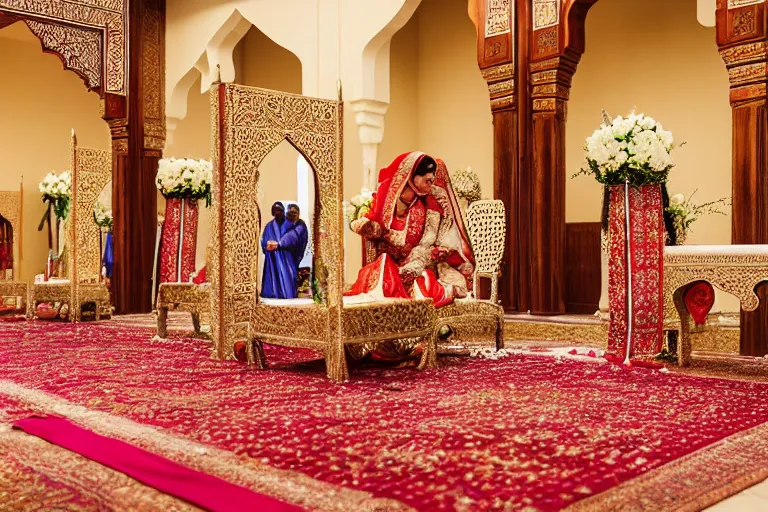
An Islamic wedding brings together a marriage agreement, religious commitments and the customs of the people celebrating it. The marriage itself is commonly called nikah; the surrounding festivities can include a meal, family gatherings and local forms of dress or adornment.
These elements have different roles. Consent and the marriage agreement concern the relationship being established. A feast welcomes the couple into a wider social setting. Henna, clothing and the scale of the reception express particular family and cultural traditions. Understanding those differences explains why Muslim weddings can look very different while sharing important religious references.
Marriage as commitment and companionship
Quran 30:21 describes spouses in connection with tranquillity, affection and mercy. The verse presents an account of companionship and divine signs; it does not prescribe a wedding programme or promise that every marriage will be free of difficulties.
This gives the celebration a horizon beyond the day itself. The couple are beginning a relationship involving care, obligations and the practical work of living together. A beautifully arranged reception can express that hope, but the religious meaning of marriage does not depend on elaborate decoration or a large guest list.
What happens in the nikah?
The nikah is a marriage contract, rather than another name for every event in a wedding celebration. A central feature is an offer of marriage and its acceptance. These establish the agreement; they are different from a speech congratulating the couple.
Egypt’s Dar al-Ifta describes a spoken offer by the bride or someone acting on her behalf, followed by the groom’s acceptance, in the presence of at least two witnesses. Its explanation also identifies the marriage gift and the woman’s willingness to marry.
That is a named religious authority’s account, not a complete statement of every school’s rules. Questions about representation, witnesses and guardianship belong to Islamic jurisprudence, and the differences matter when describing what makes a marriage valid.
Consent and the role of families
Family involvement and the couple’s consent are separate questions. Relatives may introduce prospective spouses, discuss arrangements or help organise the wedding. Such involvement does not by itself show whether a person has freely agreed to marry.
In its discussion of a woman’s choice of husband, Dar al-Ifta states that her consent must be obtained before a father or guardian acts on her behalf. It explicitly rejects forcing a woman into a marriage against her wishes.
A concrete narrative appears in Sahih al-Bukhari 5138. Khansa bint Khidam, a previously married woman, objects to a marriage arranged by her father; the report says Muhammad invalidated it. This is a particular transmitted case, and its objection to an unwanted marriage should not be lost behind a general description of family celebration.
An arranged introduction can therefore involve a willing choice. A forced marriage concerns the absence of that choice. Treating the two expressions as interchangeable obscures the issue of consent.
Why guardians and witnesses require a qualified explanation
A wali is a marriage guardian. His role is not described identically across legal traditions. In an explanation of the Hanafi position, Dar al-Ifta says that an adult woman of sound mind can conduct her own marriage contract. The discussion includes qualifications concerning a suitable match and a comparable marriage payment.
Witness requirements also differ. Ayatollah Ali al-Sistani’s Twelver Shia manual says that witnesses and a cleric are not conditions for the validity of the marriage solemnisation. It allows the couple to pronounce the marriage formula themselves or appoint representatives.
This contrasts with Dar al-Ifta’s account involving two witnesses. A cleric’s presence, a family gathering and a legal requirement are consequently different things: someone may guide a ceremony without that role being a universal condition of marriage throughout Islam.
Mahr: a marriage gift belonging to the wife
Mahr is the marriage gift owed by the husband to the wife. Quran 4:4 directs that women receive their marriage gifts and describes relinquishing any part as a willing act.
English translations sometimes use “dowry,” a word that can cause confusion because it also describes property brought from a bride’s family in other contexts. The direction of the obligation is crucial here: mahr is for the wife, rather than a payment purchasing her from her relatives.
Dar al-Ifta’s account explains that it belongs to her and that payment may be immediate or deferred by agreement. The wedding meal and the marriage gift serve different purposes. Feeding guests does not itself explain what has been agreed as mahr, and expensive reception arrangements should not be mistaken for the wife’s entitlement.
The walima: sharing a meal and announcing a new relationship
The wedding feast is commonly called a walima or walimah. Its social importance lies in gathering people around the marriage: relatives, friends and neighbours can acknowledge the new relationship and extend hospitality.
In Sahih al-Bukhari 5167, Muhammad asks Abd al-Rahman ibn Awf about his marriage gift and encourages him to give a banquet, even with one sheep. The report connects marriage with a shared meal, without describing a universal menu or a modern reception format.
A banquet is distinguishable from the contract itself. Its size, timing and presentation are aspects of how a community celebrates. The religious reference to hospitality does not mean that every family must reproduce the same costly event.
Henna and the cultural life of weddings
Henna provides a well-documented example of a custom with its own regional and social history. UNESCO’s 2024 inscription on henna practices describes its use in communities in Northern Africa and the Middle East, including adornment of hands and feet for joyful occasions such as weddings.
The account includes songs, proverbs and poems, alongside the knowledge needed to prepare and apply the paste. Families and communities pass on that knowledge through observation and practice. A henna gathering can thus be an occasion for making and sharing cultural knowledge as well as preparing for a celebration.
Henna does not appear in the marriage-contract requirements described above. Its presence tells us something about the people and traditions involved; its absence does not by itself tell us that a nikah is incomplete. The same distinction helps readers avoid treating one photographed celebration as a template for every Muslim wedding.
Religious solemnisation and civil recognition
A religious account of a valid marriage and a country’s rules for legal recognition answer different questions. A ceremony’s religious significance does not establish its civil status everywhere.
For example, the government guide for England and Wales describes registered religious buildings and the attendance of an authorised person, or a registrar where required, as part of its arrangements for religious weddings. It also explains signing and registering the marriage schedule.
This is a jurisdiction-specific example. It shows why a general description of nikah cannot replace an explanation of how a particular country records marriages.
Conclusion
Islamic weddings combine the establishment of a marriage with religious hopes for companionship and the social life of families and communities. Consent, the marriage agreement and mahr deserve clear explanation, while witnesses and guardians must be discussed with attention to the relevant legal tradition.
The walima and documented customs such as henna reveal another dimension: people welcome a new relationship through hospitality, shared knowledge and celebration. Keeping these elements distinct makes the diversity of Muslim weddings easier to understand without reducing them to a single ceremony or an elaborate reception.
Published by Ralf. About our editorial process.



