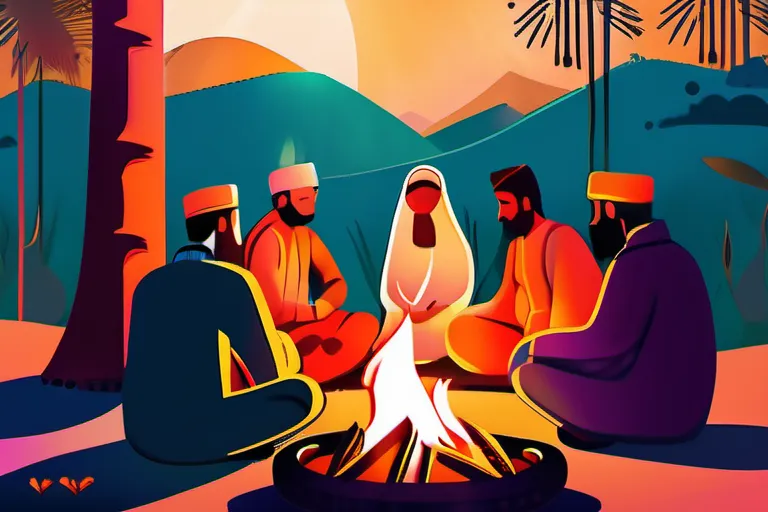
Storytelling in Islam can communicate religious teaching, invite reflection and preserve memories of exemplary conduct. Stories also circulate through the literature, art and performance traditions of Muslim societies. These forms are connected, but they do not all have the same religious authority.
A Quranic narrative, a hadith attributed to Muhammad, an illustrated biography and a collection of animal fables need to be read differently. Their sources and purposes help explain both the importance and the variety of storytelling.
The Quran connects narrative with reflection
Quran 12:111 presents stories as containing a lesson for people of understanding, within its account of guidance and mercy.
Quran 36:69 also distinguishes the message from poetry. Literary analysis can examine its language while recognizing the text’s religious self-description.
A specific narrative moment: Yusuf and forgiveness
In Quran 12:92, Yusuf addresses those who have wronged him without reproach and invokes God’s forgiveness and mercy. Forgiveness gains a voice within a relationship.
The scene raises a concrete ethical question: how does someone respond when able to blame others? Applying it today still requires thought about accountability, trust and repair.
Advice becomes memorable through a relationship
The account of Luqman offers another form of teaching. Quran 31:19 counsels moderation in movement and restraint in the voice. Its advice connects humility with recognizable actions.
Recitation is part of how the text is encountered
The Harvard Pluralism Project’s introduction to the Quran emphasizes listening and recitation alongside the written text. Quran means recitation, and the oral dimension is central to Muslim religious life.
This matters for storytelling because a text is encountered through voices as well as pages. Reciting a passage, translating its meaning and explaining it are related activities, but they are not identical.
A teacher can distinguish the Arabic text from a translation and then make clear where commentary begins. That distinction preserves the listener’s ability to identify which words belong to the source and which belong to its explanation.
Hadith can teach through narrated examples
A hadith can report something Muhammad said, did or approved. Some reports contain a story told by him, rather than describing an event from his own life.
Sahih al-Bukhari 2272 provides an example: three men are trapped in a cave and appeal to God by recalling deeds done sincerely. Their accounts involve care for parents, restraint from sexual wrongdoing and the return of a worker’s accumulated earnings.
The story links sincerity with particular choices. Its placement in a chapter about employment and another person’s wages also shows how a narrative can be used in discussing practical responsibilities.
Attribution carries its own responsibility. Sahih al-Bukhari 107 records a severe warning against lying about the Prophet. An appealing moral message is not sufficient reason to invent a saying and attach his name to it.
Identifying the collection and report allows a reader to inspect what is actually transmitted and distinguish a direct quotation from a summary.
Biographical storytelling has its own history
Stories about Muhammad also circulated through later biographical works. A tangible example survives in an Ottoman manuscript of the Siyer-i Nebi, a work devoted to the Prophet’s life.
The Metropolitan Museum of Art describes a folio dated around 1595, commissioned by Sultan Murad III and painted by Mustafa ibn Vali. The scene represents Gabriel’s encounter with the shepherd Amr ibn Zaid.
The object connects text, patronage and painting in a particular historical setting. It is evidence of how a later community represented a narrative, rather than a contemporary image made during Muhammad’s lifetime.
This kind of object helps make cultural history concrete: who commissioned the book, who made it, what story was selected and how was it presented?
Animal fables belong to a wider literary world
Not every influential story read in Muslim societies is scripture or hadith. Kalila wa Dimna is a collection of animal fables with an important place in Arabic literary history.
The Library of Congress’s manuscript description traces the collection’s Indian origins and its eighth-century Arabic translation by Ibn al-Muqaffa. It describes the work as using animal stories to explore social life and wisdom concerning rulers.
The manuscript catalogued there was produced in Egypt around 1310 and contains illustrations. Such a source demonstrates transmission across languages and settings, rather than a story appearing fully formed in one religious community.
Animal characters can create distance from a human dispute while still raising questions about trust, judgment and power. The literary mechanism is useful to understand even when the work is not claiming the authority of revelation.
Illustration is a specific practice, not one universal rule
The Met also holds a folio from a Kalila wa Dimna manuscript dated to the second quarter of the sixteenth century. The museum attributes it to Gujarat, probably based on an Egyptian original, and identifies the text as Arabic.
The qualification matters: attribution is a scholarly judgment, and the proposed relationship with an earlier model remains part of that judgment.
Together with the Ottoman biographical folio, the object shows that illustrated narratives existed in particular Muslim cultural settings. It does not establish that every religious text, audience or institution accepted the same uses of images.
Oral performance: the meddah
UNESCO’s account of the arts of the meddah describes a Turkish storytelling form performed by one narrator. Its repertoire includes romances, legends, epics, comic tales and songs.
The storyteller adapts the material to the audience and venue, using imitation, humor and improvisation. UNESCO also describes educational and critical functions, with performances historically taking place in settings including markets and coffeehouses.
This is a particular performance tradition, not a description of every Muslim storyteller. It illustrates how narrative can move between religious and secular occasions and how listeners help shape a live performance.
The example also distinguishes preserving a repertoire from repeating every performance identically. Delivery, selection and audience interaction are part of the art.
Reading and teaching with care
A useful discussion begins by identifying the kind of source. Then ask what happens, which choices matter and how the telling directs attention. Finally, distinguish what the source says from a proposed application today.
For example, a lesson on responsibility could compare the worker’s earnings in the cave narrative with the questions raised by an animal fable about trust. The comparison can illuminate a theme while preserving the different authority of hadith and literature.
Similarly, an illustrated manuscript can be studied as an object with a date and patron, while an oral performance can be examined through the relationship between teller and audience. These approaches reveal different aspects of narrative life.
Conclusion
Storytelling in Islam includes religious guidance through Quranic narratives and hadith, alongside later biography, literary fables, illustrated books and oral performance in Muslim societies. The examples of Yusuf, Luqman, the cave narrative, Kalila wa Dimna and the meddah show distinct ways stories carry meaning.
Understanding the source and setting makes those meanings clearer. It also preserves the difference between revelation, transmitted report, interpretation and creative literature, allowing narrative to be appreciated in its religious and cultural depth.
Published by Ralf. About our editorial process.