
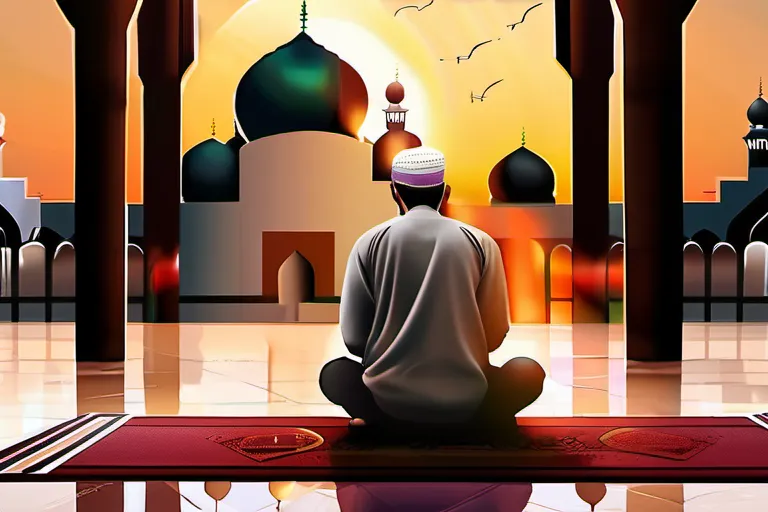
Salah is the prescribed ritual prayer of Islam, also commonly called namaz. It joins intention, recitation, bodily postures, and remembrance of God within an ordered act of worship. The five daily obligatory prayers form a central framework in Sunni and Twelver Shi‘i practice.
Understanding salah means learning both its purpose and its structure. The overview below explains the ordinary daily prayers and their basic movements, while identifying sources and distinctions that matter when learning a particular tradition’s detailed practice.
A pillar of Islam and an act of remembrance
Sahih al-Bukhari 8 includes prayer among the five foundational practices of Islam. This locates salah within religious obligation and worship, rather than treating it simply as an exercise in relaxation.
Quran 20:14 connects establishing prayer with remembering God. The relationship is expressed through the prayer itself: words, attention, standing, bowing, and prostration belong to the act of worship.
The importance of regular prayer therefore has a specifically religious basis. Its value cannot be explained only by the usefulness of having a daily schedule, even though the schedule is a visible feature of its practice.
The five prayers and their obligatory units
A rak‘ah is a unit within a prayer. Egypt’s Dar al-Ifta’s Sunni prayer guide identifies the daily prayers by their place in the day. Ayatollah Sistani’s Twelver Shi‘i rules on obligatory daily prayers state their standard numbers of units.
| Prayer | General period | Rak‘ahs |
|---|---|---|
| Fajr, also called Subh | Dawn, before sunrise | 2 |
| Dhuhr | After midday | 4 |
| Asr | Afternoon | 4 |
| Maghrib | After sunset | 3 |
| Isha | Night | 4 |
These are the regular obligatory units, separate from additional voluntary prayers. Special circumstances can change the applicable rules. Sistani’s following ruling, for example, addresses the shortening of four-unit prayers during travel under specified conditions.
The table gives general periods, not a timetable for a particular place or season. Sahih Muslim 612a relates prayer times to the sun, twilight, and night. Detailed calculations and legal boundaries require the relevant local timetable and tradition.
Five prayers and the question of combining them
The number of prayers should be distinguished from the number of separate occasions on which they are performed. Sahih Muslim 705a records the noon and afternoon prayers being performed together, and the sunset and night prayers together, without fear or travel.
Legal traditions explain the conditions for combining prayers differently. Combining two prayers does not turn them into a single prayer with a new number of units.
Order also matters. Sistani’s rules on sequence require Asr after Dhuhr and Isha after Maghrib. The distinction between a prayer’s identity, its timing, and its order makes the subject clearer.
Preparation: purification, direction, and intention
Quran 5:6 gives instructions concerning ritual purification before prayer, including ablution and provisions involving clean earth in specified circumstances. The detailed rules of wudu and other forms of purification belong to the legal tradition being followed.
Quran 2:144 directs prayer toward the Sacred Mosque in Mecca. This direction is the qiblah. It is a direction of worship, not one fixed compass bearing that would apply everywhere.
Dar al-Ifta’s guide places intention in the heart before the opening takbir. Intention identifies the prayer being undertaken. It is distinct from merely copying another person’s movements.
Sunan Abi Dawud 61 identifies purification as prayer’s key, takbir as its beginning, and taslim as its conclusion. These terms distinguish preparation, entry into the prayer, and its ending.
The structure of an ordinary rak‘ah
Sahih al-Bukhari 757 describes standing, recitation, bowing, rising, prostration, and sitting, emphasizing composure in the postures. Dar al-Ifta’s practical guide sets out the two prostrations and the sitting between them.
After the prayer has begun with the opening takbir, a basic unit includes:
- Qiyam: standing and the prescribed recitation.
- Ruku‘: bowing.
- Rising from the bow: returning to an upright standing position.
- First sujud: prostrating.
- Sitting between the prostrations.
- Second sujud: prostrating again.
This structure explains why one prostration alone is not a complete description of the unit. It also distinguishes the standing after bowing from the sitting between prostrations.
The prayer’s number of units determines how the sequence continues. Precise recitations, hand positions, and other details should be learned within the tradition being practiced; this outline is a map of the structure.
Recitation and the seated tashahhud
Al-Fatiha, the Quran’s opening chapter, has a central place in recitation. Sahih al-Bukhari 756 emphasizes its importance in prayer. Detailed rules about recitation behind an imam and in later units vary and should not be inferred from a single abbreviated outline.
The tashahhud is a seated recitation. Sahih al-Bukhari 831 records the teaching of its greetings and testimony of faith in a sitting context.
In the two-unit sequence described by Dar al-Ifta, the worshiper sits after the second unit for tashahhud and the concluding recitations, then ends with taslim, the salutation of peace. Longer prayers include the further units and seated stages prescribed for them.
Standing, sitting, and ending the prayer are therefore distinct stages. Treating tashahhud as a final standing posture would confuse the sequence.
Physical ability and accommodations
Sahih al-Bukhari 1117 addresses a person unable to stand: the instruction permits sitting and, if that is also impossible, praying on one’s side.
The report makes physical ability relevant to the form of performance. A description of the ordinary standing sequence should therefore be read alongside the provisions for someone unable to perform it.
This is one example of why learning salah involves more than memorizing a diagram. General form, personal circumstances, and the applicable religious rules belong together.
Congregation and Friday prayer
Prayer may also have a communal form. In Sahih al-Bukhari 631, a group is instructed about the call to prayer and leadership when prayer time arrives. This provides a concrete example of shared prayer organized around an imam.
Friday has a particular congregational significance. Quran 62:9 calls believers to leave business and proceed to God’s remembrance when the Friday call is made.
The daily framework and Friday’s particular congregation should be distinguished. For the latter’s significance and practice, see our guide to Friday prayer.
Prayer and conduct beyond the prayer
Quran 29:45 connects establishing prayer with restraint from indecency and wrongdoing. This gives the act an ethical significance extending beyond its outward form.
The teaching invites attention to both worship and conduct. Knowing the movements is important for performance, while the stated purpose also concerns remembrance and the direction of a person’s life.
Congregational prayer creates occasions for people to worship together. Whether a community lives out mutual responsibility and good conduct must still be assessed through its actions; attendance alone does not answer every question about character.
Conclusion
Salah is an ordered act of Islamic worship involving intention, purification, prescribed times, recitation, movement, and seated stages. The five daily prayers provide its regular framework, while detailed rules address performance and particular circumstances.
Begin by understanding the prayer names, their obligatory units, and the structure of a rak‘ah. Then learn the recitations and detailed practice within the relevant tradition, keeping the religious purposes of remembrance and ethical conduct connected to the act itself.
Published by Ralf. About our editorial process.




3 thoughts on “Salah in Islam: Prayer Times, Rak‘ahs, and Basic Practice”