
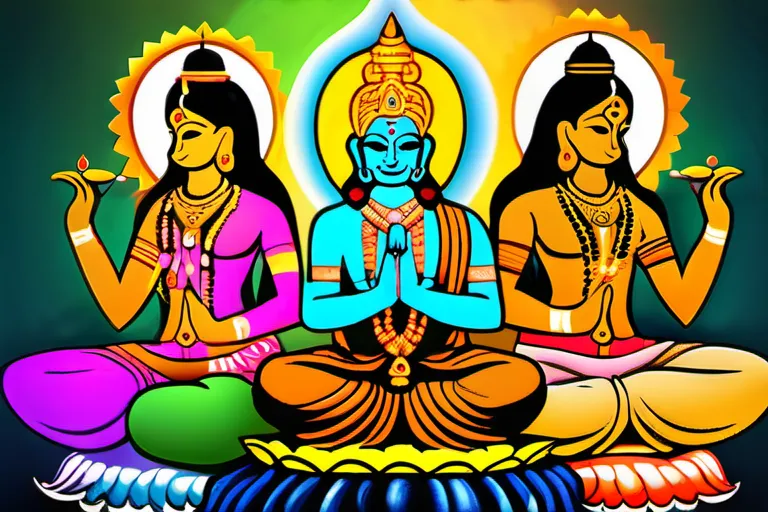
Hinduism includes many devotional traditions, teacher lineages, philosophical schools, and local practices. One widely used introductory map distinguishes Shaivism, Vaishnavism, Shaktism, and Smartism. These categories identify important orientations, especially in worship and theology, but they do not divide every Hindu into four exclusive organizations. Understanding the differences requires asking whom a tradition worships, how its teaching is transmitted, and how it understands the self, the world, and liberation.
Traditions and philosophical schools answer different questions
A devotional tradition may place Shiva, Vishnu, or the Goddess at the center of religious life. A sampradaya identifies a transmitted tradition or lineage of teaching. A philosophical darshana supplies a framework for investigating knowledge, reality, human experience, and liberation. These descriptions can overlap without meaning the same thing.
Kauai’s Hindu Monastery presents the fourfold devotional map as a way of introducing Hindu diversity. It is useful as a map, rather than a membership register. A family may worship more than one deity, and an institution can combine practices that a simple chart places in separate columns.
The Hindu American Foundation’s introduction lists the six classical darshanas as Vaisheshika, Nyaya, Samkhya, Mimamsa, Yoga, and Vedanta. That is a philosophical classification. It is different from either the four broad religious traditions or a list of six forms of divine worship.
Shaivism: Shiva and paths of spiritual realization
Shaiva traditions center religious life on Shiva. Temple worship, mantra, disciplined conduct, meditation, yoga, and guidance from teachers can all have important roles. Shaivism should therefore not be reduced to ascetics withdrawing from society, or to a single meditation technique.
There is also philosophical diversity within it. In its presentation of Saiva Siddhanta, Kauai’s Hindu Monastery distinguishes a pluralistic school associated with Meykandar from the monistic lineage it follows, associated with Tirumular. The former maintains an enduring distinction between God, souls, and world; the latter emphasizes ultimate unity with Shiva.
The example matters because a general statement such as “all Shaivas seek to disappear into Shiva” would erase real differences. Even when traditions share a deity and some ritual forms, their explanations of bondage, grace, knowledge, and liberation can differ. An account of one teacher’s school should be identified as such.
Vaishnavism: Vishnu, Krishna, Rama, and devotion
Vaishnava traditions focus on Vishnu or Narayana and forms especially associated with Krishna and Rama. Devotion, or bhakti, is central, but there are different lineages and interpretations of the relationship between God and the individual self.
A concrete scriptural example appears in Bhagavad Gita 9.26: Krishna accepts a simple offering made with devotion. The passage places the manner of offering and the relationship with the divine at the center of the act. A leaf, flower, fruit, or water can therefore carry a significance beyond the object’s material value.
Different Vaishnava traditions also explain the relationship between Krishna and Vishnu differently. In the Gaudiya text Brahma-samhita 5.1, Krishna is presented as the supreme source. An account that describes Krishna only as subordinate to another form of Vishnu would not represent that perspective accurately.
Other Vaishnava explanations emphasize Narayana and the individual self’s dependence on God. This diversity is one reason that the worship of a personal deity should not be treated as equivalent to one uniform philosophical system.
Shaktism: the divine as Mother and power
Shakta traditions understand the supreme divine reality through Shakti or Devi, the Goddess. Durga is an important form, but she is not the only one. The language of the Divine Mother includes multiple manifestations, and interpretations differ across texts and communities.
Belur Math’s account of Durga Puja provides an example of worship centered on the Mother. It explains the significance of her different forms and the narrative setting of the Devi Mahatmya, also known as the Chandi. The account presents maternal care and divine power as theological themes, rather than simply treating the Goddess as an image of worldly prosperity.
Stories of the Goddess overcoming destructive forces are religious narratives with interpretive significance. They do not independently establish that a particular ritual guarantees physical protection, wealth, or success. Likewise, referring to Shakti as divine power should not turn a theological concept into a claim about measurable energy.
Mantra, ritual, and contemplative disciplines can occur in Shakta traditions, but one description of an esoteric practice cannot stand for every household’s religious life. A tradition’s public worship and its specialized forms of instruction need to be distinguished.
Smartism and the worship of several divine forms
Smarta traditions are commonly associated with the acceptance of several divine forms and with Advaita Vedanta. This does not mean an absence of theology or a rule that every interpretation is identical. It reflects a particular way of relating worship to an understanding of ultimate reality.
The Sringeri Sharada Peetham’s account of Shankara’s devotional hymns names Shiva, Devi, Vishnu, Surya, Ganapati, and Kumara as six forms of worship. It explains them within an Advaita framework as manifestations of the supreme reality and associates this synthesis with Shankara.
That sixfold devotional framework is not the list of six philosophical darshanas. Nor does it imply that every Hindu understands all deities through Advaita. The example illustrates one tradition’s theological interpretation of religious plurality.
It also explains why worship of Ganesha, the Sun, or Skanda cannot be understood simply by checking whether a fourfold introductory chart assigns each a separate column. Such charts organize particular aspects of Hindu life; they do not exhaust its devotional possibilities.
Three Vedanta approaches to God, self, and world
Vedanta itself contains disagreements that are important for understanding Hindu traditions. Three examples show why “all paths lead to the same merger” is too simple:
- Advaita Vedanta: Sringeri’s explanation distinguishes ordinary transactional reality from the ultimate realization of Brahman. Nonduality does not function as a practical instruction to ignore conduct, worship, or the world before realization.
- Vishishtadvaita: A Sri Vaishnava handbook describes individual selves as real, inseparable from and dependent on Brahman, using the relationship of body and self. The individual is not simply identical with an undifferentiated absolute. This is a qualified nondual account associated with Ramanuja’s tradition.
- Dvaita: Uttaradi Math’s presentation affirms the reality of God, souls, and the world, with enduring distinctions. It emphasizes knowledge, devotion, detachment, and divine grace; liberated souls remain distinct servants of God.
These are concise examples from institutions teaching the respective traditions. They help clarify actual differences without requiring that one school’s description be accepted as the definition of every Hindu’s belief.
Shared practices do not erase differences
Offerings, recitation, devotion, worship, learning, and meditation can appear across traditions. A practice’s meaning depends on its setting: who is addressed, which text is recited, what the teacher explains, and how the community understands its purpose.
The Gita’s devotional offering, Sringeri’s hymns to several divine forms, and Belur Math’s Mother worship give concrete examples. Each involves more than a generic technique for feeling calm. Each belongs within a religious account of the divine, the practitioner, and the goal of spiritual life.
Concepts such as moksha, or liberation from the cycle of rebirth, also need this context. A statement about liberation may emphasize nondual realization, dependence on a personal God, loving service, or another account. Similar English vocabulary can conceal different understandings of what is attained.
How to understand a particular Hindu community
Begin with its own name, teacher lineage, principal texts, and central forms of worship. Then ask how it explains the relationship between the divine and the individual self. A temple dedicated to a particular deity tells us something important, but does not answer every philosophical question by itself.
Regional and family practices add further detail. The framework above is a starting point for inquiry, rather than a demand that every person identify with one exclusive label. It is also useful to distinguish historical interaction between religious communities from the classification of a specific Hindu lineage.
Conclusion
 Shaivism, Vaishnavism, Shaktism, and Smartism provide a useful introduction to major Hindu orientations, while teacher lineages and philosophical schools reveal greater depth. The same tradition can contain important internal differences, and similar practices can carry different meanings.
A fuller understanding combines the devotional and philosophical questions: whom a community worships, which teachings guide it, and how it understands God, the self, the world, and liberation. Reading particular communities on their own terms makes Hindu diversity intelligible without treating every difference as either a separate religion or an identical expression of one philosophy.
Published by Ralf. About our editorial process.




1 thought on “Major Hindu Traditions: Deities, Lineages, and Philosophical Differences”