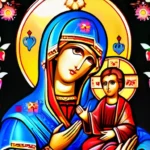
In the Greek Orthodox Divine Liturgy, the deacon remembers Mary with the saints before asking the congregation to entrust its life to Christ. In the Greek text, Mary is called Panagia, the All-Holy. The same title names churches and shrines, including the Panagia Evangelistria on the island of Tinos. A line of prayer and the name of a building thus point to the same person. The liturgy, two Byzantine ivories and the festivals of Tinos give distinct examples of how Orthodox Christians honor her.
What Panagia and Theotokos mean
Panagia is a Greek title of honor for Mary, the mother of Jesus. Another title, Theotokos, is commonly translated as Mother of God or God-bearer. Each title emphasizes something different. Panagia speaks of Mary’s holiness. Theotokos concerns the identity of the child she bore. The title was used at the Council of Ephesus in 431 and expresses the Christian teaching that Jesus Christ is fully divine and fully human. Read a Greek Orthodox parish’s explanation of Theotokos.
Both titles appear in the same passage of the Divine Liturgy. After remembering Mary and the other saints, the deacon calls on the congregation to commit itself to Christ. The choir answers the call by addressing the Lord. Another petition asks Christ for help through Mary’s intercessions, meaning her prayers on behalf of others. The people taking part hear Mary honored and ask for her prayers within a service whose worship is directed to God. Read the bilingual Greek Orthodox liturgy.
Mary and Christ in two Byzantine icons
The Metropolitan Museum of Art holds a small ivory image of Mary and Jesus, probably carved in Constantinople between the mid-tenth and mid-eleventh centuries. Mary supports the child with her left arm. This arrangement belongs to the Hodegetria type, named for an icon kept at the Hodegon Monastery in Constantinople. The museum’s ivory stands about 23 centimeters tall and was cut from a plaque. A familiar arrangement of figures could therefore be recognized in a compact carved object as well as in the famous image associated with the monastery. See the ivory Virgin and Child.
Another ivory in the same collection depicts the Dormition, or falling asleep, of Mary. In this late-tenth-century carving, Mary lies on a funeral bier. Christ holds up the small figure that represents her soul as angels approach. The two ivories lend themselves to a comparison. In the first, Mary holds Christ as a child. In the second, Christ holds Mary’s soul in the form of a child. The reversal gives visual expression to the Orthodox understanding of the Dormition, which commemorates Mary’s death and celebrates her being raised to life by Christ. The feast falls on August 15 in the liturgical calendar and is preceded by a period of fasting. See the ivory Dormition icon. Read the Orthodox Church in America’s account of the feast.
Why pilgrims go to the Panagia of Tinos
On Tinos, the shrine takes its name from an icon of the Annunciation, the scene in which an angel brings Mary news that she will bear Jesus. According to the local tradition, the nun Pelagia reported a vision that led to a search for the icon, which was found in January 1823. The site now has an upper church and a lower church associated with a spring. The feast of the Annunciation on March 25 honors the event depicted in the image. The shrine also celebrates the Dormition on August 15, a separate event in Mary’s story. Read the site’s architectural history and feast calendar.
The festival on July 23 commemorates Pelagia’s vision and connects two places important to the island’s story. In fieldwork published in 2012, Evy Johanne Håland describes the Annunciation icon being taken from the town shrine to the convent where Pelagia had lived. Later, clergy and laypeople accompanied it back to town on foot. The journey brought the icon to the place associated with the vision before returning it to the place associated with the discovery. Read Håland’s account of the festival and procession.
Conclusion
Panagia is a title for Mary that takes on a distinct form in each of these settings. In the liturgy it accompanies a request for her prayers. In Byzantine art, the figures of Mary and Christ make visible two different moments in their relationship. On Tinos, the carrying of an icon between the town and the convent gives worshippers a way to remember a story tied to their island. Together these examples show how a Greek title of honor is spoken, seen and practiced.
Published by Ralf. About our editorial process.