
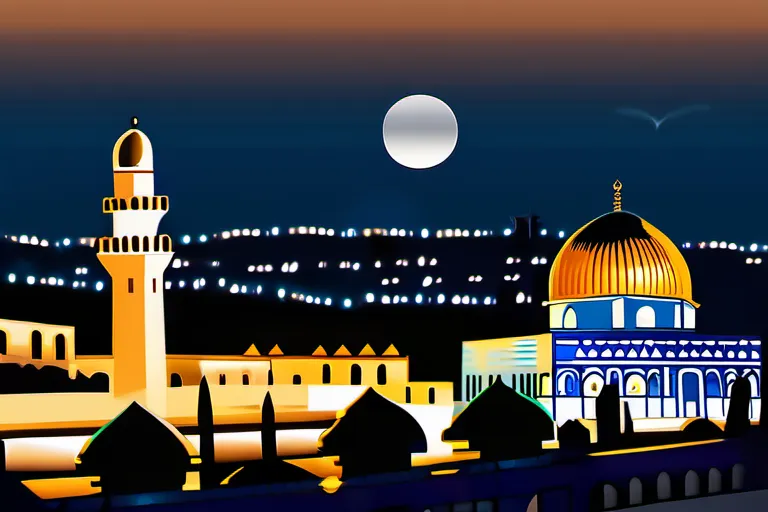
Jerusalem is sacred to Judaism, Christianity and Islam for different, overlapping reasons. In Judaism, it is the city of the ancient Temples and a focus of prayer. In Christianity, it is associated with Jesus’ crucifixion and resurrection and the beginnings of the Church. In Islam, it is connected with al-Aqsa and Muhammad’s Night Journey.
The same place can carry more than one religious meaning. Understanding those meanings does not require accepting one community’s beliefs as historical proof or dismissing another community’s connection.
Jerusalem’s religious importance at a glance
- Judaism: the Temple Mount, the Western Wall and the memory of Temple worship.
- Christianity: Jesus’ final days, the resurrection narratives and the Church of the Holy Sepulchre.
- Islam: al-Masjid al-Aqsa, the Night Journey and the sacred compound also called al-Haram al-Sharif.
UNESCO’s Old City of Jerusalem entry recognizes the city’s importance to all three traditions. The city is home to living communities as well as monuments.
Why is Jerusalem important in Judaism?
Jerusalem is central to Jewish religious memory because the First and Second Temples stood there. The Temple was a focus of communal worship, sacrifice and pilgrimage. Its loss remains a subject of mourning, while Jerusalem also expresses hope for restoration.
The Hebrew Bible connects the city with kingship and Temple worship. In 1 Kings 8:27–30, Solomon’s dedication prayer turns toward the Temple while also acknowledging that no building can contain God. This is a relevant text for Jerusalem’s religious significance; Exodus 15:27, sometimes mistakenly cited in this context, describes Elim instead.
The Western Wall, or Kotel, belongs to the retaining structure around the expanded Temple Mount platform. It is not a surviving wall of the Temple sanctuary itself. It remains an important place of Jewish prayer. The Orthodox Union’s discussion of the Kotel and Temple Mount explains the distinction between the wall’s accessibility and the Temple site’s holiness.
For more background, see what the Torah is and why it matters.
Why is Jerusalem important in Christianity?
The New Testament places Jesus’ final days and crucifixion in Jerusalem and its surroundings. Christians believe he rose from the dead there. These events are central to Christian understandings of salvation, rather than simply episodes in a city’s political history.
Luke 24 recounts the empty tomb and resurrection appearances and describes a mission beginning from Jerusalem. These passages are primary sources for Christian belief; their religious claims should be identified as such.
The Church of the Holy Sepulchre encloses places traditionally identified with Golgotha and Jesus’ tomb. It is a major Christian pilgrimage site. “Holy Land” refers to a broader region, so Jerusalem and the Holy Land are not interchangeable geographical terms.
Why is Jerusalem important in Islam?
In Islamic tradition, Jerusalem is associated with Muhammad’s Isra, or Night Journey, and Mi‘raj, the ascension. Quran 17:1 describes a night journey from the Sacred Mosque to the Farthest Mosque, whose surroundings are blessed. The verse does not name Jerusalem explicitly; its connection with Jerusalem is part of Islamic interpretation and tradition.
Sahih al-Bukhari 1189 names al-Aqsa alongside the Sacred Mosque in Mecca and the Prophet’s Mosque in Medina as destinations of special religious significance. Jerusalem is commonly described as Islam’s third holiest city, after Mecca and Medina.
The Dome of the Rock and the southern al-Aqsa prayer building are distinct structures. “Al-Aqsa” can also refer to the wider sacred compound. Calling every building there the Dome of the Rock obscures that distinction. The compound is known to Muslims as al-Haram al-Sharif and to Jews as the Temple Mount.
To read the Quranic passage in context, start with our introduction to the Quran. Readers comparing printed editions can use our English Quran translation guide, which includes free reading alternatives.
Does shared holiness settle political claims?
No. Religious attachment, historical evidence, political claims and the rights of present-day residents are related but separate questions. Recognizing a Jewish, Christian or Muslim connection does not by itself settle sovereignty or access disputes.
UNESCO’s 2016 statement on Jerusalem’s heritage explicitly calls for recognition of all three traditions. This article explains religious significance; changing political developments and visitor access require current, separate sources.
Common questions
Do the three religions worship at the same building?
No. Their sacred geography overlaps, but they have distinct places of worship and different understandings of the sites.
Is Jerusalem equally important in the same way to everyone?
No. Its role differs between religions, denominations and individuals. A shared city does not mean shared doctrine.
Conclusion
Jerusalem brings together distinct Jewish, Christian and Muslim sacred histories within one living city. The Temple, the Christian resurrection narratives and the Islamic Night Journey explain different forms of attachment, rather than one shared doctrine. Understanding those connections requires identifying the particular text, tradition and site, while keeping religious significance separate from the resolution of modern political claims.
Substantively revised on 1 November 2026. Religious texts are cited as sources for beliefs; institutional sources are identified by their own perspective. See our editorial process and AI-use disclosure.
Published by Ralf. About our editorial process.




1 thought on “Why Is Jerusalem Important to Judaism, Christianity and Islam?”