
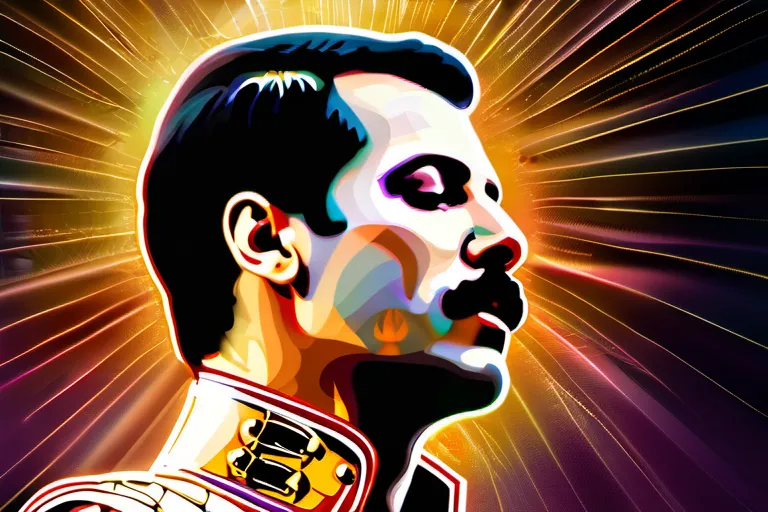
Freddie Mercury came from a Parsi Zoroastrian family. That religious and cultural background is a documented part of his biography, alongside his childhood in Zanzibar and India and his later career in Britain.
A careful account needs to distinguish this family heritage from claims about his private adult beliefs. His music can be discussed through identifiable songs and sources, but it does not provide a complete record of religious observance or an unsupported story of conversion between several faiths.
Farrokh Bulsara and his family background
Queen’s official biography identifies Mercury’s birth name as Farrokh Bulsara and records his birth in Zanzibar on September 5, 1946. His parents were Bomi and Jer Bulsara.
The biography describes much of his childhood as spent in India, where he attended St. Peter’s boarding school. It dates the family’s move to Middlesex in Britain to 1964 and connects his later development with art studies and participation in bands.
English Heritage’s account of his family home identifies the Bulsaras’ Parsi or Zoroastrian background. Their home in Feltham is commemorated by a blue plaque, placing his early British life within a specific family and neighbourhood setting.
These details describe a life crossing several cultural settings. They should not be condensed into a single national or religious label that erases the others.
What Parsi and Zoroastrian mean
The two terms are closely connected but do not describe precisely the same thing. Zoroastrianism is a religious tradition with roots in ancient Iran; Parsi refers to a particular historical community associated with Zoroastrian settlement in India.
Encyclopaedia Iranica’s historical account explains Parsi as a term commonly used for descendants of Zoroastrians who moved from Iran to India and later elsewhere. It also cautions against treating the community’s history as one simple migration story.
This helps explain how Persian religious heritage and an Indian community identity can coexist. A family can belong to a diaspora community while living in East Africa or Britain.
The account also describes changes in language and religious interpretation across different communities. Heritage is transmitted through families and institutions, but it does not make every person’s experience identical.
An ethical tradition, rather than a musical personality test
A widely recognised Zoroastrian ethical formulation links good thoughts, good words and good deeds. The World Zoroastrian Organisation’s 2020 annual report describes these as a moral framework for living.
The formulation connects intention, speech and action. It gives a useful introduction to the kind of ethical language associated with the tradition in which Mercury’s family participated.
It does not, by itself, explain a particular melody, stage costume or decision in Mercury’s career. Establishing that a teaching was present in a family’s religious world is different from proving its influence on a specific work.
The distinction allows the heritage to be taken seriously without making every aspect of his personality an illustration of religious doctrine.
The family has publicly discussed its faith
A March 2014 notice on Brian May’s website records Mercury’s sister Kashmira Cooke’s participation in the BBC programme NoRuz: The Persian Spring.
The notice reproduces a programme description saying that she discusses what faith means to her family. This provides a concrete public connection between the family and discussion of Zoroastrian religious life.
A relative’s account is valuable evidence of family history and memory. It should still be presented as such, rather than expanded into a detailed record of Mercury’s private practices at every stage of adulthood.
Religious imagery in the music: the example of Jesus
There is identifiable religious material in Queen’s early work. In its account of the expanded Queen I release, the band’s official website describes “Jesus” as biblically inspired and associates it with Mercury’s imagination.
The same account discusses “My Fairy King” in terms of fantasy imagery. The contrast gives a more concrete view of the early repertoire than a general claim that every song expresses one underlying religious system.
A songwriter can draw on a religious narrative as artistic material. That establishes an interest or choice within the work; it does not automatically establish conversion, a devotional intention or agreement with every doctrine connected to the narrative.
Listeners may find a song spiritually meaningful, but the listener’s experience and the writer’s documented intention are different subjects. Both can be discussed without turning one into proof of the other.
Check who wrote the song
Mercury’s powerful performances can make a Queen song feel inseparable from him. Authorship nevertheless matters when the song is used to support a claim about his private beliefs.
Queen’s official biography of John Deacon lists “I Want to Break Free” among Deacon’s compositions. Treating its themes as direct evidence of Mercury’s supposed Sufi practice would therefore overlook both the writer and the absence of evidence for that religious claim.
More generally, a vocal performance is an interpretation of a work. It is not necessarily an autobiographical statement by the singer, even when the performance becomes closely associated with their public image.
What the evidence does and does not establish
The cited sources establish a Parsi Zoroastrian family background, a life shaped by several countries, public family discussion of faith and particular uses of religious imagery in the music.
They do not establish a sequence of Buddhist, Hindu and Sufi commitments or a practice of tarot and astrology directing his compositions. Such claims require identifiable evidence, rather than repeated metaphors about a spiritual journey.
The responsible distinction is between an inherited background, an individual’s stated convictions and interpretations of their art. Keeping those categories clear produces a fuller account of what is known while leaving private questions open.
Conclusion
Freddie Mercury’s Parsi Zoroastrian heritage is a meaningful part of his family history and of the wider cultural setting from which he emerged. It deserves accurate explanation rather than being reduced to an exotic detail or expanded into an invented spiritual biography.
His work can be explored through specific songs, credited authorship and documented comments. That approach recognises the importance of religious and cultural material while preserving the distinction between artistic expression and personal belief.
Published by Ralf. About our editorial process.



