
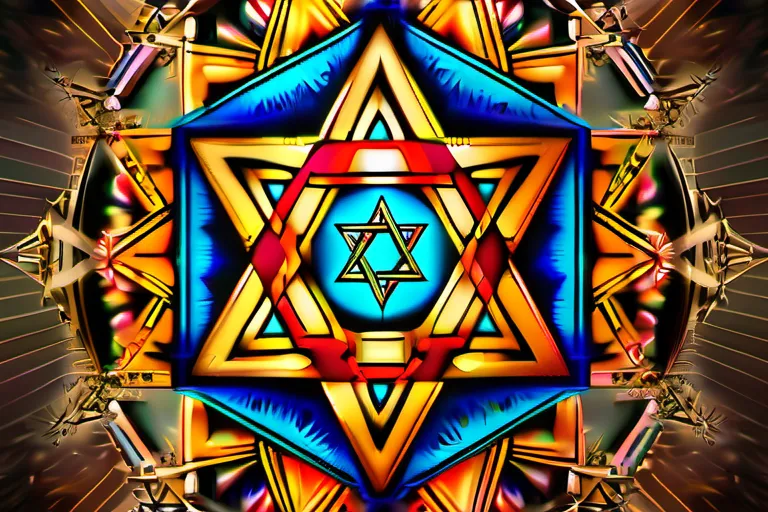
The Star of David, or Magen David, is a six-pointed star made from two overlapping triangles. Its Hebrew name means Shield of David. Over time the shape has appeared on Hebrew manuscripts, synagogue furnishings, club emblems and a national flag. It was also used on badges imposed on Jews during the Holocaust. The history becomes clearer when we ask who put the star on each object and why.

A six-pointed design in a Hebrew Bible
A decorated page of the Leningrad Codex offers an early example. Open Masorah dates this Hebrew Bible manuscript to 1008. A reproduction of one of its decorated pages in Interconnected Traditions shows a six-pointed figure within concentric circles, with Hebrew writing arranged around and inside the design. The page documents the shape’s use in a particular manuscript. Its placement among other geometric forms gives readers a reason to begin with the design of the page when interpreting it. Open Masorah, Leningrad Codex manuscript record. Interconnected Traditions, reproduction of the decorated folio.
Hexagrams also appear in other cultural settings. The Central Council of Jews in Germany distinguishes the wider history of the shape from its growing use as a Jewish communal symbol, especially on synagogues from the seventeenth century. The name evokes David. The surviving examples document particular uses of a design and help explain how its association with Jewish communities developed. Central Council of Jews in Germany, the Star of David.
A Torah curtain with a named recipient
The Jewish Museum Berlin holds a dark blue velvet Torah curtain with a star embroidered in gold. Inside the star are Hebrew initials for Keter Torah, meaning Crown of the Torah. Its dedication records that the board of a rabbinical seminary gave it to Elchanan Gumpertz for his seventieth birthday in 1921. The museum used that wording to identify him and trace the curtain’s earlier history. Jewish Museum Berlin, A Torah Curtain and Its Original Owner.
The initials and the dedication give the star two layers of context. One concerns the Torah and the object’s religious setting. The other records a gift of thanks to a specific person for his work. The embroidery can thus tell us something about the life of an institution as well as its visual language.
A sports club emblem and a national flag
The POLIN Museum’s collection includes a porcelain cup made in the 1930s for the Makabi Jewish Tourist and Ski Association in Bielsko. Its emblem contains a mountain range, a six-pointed star and the club’s name. The mountains connect the design to the group’s activity. The star appears as part of the public identity of a Jewish sporting association. POLIN Museum, Makabi cup MPOLIN-M418.
POLIN also traces the emblem’s wider use in publications and other material associated with the Zionist movement from the late nineteenth century. The Israeli flag places a blue star between two blue horizontal bands on white. A flag, a club emblem and a Torah curtain each use the star in a distinct setting. The accompanying design and inscriptions help identify the organization or purpose in view. POLIN Museum, selected objects with the Star of David. Israel Central Bureau of Statistics, flag description.
A badge imposed during the Holocaust
The National Holocaust Centre and Museum holds a yellow cotton badge printed with the French word Juif. The United States Holocaust Memorial Museum documents a German military order requiring Jews in occupied France to wear such a badge, with the requirement taking effect in June 1942. The rules and forms of compulsory identification differed across German-occupied territories. The mark’s purpose in this case came from the authorities who imposed it as a means of identifying and segregating Jews. National Holocaust Centre and Museum, badge NEKHC:2011.75. United States Holocaust Memorial Museum, Jewish badges during the Nazi era.
The United States Holocaust Memorial Museum also records that Fritz Gluckstein had to wear a yellow badge as a teenager in Nazi Berlin. That account brings the compulsory use of the symbol down to the scale of one person’s life. A regulation explains who imposed the mark. A personal account helps explain what it meant to have to wear it. United States Holocaust Memorial Museum, The Star Badge.
Conclusion
The shape is recognizable across these examples, but its history lies in the choices and circumstances surrounding each use. A scribe’s design, a gift to a rabbi and a club emblem carry different kinds of meaning. A badge imposed under Nazi rule records an act of persecution. Dates, inscriptions and the circumstances in which an object was used let readers tell these histories apart.
Published by Ralf. About our editorial process.




1 thought on “The Star of David: Its History in Manuscripts, Objects and Emblems”