
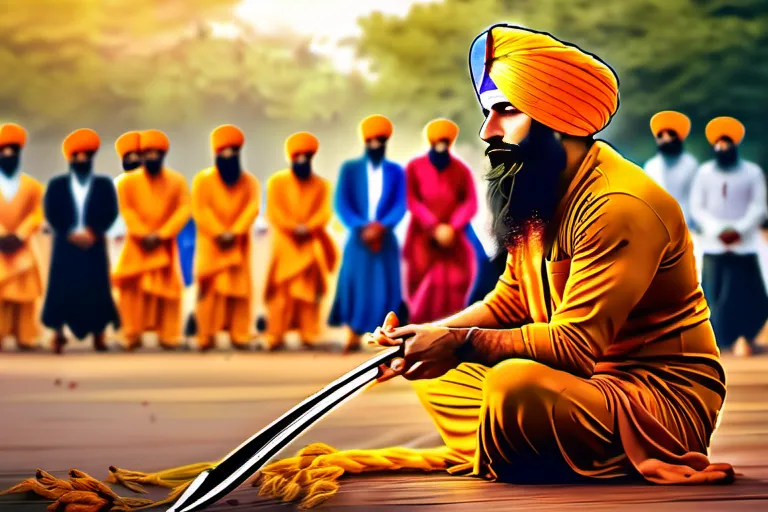
Vaisakhi is especially significant in Sikhism because it commemorates the founding of the Khalsa by Guru Gobind Singh at Anandpur Sahib in 1699. It brings questions of commitment, collective responsibility and visible religious identity into a shared annual celebration. Its meaning is expressed through worship, remembrance, initiation, public processions and service.
The festival also has an older connection with the spring harvest in Punjab. That agricultural setting and its specifically Sikh significance should be distinguished: Vaisakhi did not begin in 1699, and Sikh religious life did not begin with the founding of the Khalsa. The occasion became a defining moment within a community already nurtured by earlier Gurus.
Why 1699 matters
The Sikh Coalition’s historical introduction describes the development of the community through the ten Gurus and Guru Gobind Singh’s call for Sikhs to gather at Anandpur on Vaisakhi. It explains the Khalsa as the formally instituted community of initiates, whose commitment is expressed through initiation and a continuing religious discipline.
This gives the anniversary a particular focus. The Khalsa is not simply a name for the audience at a festival; it involves a sustained commitment to a way of life. The historical gathering is remembered as giving that commitment a recognised collective form.
Vaisakhi therefore connects the individual with the Panth, the Sikh community. A person’s religious commitments have a public and communal dimension, rather than remaining only a private preference. Celebrating the anniversary can renew attention to what those commitments require in ordinary conduct.
The Panj Pyare: the Five Beloved
The World Sikh Organization’s Vaisakhi resource kit recounts the traditional story of Guru Gobind Singh asking for volunteers prepared to give their heads. Five Sikhs answer the call and become known as the Panj Pyare, the Five Beloved. They are initiated, and the Guru then asks them to initiate him in turn.
This is a religious narrative about courage, trust and the authority of the initiated community. The Guru’s receiving initiation from the Five is especially important to its meaning: the relationship is more than a leader demanding obedience from followers. The narrative places him within the discipline he establishes.
The story is appropriately presented as Sikh tradition, rather than embellished with invented dialogue, weather, crowd reactions or an eyewitness description. Its importance can be explained without pretending that every dramatic detail has been independently established by a surviving contemporary account.
Amrit Sanskar: initiation and continuing commitment
Amrit Sanskar, also called khande di pahul, is initiation into the Khalsa. It is not simply the receiving of five objects or a performance staged for a festival audience.
The Sikh Rehat Maryada, published by the Shiromani Gurdwara Parbandhak Committee, describes a ceremony in the presence of the Guru Granth Sahib. Five committed initiated Sikhs administer it. Amrit is prepared from water and sugar in a steel vessel while scriptural compositions are recited and the mixture is stirred with a double-edged sword.
The code allows men and women who embrace Sikhism and undertake its commitments to receive initiation, without making country of origin or caste a condition of belonging. It also makes clear that religious understanding and a considered commitment matter. The ceremony belongs to an ongoing discipline, not merely to participation in one day’s celebrations.
The Sikh Missionary Society’s account of Vaisakhi notes that initiation may be held on the festival and at other times. Vaisakhi is a significant occasion for remembering and undertaking this commitment, but it is not the only date on which a person can enter the Khalsa.
The five articles of faith
The five articles, often called the Five Ks, are associated with initiated Sikh identity. The Sikh Coalition’s explanation of identity lists them as:
- Kesh: unshorn hair.
- Kanga or kangha: a small comb.
- Kara: a steel bracelet.
- Kachera: prescribed shorts or undergarments.
- Kirpan: a religious article resembling a sword or knife.
The Coalition cautions against reducing each article to a practical function. Their significance also comes from the relationship with the Guru and the commitments that initiated Sikhs undertake. They are articles of faith, rather than a set of decorative accessories worn only for Vaisakhi.
The turban is a particularly visible expression of Sikh identity and can be worn by men and women. It is closely connected with the care and public presentation of the hair, but it should not be substituted for kesh when listing the Five Ks. Nor should every Sikh visitor to a festival be assumed to have undergone initiation.
Worship and the Guru Granth Sahib
The Sikh Coalition’s account of scripture explains the Guru Granth Sahib’s central role in Sikh devotional and ceremonial life. Its compositions are in verse, much of it set to music. Vaisakhi worship belongs within that continuing scriptural life, rather than being solely a commemoration of a past political event.
The Sikh Missionary Society describes celebrations in gurdwaras involving kirtan, the singing of hymns; katha, religious explanation or discourse; talks; karah prashad; and langar. The combination gives room to listening, singing, understanding and sharing. The religious meaning is carried through these practices as well as through historical storytelling.
Nagar kirtan: bringing remembrance into public space
A nagar kirtan is a procession involving the singing of hymns through a town or neighbourhood. The World Sikh Organization’s resource kit describes processions led by representatives of the Panj Pyare and the Guru Granth Sahib, with the congregation following and singing. Food distribution and displays of gatka, a Sikh martial art, may form part of the occasion.
The procession makes the community’s worship visible beyond the gurdwara. It can also bring neighbours into contact with Sikh religious life. A description should preserve that devotional purpose rather than treating every procession as simply a parade of colourful clothing.
Langar, seva and the meaning of sharing
Langar is the shared community meal; seva concerns service. The practical work of preparing, serving and clearing food allows a celebration’s commitments to be enacted through ordinary tasks.
For a concrete example, Gurdwara Sri Guru Singh Sabha Hounslow describes its langar as free and open to anyone, including non-Sikhs. It is part of its daily religious life, not a special privilege available only to festival guests. Vaisakhi can bring additional public attention to a practice that continues throughout the year.
This also explains why a particular festive recipe should not be presented as a universal Sikh religious requirement. The important connection is between food, welcome and service. Families and communities may prepare different dishes while participating in those shared commitments.
Vaisakhi in contemporary communities
The festival is observed well beyond Punjab. London City Hall’s programme for Vaisakhi on the Square in April 2026, for example, combined religious talks and performances with gatka, turban-tying activities and free vegetarian langar. Its programme illustrates how a public celebration can include both specifically religious practices and opportunities for wider participation.
Such an event is one local example, not a template that every Sikh community must follow. Gurdwara services, neighbourhood processions and family gatherings take different forms. The Khalsa anniversary provides a shared focus while the setting and scale vary.
Visitors can participate respectfully by following the host community’s guidance. Hounslow’s gurdwara, for example, welcomes people of all faiths and asks them to cover their heads, remove shoes before entering the prayer hall and avoid alcohol and tobacco on the premises. Attention to the host’s instructions is more useful than assuming that attendance requires adopting every religious commitment oneself.
Conclusion
Vaisakhi’s significance in Sikhism lies in the relationship between the founding of the Khalsa, commitment to the Guru’s teachings and shared responsibility. The Panj Pyare narrative, Amrit Sanskar and the Five Ks explain why the anniversary concerns a continuing religious identity rather than one day of celebration alone.
Worship, processions and langar make that meaning visible in different ways: through scripture, public remembrance and practical service. Recognising those connections gives a fuller understanding of Vaisakhi than focusing only on harvest imagery, clothing or spectacle.
Published by Ralf. About our editorial process.



