
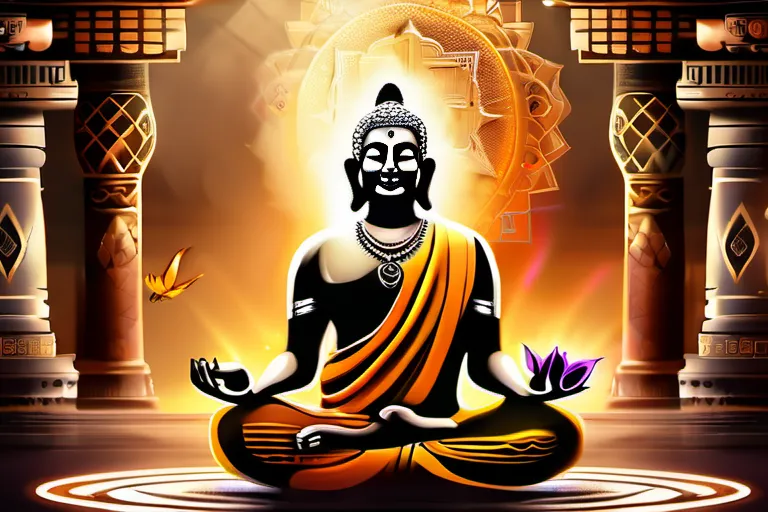
Meditation has important roles in Hindu traditions concerned with attention, devotion, knowledge of the self, and liberation. The practices grouped under this English word are diverse. A text describing sustained concentration, a devotee remembering Krishna, and a teacher explaining self-enquiry may approach religious life through different methods and goals.
Understanding that variety means paying attention to particular sources. The Upanishads, Bhagavad Gita, Yoga Sutras, and later teachers provide concrete examples, while their teachings should be distinguished from modern claims about health or productivity.
An Upanishadic example: the self and the chariot
The Katha Upanishad, in Swami Paramananda’s translation, uses a chariot to explain the relationship between the self, body, intellect, mind, and senses. The Atman, or self, is the chariot’s lord; the body is the vehicle, the intellect its driver, and the mind the reins.
The image makes discipline and discrimination part of a religious account of human life. Attention is connected with the direction in which a person is carried by the senses and desires. The text’s concern reaches beyond a moment of relaxation to questions about the self and the highest goal.
This is one specific Upanishadic presentation. Its imagery supplies a useful point of entry into the religious setting in which contemplation and the training of attention are discussed.
Dharana, dhyana, and samadhi
Patanjali’s Yoga Sutras 2.29 lists eight limbs of yoga. Dhyana is seventh and samadhi eighth. Ethical disciplines, posture, breathing, and the withdrawal of the senses appear within the larger framework.
In Swami Vivekananda’s rendering of 3.1–3, three distinctions are especially useful:
- Dharana: holding attention on a particular object.
- Dhyana: sustaining an unbroken flow of attention toward it.
- Samadhi: absorption in which the object’s meaning alone is reflected.
These descriptions distinguish related phases of practice. The account belongs to a particular interpretation of yoga; its language should be understood through that framework rather than assigned one universal meaning across every Hindu tradition.
The ethical setting also matters. Patanjali’s account includes nonviolence and truthfulness. Meditation sits within a broader discipline of conduct and attention.
The Bhagavad Gita: practice and a measured life
Bhagavad Gita 6.35 acknowledges the difficulty of controlling a restless mind and connects the task with practice and detachment. The passage recognizes a difficulty within the discipline itself.
Verses 6.16 and 6.17 also connect yoga with measured habits of food, rest, activity, and work. In their religious context, these passages place practice within the organization of a life.
The point is not a single meditation duration applicable to every person. These texts describe attention, persistence, and habits as related concerns. Their claims about the fruits of yoga belong to the religious teaching being presented.
Mantra, repetition, and meaning
Sound can also have a place in practice. In Yoga Sutras 1.27–29, as rendered by Vivekananda, Om is associated with Ishvara, and repetition is joined with contemplation of its meaning.
The combination matters: the practice involves both a repeated sound and what that sound signifies within the teaching. The separate discussion of Om in Hinduism explains several textual settings in greater detail.
Mantra practice should therefore be understood through its religious context. Different traditions use particular sounds, names, and forms of remembrance. Their meaning depends on the teaching in which they are received and practiced.
Devotion as a focus of meditation
The Bhagavad Gita also gives attention a devotional orientation. In 6.47, Krishna praises the yogi whose inner life is directed toward him with faith and loving service. The Bhaktivedanta Book Trust’s translation presents this explicitly as a Krishna-centered relationship.
This provides a concrete example of why Hindu meditation cannot be described only through an impersonal goal. Remembrance of a deity and devotion can be central to its meaning. The object of attention and the relationship cultivated are part of the practice.
Different religious presentations may emphasize knowledge, concentration, devotion, or their interconnection. Reading a source carefully makes the particular emphasis visible.
A meditatively represented deity
The Metropolitan Museum of Art’s Yoga Narasimha offers a specific artistic example. It is a twelfth-century copper-alloy sculpture from Tamil Nadu, representing Vishnu’s man-lion incarnation. The museum explains the figure’s meditative posture through the mythic story of his victory over Hiranyakashipu.
The image places yogic stillness within devotion to Vishnu. It illustrates how meditation can be represented through a deity’s form and story. The object demonstrates one way of joining a deity’s mythic identity with contemplative imagery.
Ramana Maharshi and self-enquiry
Another approach appears in Ramana Maharshi’s Who Am I?, published by Sri Ramanasramam. Its introductory account relates the teaching to questions put by Sivaprakasam Pillai around 1902 and subsequently recorded and published.
The text directs attention toward the sense of the person who thinks. When a thought arises, its method asks to whom it has arisen and then returns to enquiry into the self. The goal is expressed as Self-realization within Ramana’s teaching.
This has a different emphasis from holding attention on an external object or cultivating devotion through a divine name. The example makes the diversity within Hindu contemplative teaching concrete: similar vocabulary about attention can serve different religious explanations.
Self-knowledge and liberation
The Katha Upanishad uses the language of samsara, the realm of repeated birth and death. Its goal concerns freedom from that condition, connected with discrimination, disciplined attention, and knowledge of the Atman. Liberation, often called moksha, gives self-understanding a religious significance extending across a whole account of existence.
Ramana’s explanation of Self-realization and the Gita’s praise of devotion to Krishna likewise connect practice with a view of ultimate reality. Understanding a method therefore involves asking what the tradition means by the self, God, and freedom. A calmer period of attention is only one possible aspect of a much larger religious undertaking.
Spiritual aims and modern health research
Religious claims about liberation or Self-realization ask different questions from clinical studies of stress or symptoms. A study of a particular mindfulness programme also does not automatically test every Hindu meditative practice.
The US National Center for Complementary and Integrative Health describes research into meditation’s possible health benefits while noting limits in the evidence about safety and the reporting of negative experiences. Its account supports careful attention to the practice, setting, and person involved.
This distinction helps keep the subject accurate. Religious significance can be explained through texts and traditions, while claims about improved health or performance require their own evidence. Neither a sacred text nor an encouraging personal description establishes a guaranteed clinical outcome.
Reading practices within their traditions
A useful way to understand a practice is to identify its source, its object of attention, and its intended religious goal. Patanjali’s distinctions, the Gita’s account of practice and devotion, and Ramana’s self-enquiry each provide answers within a particular teaching.
Ethical conduct, daily habits, interpretation, and instruction belong to those settings. Attention to these connections helps readers understand what a particular tradition asks of its practitioners.
Conclusion
Meditation in Hinduism includes several ways of cultivating attention and pursuing religious understanding. The texts and examples considered here connect it with discipline, devotion, knowledge of the self, and liberation.
Its significance becomes clearer through those differences. Keeping the teaching, method, and goal together allows meditation to be understood within Hindu religious life while keeping modern claims about wellbeing subject to appropriate evidence.
Published by Ralf. About our editorial process.



