
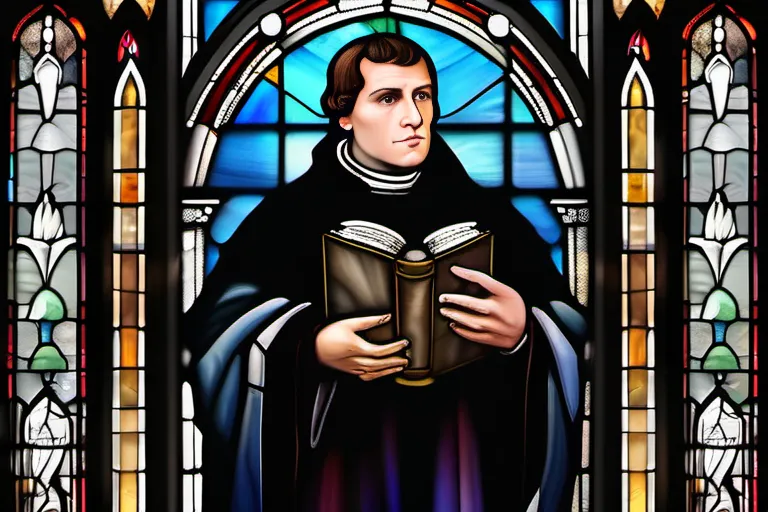
Lutheran Christianity centers on the promise that people are reconciled to God by grace, for Christ’s sake, through faith. Its distinctive emphases include the relationship between law and gospel, the authority of Scripture, and God’s action through preaching, Baptism, and Holy Communion. These teachings shape worship and ordinary responsibilities toward other people.
Lutheranism is also a family of churches, not one worldwide institution with a single governing authority. Shared confessions connect its communities, while differences in interpretation, ministry, and social teaching remain important.
Reformation origins and the Lutheran confessions
The tradition emerged from the sixteenth-century Reformation associated with Martin Luther. The Evangelical Church in Germany’s account identifies the publication of the Ninety-Five Theses in 1517 as a beginning of that movement. It also notes the uncertainty surrounding the familiar story that Luther personally nailed them to a church door.
A further landmark was the Augsburg Confession, presented in 1530 and principally associated with Philipp Melanchthon. It expressed the reformers’ beliefs in relation to the wider Christian tradition and their disputes with church authorities.
The Lutheran Church of Australia’s introduction identifies the Book of Concord of 1580 as the collection containing the Lutheran confessions, including the Augsburg Confession and Luther’s catechisms. These documents help explain why Lutheran identity involves more than admiration for one reformer.
Lutherans also confess the Trinity and Jesus Christ’s saving death and resurrection. Their Reformation concerns developed within Christianity, rather than creating a religion unrelated to the ancient Christian creeds.
Grace, faith, and justification
Justification concerns a person’s standing before God. Article IV of the Augsburg Confession teaches that people receive forgiveness freely for Christ’s sake through faith, rather than earning it through their own strength or merit.
The Evangelical Lutheran Church in America’s explanation describes faith as trust in God’s grace, not simply agreement with a list of statements. Grace is a gift. Faith therefore does not function as another achievement through which a person deserves salvation.
This helps explain the Lutheran emphasis on assurance rooted in God’s promise. The question is not whether someone has performed enough good deeds to make God indebted to them, but whether they can trust the promise given through Christ.
Why good works still matter
Justification by faith does not make ethical conduct irrelevant. Article VI of the Augsburg Confession says that faith should produce good works, while rejecting reliance on those works as the basis of justification.
The distinction is between the source of salvation and the life that follows from it. Helping a neighbor is not a payment purchasing divine acceptance. It is an expression of love and responsibility arising within a life of faith.
The ELCA’s Nebraska Synod connects this with vocation: ordinary daily work can be understood as a calling through which people serve others. Religious seriousness is consequently not limited to ordained ministry or activities inside a church building.
Law and gospel: demand and promise
The distinction between law and gospel is central to Lutheran interpretation. Lutheran Church–Canada explains that law concerns what people should and should not do and exposes sin, while gospel announces what God has done in Jesus Christ for salvation.
They are not simply alternative names for the Old and New Testaments. Nor does the gospel mean that moral demands disappear. The distinction concerns different functions of God’s word: confronting wrongdoing and announcing forgiveness.
A command to tell the truth, for example, can expose a person’s dishonesty; a promise of forgiveness addresses the person who recognizes that failure. This illustration shows why Lutheran preaching seeks both moral seriousness and consolation rather than reducing Christianity to either instructions or reassurance alone.
Scripture and the role of inherited teaching
Lutherans commonly speak of Scripture alone as the decisive norm for doctrine. This does not mean that every inherited practice must be discarded or that each individual interpretation carries equal authority.
The Australian church’s account places Scripture alongside the confessions as explanations of its teaching. The distinction is that the confessions are accepted as faithful exposition of Scripture, rather than as a rival revelation.
Disagreement can arise over what that commitment requires. The Lutheran Church—Missouri Synod’s account of differences between Lutheran bodies identifies biblical authority and the nature of commitment to the confessions as important issues separating it from the ELCA. A general statement about the Bible therefore does not erase differences in how churches interpret it.
Baptism as a means of grace
Lutheran churches give Baptism a stronger meaning than a public declaration of personal choice. In Luther’s Small Catechism, it is water joined to God’s command and promise. Its benefits are described in terms of forgiveness and salvation.
The catechism does not attribute this simply to water considered on its own. It connects water, God’s word, and faith in the promise. It also describes the continuing significance of repentance and new life after the baptismal event.
Article IX of the Augsburg Confession also affirms the baptism of children. This makes Baptism part of the Lutheran understanding of divine initiative. It is not an exception to grace in which a person purchases acceptance by performing a sufficiently impressive ritual.
Holy Communion and Christ’s real presence
In the Small Catechism’s explanation of the Lord’s Supper, Christ’s body and blood are truly given under the bread and wine. The sacrament offers forgiveness, life, and salvation through Christ’s promise.
Calling Communion only a symbol of fellowship therefore leaves out a defining Lutheran claim. The focus is on Christ’s gift received in the sacrament, not merely the strength of participants’ memories or emotions.
The catechism also ties worthy reception to trust in the words of promise. External preparation alone does not replace that trust. Different Lutheran churches nevertheless have different policies about admission to Communion, so a description of shared sacramental belief should not be mistaken for identical local practice.
Worship, confession, and public ministry
The ELCA’s worship overview describes Scripture readings, preaching, and Communion alongside substantial variety in language, music, and setting. Some congregations use organs and choirs; others use contemporary ensembles. One musical style is not a complete definition of Lutheran worship.
The tradition also retains confession and forgiveness. The Small Catechism’s account of confession connects acknowledgment of sins with receiving absolution. Its concern is the promise of forgiveness, rather than the impossible task of discovering and listing every fault.
The priesthood of all believers does not eliminate a distinct public ministry. Article XIV of the Augsburg Confession requires a regular call for public teaching and administration of the sacraments. Shared Christian dignity and a particular ministerial responsibility are therefore different questions.
Faith and civil responsibility
Lutheran discussions of spiritual and civil government are often associated with the language of two kingdoms. Article XVI of the Augsburg Confession affirms participation in civil life while limiting obedience when authorities command wrongdoing.
This is not a division in which faith matters only in private and civil power receives unlimited permission to act. It distinguishes religious ministry from civil responsibilities without making either exempt from moral judgment.
The same article permits public office and, under its account of justice, military service. Lutheranism should therefore not be described as uniformly pacifist. Contemporary disputes over war or social policy require attention to a particular church’s reasoning.
Differences and accountability within Lutheranism
Women’s ordination provides a concrete example of present diversity. The ELCA’s South Carolina Synod recounts the ordinations of Elizabeth Platz and Barbara Andrews in 1970 in predecessor churches. The Missouri Synod, by contrast, maintains a male-only pastoral office, as its own explanation of interchurch differences makes clear.
Recognizing Lutheran heritage also does not require defending everything Luther wrote. An LCMS account of its position on Luther’s anti-Jewish statements records the church’s denunciation of those statements and its 1983 resolution. A tradition can value theological contributions while confronting harmful parts of its history.
Conclusion
Lutheran belief connects salvation by grace through faith with a life of service, the distinction between law and gospel, and trust in God’s promises through word and sacrament. Baptism and Communion are consequently central, rather than optional illustrations added to a purely intellectual faith.
Its shared confessions provide continuity, while differences among churches shape ministry, biblical interpretation, and public practice. Understanding both the common theological center and those real disagreements gives a clearer picture than treating Lutheranism as one uniform institution.
Published by Ralf. About our editorial process.



