
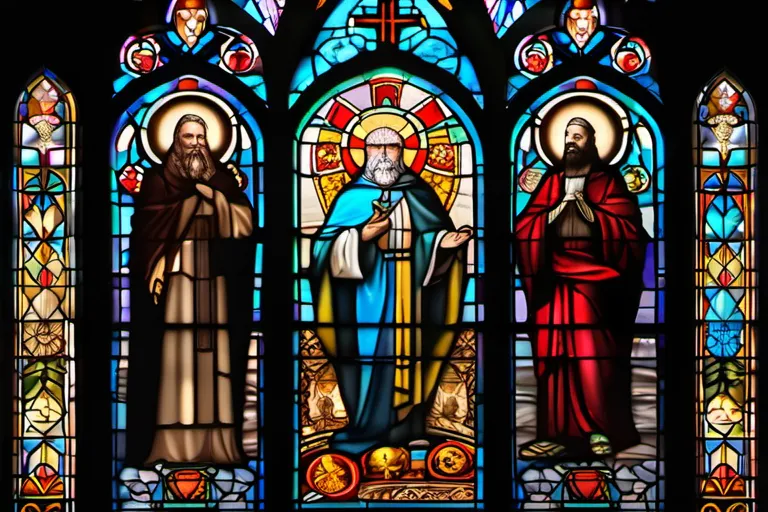
Catholicism is a tradition within Christianity expressed in the life and teaching of the Catholic Church, whose worldwide communion is united with the bishop of Rome, the pope. Its central concerns include faith in Jesus Christ, worship through the sacraments, the interpretation of Scripture within the Church and a moral life shaped by love of God and neighbour.
Understanding Catholicism requires more than knowing the names of church offices or recognizing a cathedral. Belief, worship, community and everyday responsibility belong together. Official teachings also need to be distinguished from the conduct and opinions of individual Catholics.
A Christian faith centred on Christ
The United States Conference of Catholic Bishops presents the Nicene Creed as a concise statement of Catholic belief. It professes one God, Father, Son and Holy Spirit; Christ’s incarnation, death and resurrection; the Church; baptism; and the hope of resurrection and eternal life.
The Trinity means one God in three divine persons. It does not mean three gods, or three physical parts assembled into a larger deity. Jesus Christ is confessed as the divine Son who became human for human salvation.
These beliefs locate Catholicism within the wider history of Christianity. Many are shared with Orthodox and Protestant Christians, even where those communities differ from the Catholic Church about authority, sacraments or other doctrines.
Grace, salvation and the Christian life
The Catholic Catechism’s explanation of grace describes God’s help as a free and undeserved gift, enabling people to respond to God and participate in divine life.
This gives a necessary starting point for understanding salvation. Catholic teaching does not describe a person independently buying eternal life by accumulating enough religious actions. God’s initiative comes first, including the help through which a person responds.
Faith and moral action consequently belong in a relationship of gift and response. Prayer, repentance, service and the sacraments are part of life with God, rather than substitutes for Christ. Describing them as a system of supernatural transactions would obscure their stated purpose.
Scripture, Tradition and teaching authority
The Second Vatican Council’s Dei Verbum, especially paragraphs 7–12, explains the relationship between Scripture, apostolic Tradition and the Church’s teaching office, often called the Magisterium.
Scripture is the inspired written witness. Tradition concerns the transmission of apostolic faith through the Church’s teaching, worship and life. It is not simply a name for every old local custom.
The teaching office interprets this inheritance authoritatively. Dei Verbum states that this office serves the word of God rather than standing above it. The framework therefore does not authorize church leaders to invent a new revelation whenever they choose.
The document also calls for attention to biblical authors’ intentions, literary forms and historical circumstances. Catholic interpretation is not adequately described as reading every passage as the same kind of literal historical report.
Why there are seven sacraments
The USCCB’s overview of the sacraments explains them as visible celebrations communicating God’s grace. It groups the seven according to their roles in Christian life:
- Initiation: Baptism, Confirmation and Eucharist.
- Healing: Penance and Reconciliation, and Anointing of the Sick.
- Service of communion: Matrimony and Holy Orders.
These categories show why the sacraments are not seven interchangeable ceremonies. They concern entry into the Church, continuing nourishment, forgiveness, serious illness, marriage and ordained ministry.
The Catholic claim is that Christ acts through these celebrations. The material signs and spoken words have a religious meaning within the Church’s life; they are not presented as magical techniques controlled by a person’s private power.
The Eucharist: what Catholics mean by real presence
According to the USCCB’s explanation of Eucharistic belief, Christ is truly present under the appearances of bread and wine. The change is called transubstantiation.
The teaching distinguishes the deepest reality of what is received from the appearances accessible to the senses. It does not claim that the consecrated elements must acquire the visible appearance of flesh and blood.
It is also more than a claim that bread and wine merely remind the congregation of an absent Christ. Catholic teaching connects the celebration with Christ’s self-giving, the Church’s communion with him and spiritual nourishment.
The direction of the claim matters: the teaching concerns bread and wine becoming Christ’s Body and Blood through consecration, not Christ’s body being converted into ordinary bread. Nor is the transformation attributed simply to a congregation’s collective imagination.
What happens at Mass?
The USCCB’s Order of Mass describes the Roman Rite’s two principal parts: the Liturgy of the Word and the Liturgy of the Eucharist, framed by introductory and concluding rites.
In the first, the community hears biblical readings and a homily and offers prayer. In the second, gifts are presented, the Eucharistic Prayer is offered and Communion follows. The celebration concludes with blessing and dismissal.
This structure joins listening, thanksgiving, sacramental worship and being sent back into daily life. It also explains why Mass is more than either a sermon with music or a private devotional experience shared in the same room.
This description concerns the Roman Rite. It should not be treated as an exhaustive account of all the liturgical traditions within the Catholic Church.
Initiation and care: practices vary in timing
The USCCB describes Confirmation as strengthening the baptized person through the Holy Spirit for Christian witness and service. Defining it merely as a teenage graduation ceremony would miss that purpose.
Its timing must also be understood within the relevant church tradition. The Second Vatican Council’s decree on Eastern Catholic churches recognizes priests’ administration of chrismation, or Confirmation, in connection with Baptism as well as separately.
For Anointing of the Sick, the USCCB explicitly states that people need not wait until they are at the point of death. Serious illness and the frailty of old age belong within its pastoral setting.
The hoped-for help includes spiritual strength, peace and courage. Physical recovery is not guaranteed. This distinction prevents the sacrament from being described either as a ceremony reserved for the final moments of life or as a promise that illness will disappear.
Latin and Eastern Catholic traditions
Orientalium Ecclesiarum, promulgated in 1964, affirms the dignity of the Eastern Catholic churches and their liturgical, spiritual and disciplinary inheritances.
These churches share Catholic communion while retaining their traditions. Catholic unity therefore does not require every community to reproduce Latin worship or every Latin disciplinary custom.
The distinction is useful when encountering different languages, ceremonies or forms of church government. A practice unfamiliar from a local Roman Catholic parish may belong to an established Eastern Catholic tradition, rather than representing a departure from Catholic identity.
The pope, bishops and the limits of infallibility
The Code of Canon Law, canons 330–336, describes the pope as bishop of Rome and head of the college of bishops. It affirms his universal authority while also recognizing bishops’ proper authority in the churches entrusted to them.
This is more precise than imagining a chain in which local bishops are simply assistants without responsibilities of their own.
Lumen Gentium, paragraph 25, distinguishes ordinary teaching from definitive teaching and describes the conditions under which the pope teaches infallibly on faith or morals as universal pastor.
Infallibility does not mean personal sinlessness, expertise on every subject or the impossibility of an error in any interview or administrative choice. Conversely, teaching that is not an infallible definition is not automatically without religious authority in Catholic life.
Mary, devotion and worship
Lumen Gentium, paragraphs 66–67, distinguishes the special honour given to Mary from the adoration offered to God. Marian devotion is presented in relation to Christ, rather than as recognition of another deity.
The council also warns against exaggeration and misleading accounts of devotion. This provides a useful distinction between Catholic teaching and an interpretation based only on the visual prominence of a statue or the intensity of a particular local celebration.
Ethics and relationships with other Christians
The USCCB’s themes of social teaching connect human dignity with community, responsibility, concern for poor people, workers’ rights, solidarity and care for creation.
These principles help explain why social service and public questions can be religious concerns. They do not prove that every Catholic institution fulfils them or that every Catholic supports the same political program.
The Second Vatican Council’s Unitatis Redintegratio recognizes genuine Christian life outside full Catholic communion and calls for truthful dialogue and renewal. It also acknowledges that people on different sides have contributed to historical divisions.
Ecumenical cooperation does not mean that doctrinal differences have disappeared. It means those differences can be addressed while recognizing shared Christian faith and the responsibilities that follow from it.
Conclusion
Catholicism brings together faith in the Triune God and Jesus Christ, a sacramental life, Scripture and Tradition, and communion involving the pope, bishops and the wider faithful. Its Latin and Eastern traditions demonstrate that institutional unity can coexist with distinct forms of worship and discipline.
The clearest understanding connects doctrine with concrete practice: hearing Scripture at Mass, receiving the sacraments, caring for sick people and responding to human need. It also keeps official belief distinct from individual behaviour and explains Catholic claims accurately without assuming that every reader shares them.
Published by Ralf. About our editorial process.



