
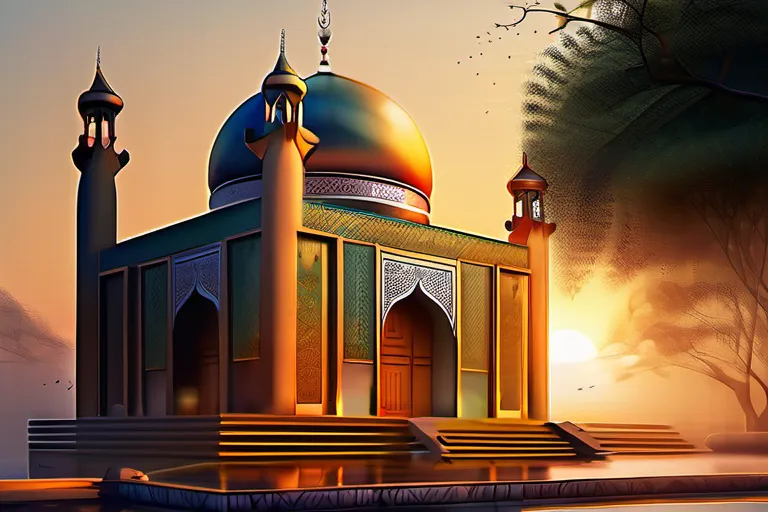
A holy place is a location regarded as having special religious or spiritual significance by a community. It may be a building used for worship, a shrine associated with a sacred person or event, or a natural feature such as an island, mountain or river.
Calling a place holy describes its place within a religious tradition. It does not require every visitor to share that tradition, experience the same emotions or accept a particular account of divine presence. Understanding a sacred site means learning who regards it as sacred, why it matters and how people use and care for it.
What makes a place holy?
There is no single process shared by every religion. A place may be connected with a deity, a founding event, a revered teacher, a relic or generations of worship. Religious communities may establish a new place of worship through dedication or consecration, while other sacred locations have meanings inseparable from a particular landscape.
These possibilities can overlap. A temple can house a revered object, serve a local congregation and attract pilgrims from far away. Its significance cannot be read from the size of its roof or the age of its walls alone.
UNESCO’s discussion of religious heritage includes buildings, shrines and sacred landscapes, as well as areas of land or water with particular spiritual significance for communities. This broad approach helps explain why an impressive monument and an unbuilt landscape can both be holy places.
Worship buildings are more than one architectural type
Religious buildings organize activities as well as space. Where people stand, sit, gather, wash, read or approach a sanctuary can express the worship practised there. The details differ between traditions and between communities within a tradition.
The Catholic Catechism, paragraphs 1179–1186, explains churches in relation to the assembled community, prayer and sacramental life. It connects the altar with the Eucharist, the lectern with the proclamation of Scripture and the baptismal place with entry into Christian life.
This is a Catholic theological account, rather than a definition of every Christian building. It also states that Christian worship is not exclusively tied to one location. A special place of worship need not imply that religious life is impossible elsewhere.
For mosques, the Pluralism Project’s account of American Muslim architecture explains the mihrab as indicating the direction of prayer towards Mecca and the minbar as a pulpit for preaching. Its examples range from purpose-built Islamic centres to converted commercial premises.
A dome or minaret can be visually prominent, but grandeur is not what makes a congregation’s prayer space meaningful. A converted building can support an active religious community just as a monumental building can.
Hindu temples: presence, images and darshan
The Pluralism Project’s account of Hindu temples describes the sanctuary containing a deity’s image, or murti, and the rites through which permanent images are established for worship.
A central practice is darshan: beholding the deity’s image and, within the religious understanding of the encounter, being seen by the deity. A temple is therefore more than an exhibition of religious sculpture. Its images belong to a continuing devotional and ritual life.
The same account describes sacred rivers, hilltops and other pilgrimage locations as tirthas, often translated as crossings or fords. Sacred geography can extend well beyond temple walls. These descriptions identify important Hindu practices without assuming that every Hindu community uses identical buildings or rituals.
A relic and a pilgrimage destination: Kandy
In Sri Lanka, the Sacred City of Kandy includes the Temple of the Tooth Relic, a major Buddhist pilgrimage destination associated with a relic venerated as a tooth of the Buddha. UNESCO also places the city within the history of the Sinhala monarchy.
This example brings together devotion to a relic, pilgrimage and royal patronage. The site matters through the relationships between the object, the temple, its worshippers and its historical setting.
Describing the relic’s religious identity records what is venerated there. It should be distinguished from claiming that a heritage listing has scientifically authenticated its connection with the Buddha. Religious recognition and historical verification are different kinds of statement.
A sacred landscape: Okinoshima
UNESCO’s account of Okinoshima and the Munakata sites describes a Japanese island with archaeological evidence of offerings and rituals from the fourth to ninth centuries, associated with maritime safety and exchanges across East Asia.
The island remains sacred within the Munakata shrine tradition. Here, the religious significance belongs to a whole landscape and its relationships with surrounding waters and worship sites, rather than only to a building.
The site’s preservation council explains that the island itself is understood as a place in which the deity dwells. Its account describes purification, restrictions on removing objects and taboos governing knowledge about the island.
Okinoshima is not open to the public. This illustrates an important distinction: recognition as World Heritage does not mean that every part of a sacred site becomes a public visitor attraction. Learning about a place can include respecting the limits on physical access.
Community life and hospitality: a gurdwara example
Holy places can bring worship together with practical service. The Sikh Sabha of New Jersey’s visitor guidance welcomes guests to its gurdwara and describes langar, a free meal prepared and served by volunteers.
Its guidance asks visitors to cover their heads, remove shoes and wash their hands. It also makes clear that guests can observe quietly without taking part in worship, and provides chairs for people who cannot sit on the floor.
This local example shows how religious identity, hospitality and accessibility can be expressed through everyday arrangements. The meal is part of the community’s life, rather than an incidental tourist service. At the same time, the details of this congregation’s guidance should not be substituted for the instructions of every other gurdwara.
One city can hold several sacred geographies
UNESCO’s listing of Jerusalem’s Old City recognizes its importance to Judaism, Christianity and Islam. The Western Wall, Church of the Holy Sepulchre and Dome of the Rock belong to distinct religious histories and practices.
Geographical proximity does not make those traditions interchangeable. People may honour different events, approach different locations and understand the city through different sacred narratives.
A city shared in this sense is not automatically a place of agreement or unrestricted common worship. Careful description distinguishes religious significance from questions of ownership, administration, political authority and access. It also avoids presenting one stone or monument as though it had exactly the same meaning for every community.
When religious and recreational uses conflict
At Devils Tower in Wyoming, the National Park Service describes a voluntary June climbing closure intended to respect the cultural and ceremonial values of affiliated Native American communities.
The NPS explains that ceremonies can be private and need not be visible to visitors. A climber’s inability to see a ceremony therefore does not establish that religious use is absent.
This voluntary arrangement is distinct from mandatory route closures protecting nesting falcons. The distinction shows why site rules need to be read carefully: different restrictions can have different purposes and different force.
The example also challenges the assumption that everyone approaches a landscape in the same way. A recreational destination can simultaneously be a place of religious responsibility, memory and ceremony.
Preserving a living place
Conservation involves more than keeping masonry intact. Worship may depend on access for a community, the continuity of ceremonies, the care of objects or the protection of a landscape from disturbance.
UNESCO’s religious heritage initiative emphasizes consultation with the relevant communities and other stakeholders. This matters because a plan designed solely around visitor numbers or attractive photographs may overlook the practices that give a place its significance.
For visitors, a useful approach is to consult the site’s own current guidance, respect areas closed to entry, ask before photographing people or ceremonies, and recognize that admission to a building does not necessarily include participation in every rite. Local instructions take priority over assumptions drawn from another religious site.
Conclusion
A holy place is understood through the religious relationships attached to it: worship, sacred narratives, relics, landscapes, memory and community responsibility. Architecture can express those relationships, but neither magnificence nor antiquity provides a complete definition.
Comparing Kandy, Okinoshima, a local gurdwara and Devils Tower reveals both variety and specificity. Each needs to be understood on its own terms. Respectful study preserves that depth while distinguishing a community’s beliefs from historical evidence and recognizing that a living sacred place has purposes beyond being visited.
Published by Ralf. About our editorial process.



