
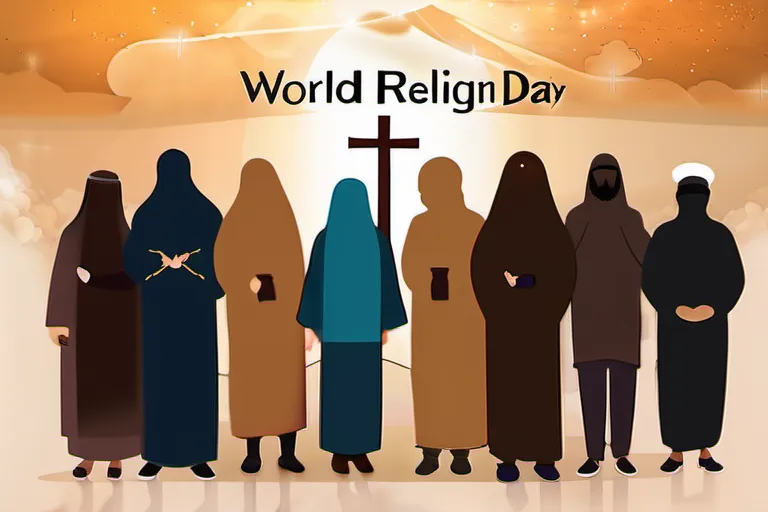
World Religion Day in 2023 fell on Sunday, January 15. It provided an occasion for religious communities, educators, and other organizations to draw attention to religion and relationships across religious differences. Its significance is clearest in identifiable activities: an interfaith address, educational resources, or an institution’s communication about faith and belief.
The day has Bahá’í origins and is commonly observed on the third Sunday of January. Understanding that background helps explain its emphasis on unity. Looking at what particular organizers actually did in 2023 also gives a firmer basis for discussing its relationship with religious practice than assuming that a single annual observance transformed religions worldwide.

How did World Religion Day begin?
A contemporary institutional source documents the observance’s origins. The January 1955 issue of Bahá’í News describes World Religion Day as an annual Bahá’í event established in 1950 by the National Spiritual Assembly. Its account identifies the third Sunday of January as the recurring date.
The notice encouraged local assemblies and groups to organize public meetings, publicity, radio programs, displays, and other activities. It also presented the event through Bahá’í religious teaching and the significance of the Bahá’í revelation. The historical source therefore shows both a religious purpose and practical methods of public outreach.
This background matters when the day is used in an interfaith setting. An invitation to discuss unity can originate within a particular religion. Recognizing that origin makes it possible to understand the organizer’s perspective while allowing other participants to explain their own beliefs in their own terms.
What did unity mean in the 2023 educational materials?
On January 11, 2023, the Cumbria Development Education Centre published resources for World Religion Day. The page identified January 15 as that year’s date and introduced contributions from Karen O’Donoghue concerning the day and the Bahá’í Faith.
The materials described a Bahá’í understanding of the world’s religions as sharing a divine source and introduced a video presentation about progressive revelation. The page also proposed activities for a school assembly or religious education lesson, including comparing statements associated with the Golden Rule.
There are two different educational tasks here. One is learning what Bahá’ís mean by religious unity; another is comparing how particular traditions express moral responsibilities. The first is an account of a religious belief. The second invites examination of texts and ideas. Neither requires a pupil to conclude that all religions have identical doctrines, histories, or forms of worship.
Dublin: a named interfaith gathering and address
Dublin City University’s dated record identifies Philip McDonagh’s address at Ireland’s National Bahá’í Centre on World Religion Day, January 15, 2023. The Dublin City Interfaith Forum’s published report and speech give the theme as “One People, One World.”
In his opening explanation, McDonagh set out four areas: the idea of humanity sharing one world, religion’s contribution to imagining peace, relations between public authorities and faith communities, and reasoning about political processes. This provides actual content for an account of the event, rather than merely asserting that dialogue occurred.
A gathering of this kind offers a place for religious and civic questions to be considered together. It is different from demonstrating that the participating communities adopted a common theology or changed their regular worship. The documented example is a particular address and encounter; its longer-term consequences would need their own evidence.
Workplaces: recognition can take the form of communication
A UK parliamentary answer dated December 12, 2024 gives a retrospective example from 2023. It explains that the Department for Work and Pensions celebrated or signposted a range of faith-related festivals and events through blogs, live events, and podcasts. World Religion Day on January 15, 2023 appears in that list.
The answer also describes the department’s Faith & Belief Network as providing insight about faith, belief, and nonbelief. This is evidence of organizational recognition and communication. The wording does not identify which format was used specifically for World Religion Day or establish a separate shared worship service.
The distinction is useful beyond this example. A calendar entry, an educational blog, and a gathering have different purposes and levels of participation. All may bring a religious subject to attention, but they should not be reported as though they were the same activity.
How can an annual observance affect religious practice?
The examples suggest several possible routes. An educational resource can make a tradition more intelligible to people outside it. A public address can put questions of religion and civic responsibility before a mixed audience. A workplace communication can acknowledge that colleagues hold different convictions, including nonreligious ones.
These are opportunities for encounter and learning. Whether they become enduring relationships depends on what follows. For example, an introductory meeting could lead to another discussion or a joint community project. That is a plausible pathway to examine, rather than a result that can be assumed from the event’s title.
Religious practice also includes commitments that an interfaith event may leave untouched: a congregation’s liturgy, a community’s initiation requirements, its interpretation of scripture, or its calendar of obligatory observances. Cooperation need not mean combining those commitments into a new ritual. People can learn about one another while continuing to explain why their own practices matter.
How should the effects of 2023 be assessed?
A useful assessment separates several questions. What activity was offered? Who participated? What did participants say they learned? Did a relationship or project continue afterward? Each question calls for a different kind of evidence, from an organizer’s program to a participant account or a later record of collaboration.
The sources discussed here establish historical origins, particular resources, an address, and institutional acknowledgment. They do not measure worldwide changes in tolerance, conversion, doctrinal agreement, or conflict. Keeping those distinctions visible makes the documented activities more understandable: their importance can be described without assigning them outcomes that have not been demonstrated.
Conclusion
World Religion Day 2023 brought an established Bahá’í observance into settings that included interfaith discussion, education, and workplace awareness. The Dublin address, Cumbria resources, and British departmental record show specific ways that religion became a subject of public engagement.
Its relationship with contemporary religious practice is best understood through those concrete connections. The day can provide an occasion to explain beliefs, listen across differences, and begin relationships. Determining what changed afterward requires follow-up evidence and attention to the particular people and communities involved. That approach respects both the observance’s origins and the differences among those who encounter it.
Published by Ralf. About our editorial process.




1 thought on “World Religion Day 2023: Origins, Events, and Religious Engagement”