
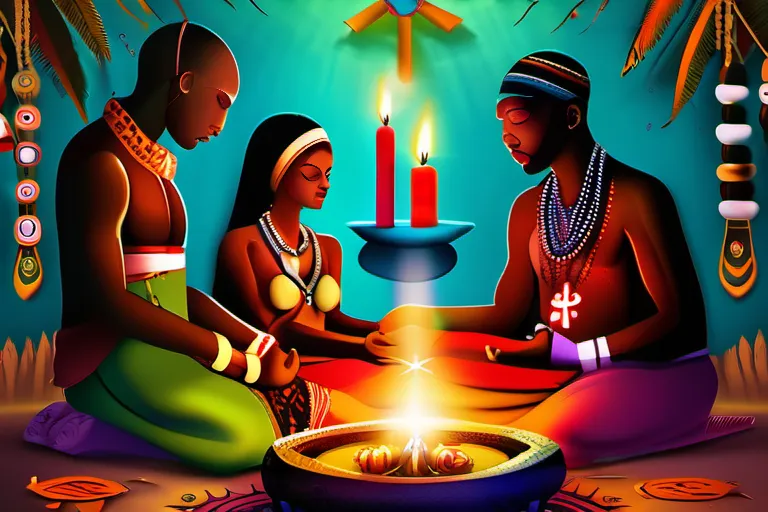
Haitian Vodou is a religious tradition that developed in Haiti through African religious inheritances and their interaction with Catholicism under colonial slavery and afterward. Relationships with spirits, ancestors, and living communities are central to its practice. Practitioners often describe their religious activity as serving the spirits.
Understanding Vodou means attending to those relationships: who is being honored, how a ceremony communicates its purpose, and how people learn their responsibilities within a community. Familiar images from entertainment reveal little about these questions. Religious objects, music, and ritual actions acquire meaning within a particular setting.
How Did Haitian Vodou Develop?
The Pluralism Project’s account identifies Fon, Kongo, and Yoruba traditions among Vodou’s African inheritances and describes their interaction with French Catholicism. This history connects West and Central Africa with the conditions of slavery in the Caribbean. Haitian Vodou developed through those encounters; it is not simply a complete, unchanged African religion transported overseas.
Gerdes Fleurant’s Smithsonian Folklife essay places Vodou within Haiti’s resistance to enslavement and cultural oppression. He connects religious gathering and political solidarity with the history culminating in independence in 1804.
That historical connection helps explain why religious practice can also concern dignity, memory, and collective belonging. It does not mean that every ceremony has a single political purpose, or that every Haitian relates to Vodou in the same way.
God and the Lwa
Vodou recognizes a supreme God. Fleurant emphasizes this point when challenging the reduction of the religion to magic. In her writing about Vodou, practitioner Mambo Chita Tann uses the name Bondye for God; the Canadian Museum of History’s materials also use Gran Mèt, or Great Master.
The museum’s exhibition companion describes the lwa as a special category of spirits associated with this divine reality. Relationships with lwa are expressed through service, communication, and ritual attention.
This distinction is more informative than describing the lwa as interchangeable “guardian angels.” A comparison with another religion may suggest a question, but it cannot replace the names, roles, and relationships through which Vodou practitioners understand the spirits themselves.
Different Spirits and Particular Relationships
The museum’s Vodou glossary gives concrete examples. Legba is associated with opening communication between humans and the other lwa. Danbala is associated with the serpent and life’s sustaining force. Ogou names a family of spirits with martial associations.
These are examples of distinctive identities, rather than a list of generic powers available on demand. A particular spirit’s symbols and ceremonial associations help explain how it is recognized and served. Understanding those associations requires context, not simply matching a name to a request.
The introductory examples also leave room for variation. A description of one community’s service to a lwa should identify that community and setting before being treated as a rule for all Vodou practice.
Religious Communities and Responsibilities
An oungan is a priest and a manbo a priestess. The glossary also identifies the ounsi as an initiated participant who assists them. These terms make visible a community of responsibilities rather than a ceremony performed by an isolated specialist.
The description of Mambo Chita Tann’s Haitian Vodou identifies the sosyete as a Vodou house and includes initiation and community participation among the subjects discussed. A house is an important setting for understanding how people enter relationships of teaching and service.
Learning about such a community involves more than learning vocabulary. It means asking who teaches, what participation entails, which responsibilities belong to initiated members, and which activities are open to others. A public description cannot automatically answer those questions for every house.
What Happens in a Ceremony?
Vodou ceremonies bring together people, sacred space, music, movement, and offerings. The glossary identifies the peristyle as a space for ritual dances and ceremonies and the potomitan as the sacred center pole. A vèvè is a symbolic drawing associated with a lwa.
These elements work together. The arrangement of a space, the identity of a spirit being honored, and the actions of participants belong to one ceremonial setting. Treating each element as an exotic object detached from the others loses the relationships that make it religiously meaningful.
Offerings, singing, and drumming should likewise be understood in relation to the service taking place. Their significance is not captured by a simple contrast between “real belief” and outward performance: the actions themselves are ways of expressing religious commitments.
Possession in Its Religious Context
The exhibition companion explains possession as communication in which a practitioner temporarily provides a bodily presence for a lwa. Within that interpretation, movements and speech can be understood as the spirit’s expression. The religious account concerns a relationship between people and spirits, not the horror-film idea of an invariably malevolent intrusion.
Describing that interpretation does not require claiming that a supernatural event has been independently demonstrated. It does require representing participants’ understanding accurately. Observing movement alone, without the ceremonial and communal context, is insufficient to explain what the event means to them.
Ancestors and the Continuing Community
The museum’s companion also emphasizes relationships with ancestors. Objects connected with the dead can express nearness, memory, and access to ancestral experience. A visitor who sees only an unfamiliar object may miss that relational meaning.
Remembering the dead therefore belongs within continuing relationships between living families and earlier generations. Ceremonies connected with death concern how those relationships are understood and maintained, alongside grief and remembrance. The details belong to particular family and community settings.
Art: The Example of Vodou Flags
The Fowler Museum’s exhibition of Haitian ritual flags provides a concrete example of religious art. Known as drapo, the flags can be decorated with sequins, beads, and appliqué. The exhibition describes their use at the beginning of ceremonies to salute the spirits.
A flag is typically dedicated to a particular lwa through its colors and symbols. The Fowler’s account also traces visual connections with Catholic processional banners, military ensigns, and Masonic designs.
This illustrates cultural creativity rather than a tradition frozen in the past. A work can be admired for its materials and craftsmanship while also being understood as an object with a ceremonial role. Museum display, artistic production, and religious use are related contexts, each requiring attention.
Catholic Connections and Life Beyond Haiti
The Pluralism Project discusses associations between lwa and Catholic saints and the relationship of ceremonial calendars with saints’ feast days. It also cautions against explaining these connections only as a disguise imposed under slavery: adaptation could expand religious imagery and practice as well.
Its account of Haitian communities in the United States shows another form of adaptation, with ceremonies conducted in homes, rented halls, and other settings. Migration changes the circumstances of gathering while relationships of service and teaching continue.
Such examples give a more precise picture than saying that Vodou is either wholly secret or uniformly public. The community, occasion, location, and responsibilities of participants all help determine the setting.
Conclusion
Haitian Vodou connects belief in God with service to the lwa, relationships with ancestors, and responsibilities within living communities. Its African inheritances, Catholic connections, and Haitian history provide the context for ceremonies, sacred art, and everyday religious commitments.
Its diversity appears in the relationships between particular houses, the spirits they serve, and the settings in which they gather. Attention to these connections reveals how belief takes form through religious leadership, communication, remembrance, and artistic work.
Published by Ralf. About our editorial process.



