
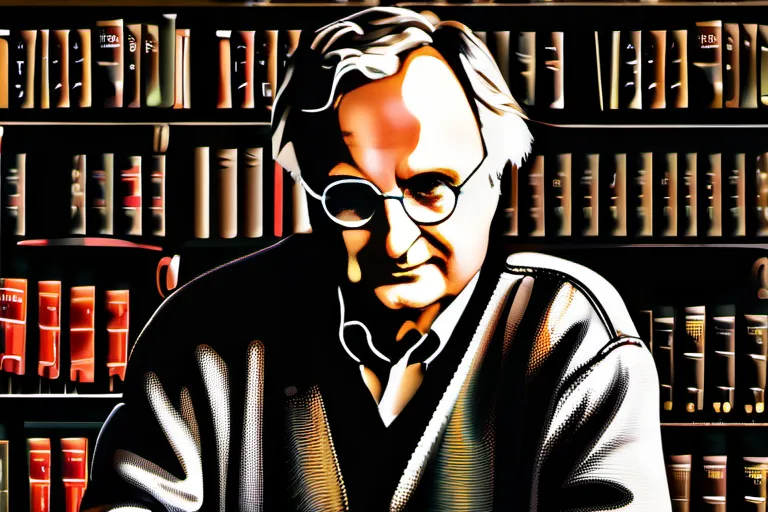
Richard Dawkins is an evolutionary biologist and a public advocate of atheism. He argues that religious claims should be examined critically rather than protected from ordinary demands for evidence. His description of himself as culturally Christian refers to an inherited cultural background, not a profession of Christian belief.
His views are clearest when three questions remain distinct: what evolutionary biology explains, what he argues about God, and what he values or criticizes in religious cultures. Those positions are related, but they are not interchangeable.
Scientific background without an invented conversion story
A University of California, Berkeley lecture biography records that Dawkins completed his undergraduate and graduate work at Oxford under Niko Tinbergen. It places his appointment as an assistant professor at Berkeley in 1967–1969.
Berkeley was therefore a place where he taught, not the institution where he earned a doctorate under Ernst Mayr. Nor should his education be reconstructed around several different Oxford colleges and famous biologists without evidence.
These details establish a professional background. They do not, by themselves, explain every stage of his thinking about religion. For that question, his own dated accounts are more useful than a speculative story about childhood motives.
How Dawkins describes his movement towards atheism
In a Big Think interview recorded on 21 October 2009, Dawkins says that recognizing the existence of many competing religions made him question the special status of the Christianity in which he had been raised.
He then identifies understanding Darwinian evolution as decisive for his judgment that a supernatural creator was not scientifically required. This is his retrospective explanation of his own intellectual development.
This account does not identify a particular lecture or teacher as the cause of his atheism.
Evolution and the argument about design
In his 25 October 2006 essay for Edge, Dawkins argues against inferring a supernatural designer from the complexity of living organisms.
In his 2002 TED talk, he explains cumulative natural selection as an alternative to a complex organism appearing fully assembled in one random event. The Edge essay also argues that invoking a sufficiently capable designer creates another demand for explanation.
The scope of these claims matters. Explaining biological adaptation and judging every possible concept of God are different tasks. Dawkins uses evolutionary explanation within a broader argument against supernatural intelligence; that broader argument should be identified as his position.
Presenting his conclusion about God as a statement automatically made by every evolutionary biologist would go beyond what this individual author’s essay establishes.
Atheism, uncertainty and the burden of evidence
The title of the Edge essay expresses a judgment of very low probability, rather than an assertion that every conceivable deity has been disproved with absolute certainty.
Dawkins distinguishes a personal supernatural intelligence from uses of “God” as a poetic name for nature or the universe. Admiration for nature does not, in his account, imply belief in a being who answers prayers or intervenes in events.
This helps explain why uncertainty need not mean treating belief and disbelief as equally likely. The relevant question is what evidence supports a particular claim, rather than whether someone can eliminate every imaginable possibility.
Public advocacy before The God Delusion
Dawkins’s public opposition to religion was already prominent before the reception of The God Delusion. His TED2002 talk, titled Militant atheism, urges atheists to state their position openly and challenges religious influence on politics and science.
In the talk, he also addresses the social difficulty of identifying publicly as an atheist. His concern is not only an argument about whether God exists, but how nonbelievers are treated and represented.
The talk’s title describes an assertive form of advocacy. It should not be used as evidence that he calls for physical violence. His stated campaign concerns public identification, criticism and participation.
Why he criticizes faith as well as extremism
RTÉ’s archive of his appearance on The Late Late Show, broadcast on 8 December 2006, records his criticism of belief without evidence.
In that discussion, Dawkins does not restrict his concern to people committing harmful acts. He argues that treating faith as a virtue can also provide support for more dangerous forms of belief.
This is a causal and moral criticism of religion, rather than simply a definition of atheism. The broadcaster’s account documents the position he expressed; it does not establish that every religious practice has the same social consequences.
What “cultural Christian” means in his own explanation
LBC published an interview with Rachel Johnson on 1 April 2024 in which Dawkins discussed Easter and Christianity’s role in British life. Its description identifies him as culturally Christian and reports his preference for Christianity over Islam when asked to compare the two.
That preference is an evaluative judgment about religious cultures. It is not, on its own, evidence of accepting Christian doctrine or joining a church.
Dawkins makes the distinction explicit in his own essay in Free Inquiry’s June/July 2026 issue. He describes an Anglican school background, familiarity with hymn tunes and the importance of biblical allusions for appreciating English literature.
He also explicitly identifies himself as an atheist and rejects the interpretation that he has adopted Christian faith. Cultural familiarity and doctrinal assent are different claims, and his explanation keeps them separate.
The essay contains strong criticisms of religion. Those should be read as his judgments, rather than adopted as neutral descriptions of everyone belonging to the religions he discusses.
Trust in science and his definition of faith
In the 2009 Big Think interview, Dawkins distinguishes religious faith, as he defines it, from confidence in scientists working outside his own expertise.
He grounds the latter in scientific methods, criticism and the ability of other specialists to test claims. He does not pretend personally to understand every branch of physics.
The distinction explains his position more clearly than saying he never relies on anyone else’s knowledge. It also makes the disagreement identifiable: readers can ask whether his definition adequately describes the religious forms of trust or reasoning they have in mind.
Assessing his arguments without inventing their impact
A public lecture, interview or essay establishes that Dawkins expressed a view. It cannot by itself establish how many people abandoned religion because of him, whether his rhetoric persuaded a particular audience, or whether his work caused a measurable social change.
The positions also need to be evaluated separately. An objection to a biological design argument differs from an argument about miracles, a criticism of religious institutions or a preference for inherited music and literature.
Agreement with one does not automatically imply agreement with all the others. Keeping the distinctions visible gives both sympathetic and critical readers a clearer account of what is at issue.
Conclusion
Dawkins’s religious outlook combines atheism, a strong preference for evidence-based explanation and criticism of the authority granted to faith. Evolution plays an important role in his account of why a supernatural designer is unnecessary.
His cultural identification with Christianity does not reverse that position: his 2026 explanation expressly distinguishes cultural inheritance from belief. An accurate overview therefore uses dated public statements, avoids invented biographical motives and treats his arguments as arguments that can be examined individually.
Published by Ralf. About our editorial process.



