
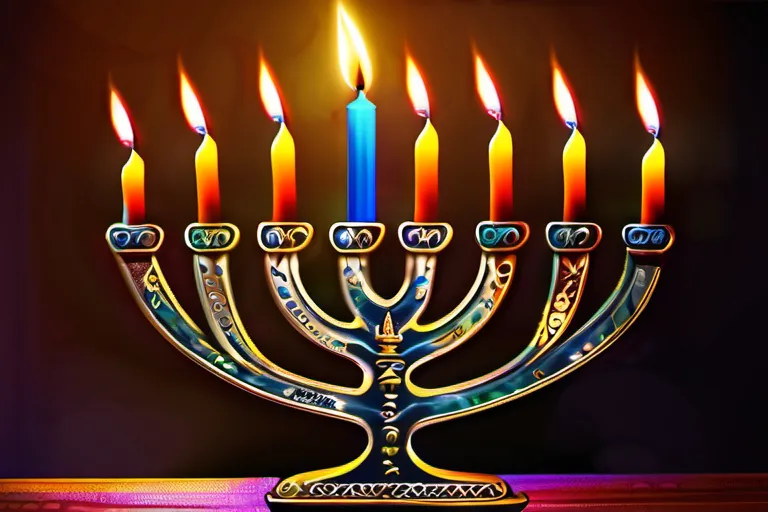

Hanukkah is an eight-day Jewish festival that begins on the twenty-fifth of Kislev and commemorates the rededication of the Second Temple in Jerusalem. Lighting a lamp on successive evenings gives the festival a familiar form. The lamps themselves, like the spinning tops and foods associated with the holiday, can look different from place to place. A Moroccan oil lamp, a lamp with a clock in its pediment and a twentieth-century American design show how makers gave a shared practice a form recognizable to their own communities. 1 Maccabees 4:36–59 · Babylonian Talmud, Shabbat 21b · The Jewish Museum’s Moroccan lamp · The Jewish Museum’s lamp in the form of a building · Smithsonian record of Manfred Anson’s lamp
Why the festival lasts eight days
First Maccabees describes Judah Maccabee and his followers restoring worship at the Temple after its desecration in the second century BCE. The account describes eight days of dedication and a decision to observe them each year. A later account in the Babylonian Talmud tells of a single sealed supply of oil that lasted eight days. The texts give two ways of remembering the rededication, one through the restoration of the altar and worship, and the other through the oil that kept a light burning. 1 Maccabees 4:36–59 · Babylonian Talmud, Shabbat 21b · Temple rededication and the memory of Hanukkah
What three lamps reveal about the same practice
The Hanukkah lamp has eight lights for the festival, with a separate helper light, or shamash, used to kindle them. The number of festival lights generally increases by one each evening. In a Moroccan example at the Jewish Museum, four oil wells have two spouts each. This gives eight places for wicks even though the lamp has four reservoirs. Its horseshoe arch, birds and scrolling decoration set the row of lights within a local design. The shape makes the arrangement of the fuel as much a part of the object’s design as its decoration. The Jewish Museum’s Moroccan lamp · Hanukkah lights, blessings and placement
Another lamp at the same museum, attributed to the Kingdom of Poland or Russian Empire in the early nineteenth century, takes the shape of a two-storey building. A clock with Hebrew letters for numerals sits in the pediment. The museum identifies the present oil row as a replacement. The record lets readers see both the maker’s design and evidence of a change made during the object’s lifetime. It also shows how a lamp could incorporate a feature familiar from clocks and civic buildings. The Jewish Museum’s lamp in the form of a building
Manfred Anson used a different public image when he designed a Hanukkah lamp for the 1986 centennial of the Statue of Liberty. The Smithsonian records that he escaped Nazi Germany as a teenager and later reunited with family in the United States. He combined a Polish lamp form with figurines cast from a souvenir of the statue. The figures bear inscriptions about events in Jewish history, including the Exodus and the Shoah. The familiar arrangement of lights remains visible while the figures and inscriptions connect the festival to other memories of freedom, migration and persecution. Smithsonian record of Manfred Anson’s lamp
How a spinning top became part of the celebration
The Jewish Museum catalogues a carved wooden dreidel from eighteenth-century Poland. Its four faces belong to a type of game in which the letter facing up after a spin tells the player what to do with a shared pot. The Library of Congress traces the rules to related European games. The letters can cue actions such as taking all, taking half or putting something in. They also acquired a familiar reading as initials of a Hebrew phrase meaning that a great miracle happened there. The second reading connects the act of playing with the holiday even though it does a different job from the directions for each turn. The Jewish Museum’s carved Polish dreidel · Library of Congress research on the dreidel · Jewish Museum London on holiday customs
Some dreidels sold in Israel replace the letter shin with pe. In the Hebrew reading, that changes the last word from sham, meaning there, to po, meaning here. Photographs cited by the Library of Congress show both versions for sale in Jerusalem. The change makes the location of the miracle part of what the object says. Library of Congress research on the dreidel
Why oil appears at the table as well as in the lamp
Many families serve food fried in oil, including potato pancakes called latkes or filled doughnuts called sufganiyot. Recipes and the occasions on which they were served have varied. The Library of Congress describes a 1962 Phoenix Jewish News column that printed a latke recipe alongside an account of a synagogue tea where people of different faiths were invited to learn about the holiday. That example puts a domestic recipe and a public explanation of Hanukkah on the same page. Families can also give gelt, a Yiddish word for money, or chocolate coins. These customs can give people another way to mark an evening together alongside the religious act of lighting. Library of Congress on Hanukkah recipes in the American press · Jewish Museum London on holiday customs · Hanukkah lights, blessings and placement
Conclusion
The eight nights give Hanukkah a repeated act of remembrance. The Moroccan lamp and Anson’s Statue of Liberty lamp show how different objects can serve that act. The dreidel and the recipes show how play and food can carry the memory into another part of the evening. Their histories matter because they give us concrete examples of how communities have handed on the same festival while making room for local materials, family customs and new experiences. The Jewish Museum’s Moroccan lamp · Smithsonian record of Manfred Anson’s lamp · The Jewish Museum’s carved Polish dreidel · Library of Congress on Hanukkah recipes in the American press
Published by Ralf. About our editorial process.



