
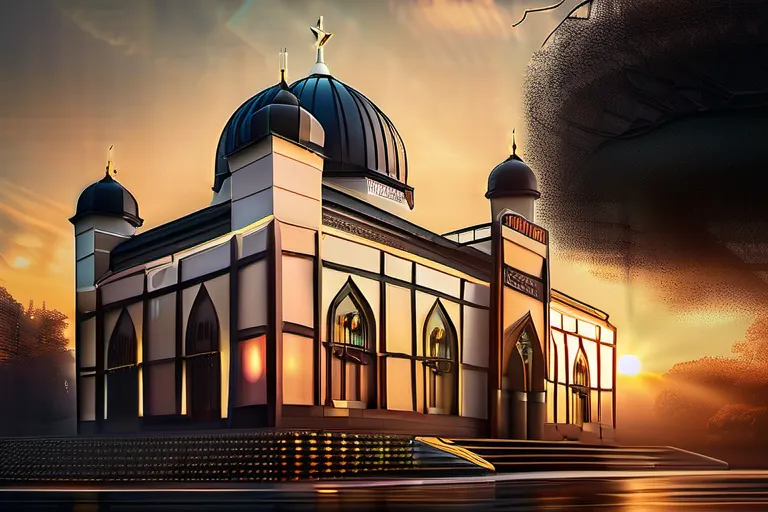
What a synagogue is: prayer, study, architecture, and community
A synagogue is a Jewish place of communal prayer, learning, and gathering. Its sanctuary usually includes a Torah ark and a place for reading the Torah, but buildings and customs vary among communities. Understanding a synagogue requires attention both to what happens there and to the particular congregation that uses it. A medieval site, a modern purpose-built sanctuary, and a rented prayer space need not look alike to serve Jewish communal life.
Synagogue, beit knesset, and shul
The Chabad Synagogue FAQ explains synagogue through the Greek equivalent of the Hebrew beit knesset, a house of assembly. The Yiddish word shul, related to “school,” also reflects the importance of learning in the building.
These names help explain why a synagogue is more than an auditorium for an occasional ceremony. Prayer, Torah study, education, and meetings can belong to the same institution. The word can also refer to the community organized around the place, not only its walls and roof.
Early evidence and the Jerusalem Temple
The synagogue and the Jerusalem Temple are historically distinct institutions. The Posen Library’s public catalogue entry for the Theodotos inscription dates it to the late first century BCE or early first century CE. Its description identifies Theodotos as a priest and founder of a synagogue in Jerusalem.
This is evidence for a synagogue while the Second Temple still stood, before its destruction in 70 CE. It does not identify a securely established date for the first synagogue anywhere. The evidence is more useful than assigning the institution one speculative founding year.
The coexistence matters: synagogues were not simply invented as buildings after the Temple disappeared. Jewish prayer, teaching, and gathering had a history alongside the Temple’s distinctive role. A synagogue’s Torah ark should likewise not be confused with the ancient Ark of the Covenant.
Reading a sanctuary’s main features
The Chabad account of synagogue architecture places the aron kodesh, the Torah ark, on the side toward which people pray. It houses Torah scrolls and helps establish the sanctuary’s orientation. The direction of prayer is associated with Jerusalem, giving the arrangement of the interior a religious reference beyond the building itself.
The bimah is the platform or reading area associated with Torah reading and, in some layouts, leading worship. Traditional arrangements may place it centrally. Reform Judaism’s definition recognizes positions at the front or in the middle. Knowing that variation prevents one floor plan from becoming a test applied to every synagogue.
Another familiar feature is the ner tamid, the eternal light near the ark. The Reform guide to sanctuary customs explains it as a reminder of God’s enduring presence.
Torah reading and the prayer book
A Torah scroll contains the Five Books of Moses, handwritten in Hebrew on parchment. The Chabad FAQ distinguishes the scrolls stored in the ark from the siddur, the prayer book used during worship. A printed book used to follow a reading and the scroll from which it is read are related but different objects.
Public Torah reading is also one part of a service, rather than a name for everything that happens there. The Chabad description of Shabbat morning distinguishes prayers, Torah reading, a selection from the Prophets, and Musaf. It describes a particular traditional service; details differ among congregations.
The haftarah is a reading from the Prophets associated with the Torah reading. This illustrates how synagogue use of scripture extends beyond the Torah scroll itself. Participation can involve listening, following the text, prayer, and communal responses.
People, participation, and the minyan
A rabbi may teach, give sermons, and guide a community. Prayers can be led by a congregant or a designated chazzan, or cantor. A gabbai helps organize synagogue activities. These are different roles; the rabbi need not personally conduct every part of every service.
A minyan is a quorum associated with certain forms of public prayer. Reform Judaism’s glossary defines it as ten people, while the Chabad FAQ gives the Orthodox rule of ten adult Jewish men. The people counted and the practices requiring a quorum need to be understood in the relevant community.
Seating arrangements also differ. Chabad describes separate men’s and women’s sections, sometimes divided by a mechitzah. That account reflects its Orthodox setting. It should not be assumed to describe every Jewish congregation, just as one congregation’s custom about head coverings does not establish a universal rule for every visitor.
A historical example: the ShUM sites
UNESCO’s description of the ShUM Sites of Speyer, Worms and Mainz connects synagogues with wider medieval Jewish communal infrastructure. The property includes prayer buildings, study-related remains, ritual baths, community spaces, and cemeteries. Its account emphasizes the development of these communities between the eleventh and fourteenth centuries.
UNESCO specifically identifies the Worms synagogue compound as including a postwar reconstruction of the medieval synagogue and women’s shul. This is an important distinction between a site’s medieval history and the age of every part of the structure visible today.
The example shows why a synagogue’s history should be told through particular evidence. Construction, destruction, reconstruction, and continued use can belong to the same site’s story. Calling a building “historic” need not mean that all of its fabric has survived unchanged.
Community life and the variety of buildings
Synagogues can host classes, children’s education, life-cycle celebrations, and gatherings as well as services. The combination depends on the congregation’s facilities and activities. The Chabad FAQ, for example, describes study and educational programs alongside prayer.
A building’s scale or decoration alone does not establish how active its community is. Equally, one congregation’s use of a particular technology does not make that technology standard across Jewish worship. The useful questions concern what the space is used for and which community’s practices explain it.
For a visitor, the congregation’s own description is therefore an important companion to general architectural knowledge. A large historic sanctuary and a small contemporary prayer room can share core functions while expressing very different local histories.
Visiting a synagogue
Check the congregation’s published visitor information or contact it ahead of a visit. Confirm the service or opening time and ask about access arrangements and local customs. Head coverings, clothing, photography, and the use of phones should be understood through those instructions.
The Reform sanctuary guide notes that service leaders commonly indicate pages and when to stand or sit, and that a congregation’s etiquette can be learned by observing and asking. Being unfamiliar with the service does not require pretending to understand every detail. Follow guidance and avoid interrupting prayer or reading.
Conclusion
 A synagogue brings together Jewish prayer, learning, and community life. Its ark, reading area, books, and patterns of participation make most sense when understood through the congregation that uses them. Historical evidence also matters: early inscriptions, medieval sites, and reconstructed buildings tell different parts of the story. Learning the shared functions while respecting local variation gives a clearer understanding than treating every synagogue as one identical kind of building.
Published by Ralf. About our editorial process.




1 thought on “What Is a Synagogue? Prayer, Study, Architecture, and Community”