

For a first book about Buddhism, start by deciding what you want to do: understand the tradition, read a Buddhist text, or explore a teacher’s account of practice. Our shortlist pairs Damien Keown’s Buddhism: A Very Short Introduction with Juan Mascaró’s translation of The Dhammapada and Thich Nhat Hanh’s The Heart of Buddha’s Teaching. They are three different kinds of reading, rather than interchangeable introductions.
This guide accompanies our Buddhism reading path. The recommendations concern specific English-language editions offered through Amazon UK. They do not rank Buddhist schools or suggest that buying a particular book makes someone a Buddhist.
Affiliate disclosure: As an Amazon Associate I earn from qualifying purchases. The book cards contain affiliate links to Amazon.co.uk. Publisher and institutional links are not affiliate links. Check the selected format, seller, condition, delivery and total cost before ordering.
How we selected them: We checked publisher information, edition identifiers and Amazon UK catalogue data afresh. Our recommendations are editorial judgements about reading purposes. We have not physically tested these books or compared every passage of their translations. Checked on 8 November 2026.
Buddhism books for beginners: choose a reading purpose
| Book | Why shortlist it? | Main limitation | ISBN-13 |
|---|---|---|---|
| Damien Keown: Buddhism: A Very Short Introduction, second edition | Build a first map of Buddhist ideas and religious life. | A short survey cannot explain every school in depth. | 9780199663835 |
| The Dhammapada, translated by Juan Mascaró | Encounter a Buddhist literary text rather than another overview. | A verse collection needs context and is not the whole Buddhist canon. | 9780140442847 |
| Thich Nhat Hanh: The Heart of Buddha’s Teaching, Rider paperback | Explore foundational teachings through a named teacher’s approach. | One teacher’s presentation is not the voice of every Buddhist community. | 9780712670036 |
On smaller screens, scroll the table sideways. You do not need all three books. A useful first choice answers a question you already have, or helps you formulate the next one.
Damien Keown: begin with an overview
Oxford University Press describes Keown’s second edition as an introduction to Buddhist teachings and their place in daily life. Its publisher record identifies print ISBN 9780199663835. This is the second edition of Buddhism: A Very Short Introduction, not Keown’s separate book about Buddhist ethics.
Our recommendation: Start here if you are still trying to connect basic ideas, historical development and practice. As you read, make a short list of questions rather than a long list of isolated definitions. For example, ask how an explanation of suffering relates to what a practitioner does, and whether a passage describes one tradition or makes a broader comparison.
The trade-off: Brevity helps orientation but leaves less room for detailed disagreements. When a subject interests you, use the bibliography or a more focused resource to continue. A survey is also not a substitute for instruction in a particular meditation method.
Edition check: Match the author, second-edition statement and ISBN. Retailer metadata sometimes formats edition numbers oddly; the publisher’s edition record is a better reference than an isolated catalogue label.
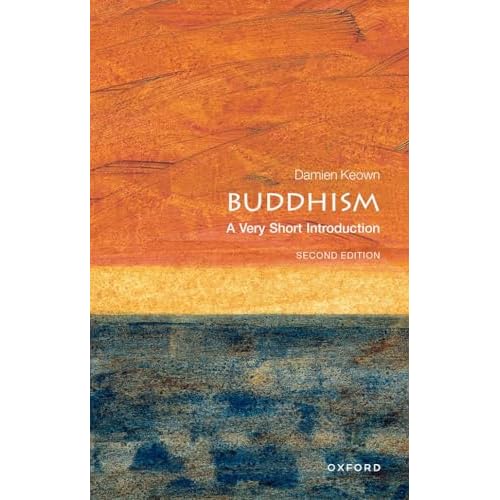
Buddhism: A Very Short Introduction 2/e
The Dhammapada: move from a survey to a text
Penguin identifies this English Dhammapada as Juan Mascaró’s translation, ISBN 9780140442847. It is a short collection of verses associated with Buddhist moral teaching. The translator’s name matters: books called The Dhammapada can differ in wording, introductory material and notes.
Our recommendation: Consider it after an overview if you want to encounter a text that people read and interpret within Buddhist traditions. Try a small group of verses and write down what is actually said before looking for a general lesson. Ask what background you would need to explain an unfamiliar image or term.
The trade-off: A short text can be demanding. A memorable line does not carry its entire historical and religious context with it. Nor does reading this collection give you a complete account of all Buddhist scriptures. Our introduction to different Buddhist traditions can help you frame further questions.
Edition check: The card below is for Mascaró’s Penguin translation. It is not the German translation discussed in our German-language guide, and it is not a claim that one rendering settles every question about the original.

The Dhammapada (Penguin Classics)
Thich Nhat Hanh: teachings in a practice-oriented presentation
Penguin’s Rider catalogue entry identifies this paperback by ISBN 9780712670036. It presents the Four Noble Truths, the Noble Eightfold Path and other foundational teachings. The Plum Village biography locates Thich Nhat Hanh in Vietnamese Zen and engaged Buddhist practice.
Our recommendation: Shortlist this book if your next question is how a teacher connects ideas with ways of living and practising. Read with attention to the author’s religious vocabulary, rather than assuming every familiar word has its everyday English meaning. Note where a teaching, an example and an invitation to practise serve different purposes.
The trade-off: A teacher’s voice can make a subject approachable, but it is still a particular perspective. Read it alongside, rather than as a replacement for, an understanding of Buddhist diversity. A book cannot provide the personal feedback available in an appropriate learning setting.
Edition check: This is the Rider English paperback. Retailers also list other bindings and editions. Check the ISBN rather than relying on a similar cover, and inspect a sample before deciding whether the presentation suits you.

The Heart Of Buddha's Teaching
A practical first-reading plan
Choose one question for your next reading session. If you cannot yet formulate one, begin with a survey. If you already have a question about a verse or a named teaching, a text or a teacher’s explanation may be more useful. There is no requirement to complete a reading ladder before opening a source.
- Read a manageable section. Aim to follow an argument or a sequence of verses, not to finish a certain number of pages.
- Identify the kind of writing. Is this an overview, a translated text, a note or a teacher’s interpretation?
- Record one uncertainty. A question you can investigate is more useful than a quotation you cannot explain.
- Compare responsibly. Use another source to illuminate the question, while keeping track of which tradition or author it represents.
- Decide what you need next. That might be another chapter, a library loan, a glossary or a conversation, rather than another purchase.
Before you buy
Inspect the available publisher information and try a library copy where possible. Check whether you want print, an ebook or audio: a good layout for notes and a convenient listening format solve different problems. We have not measured the paper, binding or type size of the copies offered by individual sellers.
Older publication dates do not automatically make a foundational book unsuitable, but contemporary developments need contemporary sources. Used listings can also refer to a different edition. This guide makes no fixed price, stock or translation-accuracy promise.
Questions beginners ask
Should I start with a Buddhist scripture?
You can, but an overview may make the questions easier to recognise. A translated text and a survey are complementary kinds of reading, not competing substitutes.
Does one of these books represent all Buddhism?
No single selection can do that. Notice which author, text and teaching tradition you are reading, and avoid treating one explanation as a universal description.
Do I need to buy all three?
No. Start with a sample or a library copy and choose for your next learning task. Our guide to why Buddhists meditate offers another way to explore practice before choosing further reading.
Researched and checked on 8 November 2026. Sources are linked beside the relevant edition facts; Amazon UK product identifiers were checked through the product API. The header shows a lotus, not the covers of the recommended books. See our editorial approach and AI transparency.
Continue: Buddhism for beginners · Choose another reading path
Published by ki-lian. About our editorial process.



