
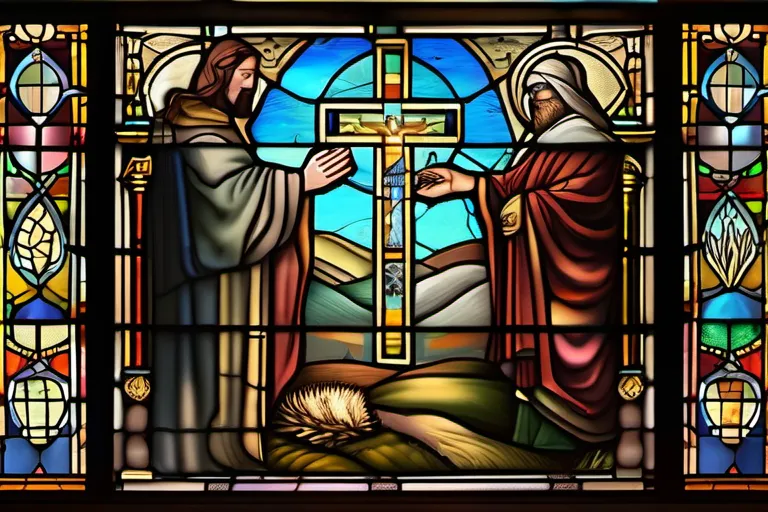
Christians read the Old Testament as part of the scriptural story through which they understand Jesus. Its covenants, narratives, royal hopes and prophetic images provide language that the New Testament uses to explain his identity, ministry, death and resurrection.
These connections take different forms. Some concern promises, others recurring patterns, and others a New Testament writer’s interpretation of an earlier passage. Reading the paired texts makes the reasoning visible while preserving the earlier passage’s own setting.
The New Testament’s Starting Point
In Luke 24:13–35, the risen Jesus accompanies two disciples on the road to Emmaus and interprets Moses and the prophets in relation to himself. The scene presents a Christian understanding of the Scriptures after the resurrection.
This gives the question a definite framework. Christians examine Israel’s scriptures in light of the person they confess as Messiah. The New Testament itself supplies examples of that reading.
One important term is typology: an earlier person, event or institution is understood as a pattern anticipating a later fulfillment. The Catholic Catechism, paragraphs 128–130, explains this approach while affirming the Old Testament’s intrinsic value.
A direct prediction and a typological connection therefore need different explanations. Ask what the earlier passage says, what the later text does with it and what kind of relationship is being proposed.
Abraham: Blessing Extending to the Nations
Genesis 12:1–3 describes God’s call to Abram and promises involving land, a people, blessing and the families of the earth. The passage begins a story about Abraham and his descendants while giving that story a wider horizon.
Paul makes an explicit Christian connection in Galatians 3:6–14. He reads the promise of blessing for the nations in relationship to God’s acceptance of Gentiles through faith and to the blessing coming through Christ.
The connection is theological: Paul explains how non-Jewish believers participate in the blessing associated with Abraham. Understanding his argument requires reading the Genesis promise alongside the letter’s discussion of faith, Christ and the Spirit.
For a practical reading exercise, list what Genesis promises and then identify how Paul uses that promise. This keeps the earlier narrative and the later interpretation distinct enough to understand their relationship.
Moses, Exodus and the Passover Pattern
The Exodus narrative gives Christian interpretation a major language of deliverance. Exodus 12 describes Passover, judgment in Egypt and the departure of the Israelites. It also establishes remembrance of the event through an observance handed on across generations.
In 1 Corinthians 5:7–8, Paul identifies Christ with Passover and uses the removal of leaven as an image for the community’s conduct. He connects the festival’s imagery with Christ and with the ethical life of believers.
This is a concrete example of typological reading. The earlier event has its own participants, setting and meaning, while Paul uses its pattern to explain a Christian claim. The relationship involves interpretation rather than a claim that Exodus names Jesus directly.
Moses’ place in the story concerns the people’s deliverance and instruction. Following that narrative helps a reader understand why later Christian authors draw on its language when discussing liberation, covenant and life with God.
Where John the Baptist Belongs
John the Baptist stands at the New Testament end of this account of preparation. Mark 1 presents his role through prophetic language, including the voice in the wilderness associated with Isaiah 40.
He is a New Testament figure whose activity is interpreted through earlier scripture. His example shows how an Old Testament passage can shape the presentation of a later person.
David’s House and the Hope of a King
2 Samuel 7:12–16 concerns David’s offspring, the building of a house for God’s name and the enduring establishment of David’s dynasty. Its immediate setting is a promise about the royal house and its successor.
The wider dynastic promise provides language for later hope. In Luke 1:30–33, the announcement to Mary identifies Jesus with David’s throne and a kingdom without end. Luke presents Jesus’ kingship within that scriptural horizon.
The connection becomes clearer when its parts are stated: the earlier passage concerns David’s house; the later narrative claims that Jesus receives Davidic kingship. Interpreting the relationship requires attention to the whole promise rather than selecting a royal phrase alone.
Royal Hope in Christian Worship
Isaiah 9 also supplies language of light, a child, Davidic rule, justice and peace. A concrete Christian use appears in the USCCB’s published Christmas Mass during the Night readings, which pair a passage from Isaiah 9 with Luke’s account of Jesus’ birth.
The arrangement shows interpretation through worship: the readings are heard together within a celebration of Christ’s Nativity. The earlier royal imagery contributes to the meaning Christians give the later Gospel narrative.
Studying the pairing involves reading both passages and asking which images the liturgical setting brings into relation. This is an identifiable example of how the Old Testament continues to shape Christian religious life.
The Suffering Servant and the Passion
Isaiah 53 describes a servant’s rejection, suffering, relationship to the wrongdoing of others and eventual vindication. The passage’s images are central to Christian interpretation of Jesus’ suffering.
The New Testament gives an explicit example in Acts 8:26–35. Philip encounters an Ethiopian official reading the passage about a sheep led to slaughter. The reader asks whom the prophet is describing, and Philip begins from that scripture to proclaim Jesus.
The scene is valuable because it shows the interpretive act. A passage is read, a question about its referent is raised and a Christian explanation is offered. The identification of the servant with Jesus is part of that explanation.
To study the connection, compare the servant’s suffering and vindication with the New Testament account under discussion. Keep each text’s actual details in view. A proposed parallel should be explained through what the passages say.
The theological significance for Christians concerns how Jesus’ death is understood in relationship to others’ salvation. Explaining that significance requires more than matching isolated images: it involves the larger account of Christ’s identity, suffering and resurrection.
Jeremiah’s New Covenant and the Letter to the Hebrews
Jeremiah 31:31–34 announces a new covenant with the house of Israel and the house of Judah. It speaks of God’s law written inwardly, knowledge of God and forgiveness.
The named people and the covenantal setting are important parts of the passage. The promise concerns a renewed relationship with God, described through instruction, belonging and mercy.
Hebrews 8:6–13 quotes this promise within its argument about Christ’s ministry and mediation. The author interprets Jeremiah through the claim that Christ establishes the promised covenantal relationship.
The pair therefore illustrates another form of preparation: an earlier promise supplies the language through which a New Testament writer explains Christ’s work. Read the quotation within Hebrews’ surrounding argument as well as in Jeremiah.
Ezekiel: Cleansing, a New Heart and the Spirit
Ezekiel 36:25–28 describes cleansing, a new heart, the gift of God’s Spirit and a restored people living in the land given to their ancestors. The renewed heart is connected with living according to God’s instruction.
Christian reflection on new life draws these themes into relationship with the New Testament. Compare the passage with John 3, where Jesus’ conversation with Nicodemus concerns birth through water and Spirit.
The comparison concerns cleansing, divine initiative and transformed life. Explaining those themes together gives more substance to the relationship than treating the promise as a general message about personal improvement.
Ezekiel’s account of restoration remains part of the earlier text’s meaning. A Christian reading should be able to explain that setting while showing how the themes inform its understanding of Christ and the Spirit.
Reading the Whole Relationship Carefully
Matthew 5:17–20 presents Jesus’ relationship to the Law and Prophets through fulfillment. Its place in the Sermon on the Mount invites attention to teaching and conduct as well as to claims about his identity.
The Catholic Catechism’s account of typology also says that earlier figures and events retain their own value. This is an important discipline for reading: Abraham, Exodus and Israel’s prophetic hopes have meanings in their own narratives.
Jewish interpretations continue to read these scriptures within Jewish religious life. For that distinct setting and its relationship with Christian belief, see Jesus and Judaism.
A useful method for studying a proposed connection is:
- Read the earlier passage completely. Identify its people, setting, promise or action.
- Read the later passage. Note whether it quotes, alludes to or develops the earlier material.
- Name the connection. Distinguish promise, typological pattern, theme and explicit interpretation.
- Explain the Christian claim. State what the connection contributes to understanding Jesus.
- Preserve the earlier context. Show how the original narrative remains intelligible.
Conclusion
In Christianity, the Old Testament prepares the way for Jesus through promises and patterns that the New Testament receives and interprets. Abraham’s blessing, Passover, Davidic kingship, the suffering servant and hopes of covenantal renewal all contribute to the language of Christian faith.
The most fruitful study follows a particular connection from one complete passage to another. Explain what the earlier text says and how a New Testament writer relates it to Christ. This reveals the depth of the Christian reading while preserving the history, people and religious meaning of the scriptures it receives.
Published by Ralf. About our editorial process.




1 thought on “How Christians Read the Old Testament in Relation to Jesus”