

The Night Journey and Ascension, usually called al-Isra and al-Mi‘raj, are central events in Muslim accounts of Muhammad’s prophetic life. Isra refers to the night journey from the Sacred Mosque in Mecca to the Farthest Mosque, traditionally identified with Jerusalem. Mi‘raj refers to the heavenly ascent. The Qur’an gives a brief scriptural foundation, while hadith collections supply many of the narrative details associated with the journey and the five daily prayers.
Isra and Mi‘raj: connected, but distinct
Qur’an 17:1 praises God for carrying his servant by night between the two sanctuaries to show him divine signs. The verse identifies God as the agent of the journey and Muhammad as God’s servant. It does not portray Muhammad as becoming divine.
The two familiar terms distinguish stages in the traditional account. Isra concerns the journey to the sacred site associated with Jerusalem; Mi‘raj concerns the ascent beyond the earthly destination. Using both terms helps prevent the whole story from being reduced either to ordinary travel or to one undifferentiated journey through the sky.
The verse itself is concise. It does not provide a complete itinerary, a list of encounters in every heaven, or a description of every later artistic image. Those details need to be traced to the particular reports and interpretations that contain them.
Where it belongs in Muhammad’s life
Islamic accounts generally place the event before the Hijra, the migration from Mecca to Medina in 622. Egypt’s Dar al-Ifta’s overview places it around a year before that migration, in the setting of opposition, loss, and difficulty during the Meccan period.
This setting gives the event a religious significance of reassurance and honor within the prophetic mission. It should not be confused with the migration itself, or with the beginning of revelation at Hira. Muhammad is already a prophet in the account.
Many Muslims commemorate the journey on 27 Rajab. Dar al-Ifta’s discussion of its date acknowledges differing scholarly opinions while defending that established commemorative date. A widely observed anniversary and an uncontested historical date are therefore different kinds of claim.
The journey to Jerusalem in a hadith account
In Sahih Muslim 162a, Muhammad is brought Buraq, described as a white animal larger than a donkey and smaller than a mule. He travels to Bayt al-Maqdis, tethers the animal, and prays there. The report then describes Gabriel presenting milk and wine, with Muhammad choosing milk.
These are features of a particular transmitted account. Buraq belongs to the miraculous narrative, rather than to an ordinary description of a journey by horse. Later artistic conventions may add visual features that are not specified by this report.
The account connects the sanctuary with the wider history of prophecy. Its religious importance lies in the relationship between Muhammad’s mission, worship, and earlier prophets.
The heavenly ascent and encounters with prophets
The same report describes Gabriel accompanying Muhammad through the heavens. In its sequence, Muhammad encounters:
- Adam in the first heaven;
- Jesus and John in the second;
- Joseph in the third;
- Idris in the fourth;
- Aaron in the fifth;
- Moses in the sixth;
- Abraham in the seventh.
The prophets in this report welcome Muhammad and pray for his well-being. Their encounters present his mission in relation to a shared history of divine guidance. Moses later acts as an adviser concerning the community’s ability to fulfill the obligation of prayer.
The encounters place Muhammad among figures honored in Islamic understandings of prophetic history. The account also describes Sidrat al-Muntaha, the lote tree of the utmost boundary. These are religious descriptions of the unseen, rather than a scientific map of atmospheric layers or outer space.
Hadith collections contain versions with differing details and emphases. The sequence above follows Muslim 162a. Identifying the report avoids presenting a composite retelling as though every narration supplied exactly the same arrangement.
The prescription of the five daily prayers
The connection with prayer is especially important. Sahih al-Bukhari 349 recounts an initial command of fifty prayers, repeated advice from Moses to seek a lighter obligation for the community, and the final prescription of five daily prayers with the reward of fifty.
Within the narrative, this combines an obligation with divine generosity. The daily rhythm of prayer is connected with an exceptional encounter in the prophetic story. The emphasis is not simply on a spectacular experience, but on worship that structures ordinary Muslim life.
The report concerns a particular religious obligation. It does not mean that the entire Qur’an or every later rule of Islamic jurisprudence was delivered during that night. The prophetic mission and the interpretation of its teachings extend beyond this episode.
Was the journey bodily, and what did Muhammad see?
These are two related but separate questions. In its discussion of the miracle, Dar al-Ifta defends the majority view it identifies: a real journey involving body and soul while awake. On that understanding, the presence of spiritual meanings does not make the event merely a metaphor or an ordinary dream.
The question of seeing God has its own transmitted debate. In Sahih Muslim 177a, Aisha rejects the claim that Muhammad saw God with bodily eyesight and explains the relevant vision passages as referring to Gabriel. In Muslim 176a, a report from Ibn Abbas speaks of seeing with the heart.
These reports show why a confident description of an ordinary face-to-face visual encounter with God would be inadequate. Affirming the ascent does not automatically settle how the divine encounter is understood.
Qur’an 53:13–18 describes a further vision near Sidrat al-Muntaha and the seeing of great divine signs. Its interpretation needs to be considered alongside the reports and the theological question involved. Expansive later descriptions should not be presented as the wording of the verses themselves.
Faith, testimony, and the reception of the account
In Sahih al-Bukhari 4710, Muhammad describes opposition from Quraysh concerning the journey and an account of Jerusalem being displayed to him so that he could describe its features. The report places testimony and the response to a miraculous claim within the story.
For believers, such reports help explain the event’s religious significance. A historian can also investigate how the traditions were transmitted and interpreted. A report’s place in a trusted collection and an independently reproducible demonstration of a miracle are different kinds of evidence.
That distinction allows the event to be described respectfully and precisely. The subject is a sacred narrative with enduring importance in Muslim life, whose meaning is understood through scripture, transmitted accounts, and interpretation.
Art and literature: a concrete example
The journey also appears in poetic manuscripts and visual art. The Metropolitan Museum of Art catalogs a folio depicting Muhammad’s ascent on Buraq from a Yusuf and Zulaikha of Jami. It attributes the work to Shiraz in Iran and dates it to the second half of the sixteenth century.
This is a particular object from a particular artistic setting. It shows how the theme entered the visual and literary culture of later communities. It is not a documentary image of the event or evidence that every Muslim tradition permits or uses the same kinds of representation.
The manuscript’s date and attribution place it within a later Persianate cultural setting. The period of artistic production and the sacred event depicted are different historical contexts, both important to understanding the object.
Conclusion
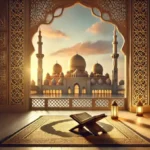 Isra and Mi‘raj connect the sacred journey to Jerusalem, the heavenly ascent, earlier prophets, and the obligation of daily prayer. Their significance becomes clearer when the Qur’an’s brief passages are distinguished from the fuller hadith narratives and later interpretations.
A careful account identifies the source of particular details, recognizes debates about the divine encounter, and places commemoration and art in their own contexts. This preserves the depth of the tradition and makes the particular language and context of its sources easier to understand.
Published by Ralf. About our editorial process.



1 thought on “The Night Journey in Islam: Isra, Mi‘raj, Prayer, and Interpretation”