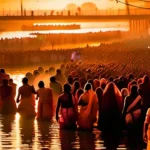
The Kumbh Mela is a major Hindu pilgrimage gathering associated with bathing in sacred rivers, religious teaching and temporary communities of pilgrims and ascetics. Its principal locations are Prayagraj, Haridwar, Ujjain and the Nashik–Trimbakeshwar area.
The festival’s significance includes several connected dimensions: sacred geography, a religious account of the nectar of immortality, auspicious timing, the practices of pilgrims and the organisation needed to sustain a large gathering. Understanding those dimensions gives a fuller picture than treating the mela only as a spectacular crowd.
What does “Kumbh Mela” mean?
Kumbh refers to a pot or pitcher, while mela means a fair or gathering. The pot is connected with amrita, the nectar of immortality, in a religious narrative about the churning of the ocean.
Haridwar’s district account relates a struggle between devas and asuras over the vessel containing the nectar. It records versions connecting the vessel or drops of nectar with the four pilgrimage places.
This is a sacred origin narrative explaining the places’ significance. It should be identified as such, rather than presented as an independently dated historical event. The pot and the nectar are also distinct: kumbh is not the word for the nectar itself.
The four locations and their rivers
The Indian government’s February 2025 overview identifies four principal locations and their river settings:
| Location | Sacred river setting |
|---|---|
| Prayagraj, also known historically as Allahabad | The meeting of the Ganga and Yamuna, associated in sacred tradition with the unseen Saraswati |
| Haridwar | The Ganga |
| Ujjain | The Shipra, also spelled Kshipra |
| Nashik–Trimbakeshwar | The Godavari |
At Prayagraj, the confluence is called the Triveni Sangam. The district’s description distinguishes the Ganga and Yamuna from the Saraswati of sacred tradition. An account of three sacred rivers should not imply that three visible channels meet there.
The geography matters to the pilgrimage. A sacred riverbank or confluence is part of what people travel to encounter; the mela is not simply the same event placed in an interchangeable exhibition ground.
Why timing is more complex than “once every twelve years”
The Kumbh gatherings are associated with a roughly twelve-year cycle at the principal sites, with observances at different places occurring in different years. The calendar takes account of the Sun, Moon and Jupiter within a religious astrological framework.
The government’s 2025 overview describes the four-location cycle and identifies particular auspicious bathing dates. A twelve-year interval at a particular site is therefore different from saying that India has only one Kumbh gathering every twelve years.
Related terminology can also vary. A Prayagraj district description distinguishes its twelve-year Maha Kumbh from a gathering at the six-year interval. Meanwhile, the Ministry of Tourism’s Magh Mela page describes the annual Magh gathering.
The annual mela and the larger periodic gatherings share a sacred setting without being identical occasions. For understanding the tradition, it helps to keep the location, the named event and its particular year together.
What the sacred bath means
Bathing, often called snan, is central to the pilgrimage. UNESCO’s description of the tradition explains that devotees connect bathing with release from sin and liberation from the cycle of birth and death.
These are religious meanings of purification. They are different from a claim about the chemical purity of the river or a guaranteed medical effect. The act is understood within a sacred setting and an account of the person’s relationship with the divine.
A dip can be brief while carrying considerable significance for a pilgrim who has travelled to the site. Its meaning does not depend only on how long the visible action lasts: the journey, chosen occasion, prayer and intention also form part of the pilgrimage context.
Ascetics, religious communities and the transmission of knowledge
The people at the mela do not all participate in the same way. UNESCO identifies ascetics, sadhus, kalpavasis and other visitors, and names ashrams and akhadas among the principal institutions sustaining the tradition.
Akhadas, also spelled akharas, are religious organisations associated here with ascetic communities. Their role cannot be reduced to providing colourful figures for photographs. They help maintain lineages of practice and learning.
UNESCO particularly emphasises teacher–student relationships in transmitting knowledge and skills, alongside oral traditions and religious and historical texts. This makes the gathering a setting for teaching and continuity as well as an occasion for individual bathing.
The range of participants also cautions against treating the whole mela as the exclusive celebration of one deity or assuming that every Hindu follows the same ascetic discipline.
Kalpavas: staying for a period of discipline
Some pilgrims remain for an extended religious observance rather than making only a short visit. A December 2024 government introduction to Kalpavas describes a retreat involving spiritual discipline and austerity in preparation for the 2025 gathering.
The February 2025 overview describes Kalpavas as a month-long period of relinquishing comforts, meditation and ritual participation. This is a different pattern from arriving for one bathing day and leaving.
The distinction helps explain the temporary camps. Some people need a place to sustain daily religious life over a period of time, while others pass through. A single image of the busiest riverbank cannot show the full range of these rhythms.
The mela also has a changing history
An origin narrative does not mean that the gathering’s organisation and social role have remained unchanged. In Pilgrimage and Power: The Kumbh Mela in Allahabad, 1765–1954, historian Kama Maclean investigates the festival’s relationship with colonial rule, Indian nationalism and changing religious and social practices.
The abstract of her chapter on 1857–1870 distinguishes the older annual Magh Mela from the development of the Kumbh designation at Allahabad. It argues that pilgrimage priests adapted the Kumbh festival tradition associated with Haridwar within a changed political setting.
This historical argument does not erase the significance of pilgrimage for participants. It shows why a sacred place’s long history, a festival’s particular name and the development of its institutions need not have one identical starting point.
A temporary city serving a pilgrimage
Harvard’s Mapping the Kumbh Mela project studied the 2013 gathering from preparation through the event. Its research brought together questions about temporary urban planning, public health and the movement of people and resources.
The project also describes work at Nashik and Trimbakeshwar in 2015, including a digital disease-surveillance programme and health screening. These are documented examples of practical services accompanying religious activity.
The temporary city requires arrangements for movement, accommodation, water and sanitation. Its eventual dismantling is part of the planning problem: infrastructure must serve an intense, limited period rather than simply expand like a permanent city.
Scale also carries risks. A January 29, 2025 report by India’s public broadcaster, citing the Kumbh police official’s press conference, reported at least thirty deaths and sixty injuries in the crowd incident at Sangam Ghat. Acknowledging this loss is necessary alongside descriptions of devotion and organisation.
Conclusion
The Kumbh Mela joins sacred rivers, a religious narrative of the nectar-bearing pitcher, auspicious occasions and the practices of diverse pilgrims and ascetic communities. Bathing is central, while teaching, extended religious discipline and temporary communal life give the gathering further depth.
Its significance is best understood through both belief and history. The rivers and rituals explain why people travel; historical research and the study of its temporary city explain how the gathering changes and is sustained. This combination gives a fuller account than either a romantic portrait of universal unity or a description concerned only with crowd size.
Published by Ralf. About our editorial process.