
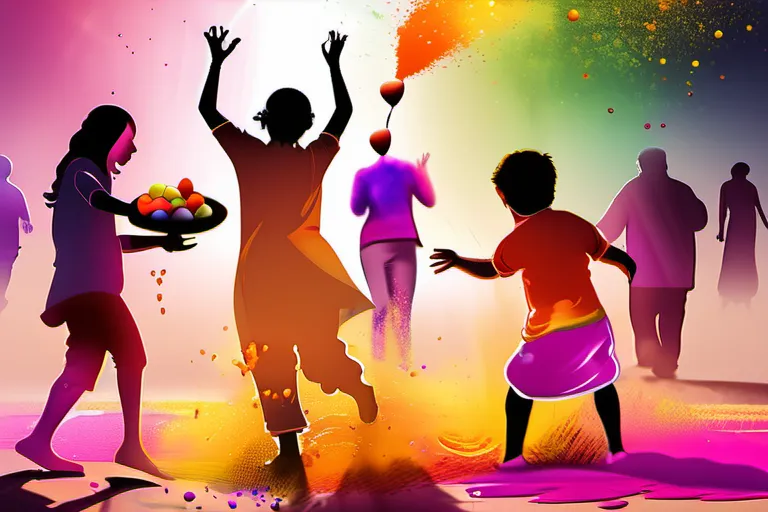
Holi combines Hindu devotional meanings with springtime celebration, colour, music, and social gathering. Its familiar public image is the exchange of coloured powder and water, but the festival also includes stories of faith, ritual observances, regional traditions, and relationships with Krishna and Radha.
There is no single programme followed by every Hindu community. A clear account distinguishes the Holika bonfire, colour play, local forms of worship, and later cultural adaptations. These differences help explain how Holi can be both a recognizable festival and a varied religious and social experience.
Spring, the Calendar, and the Festival’s Different Parts
Holi is associated with the full moon of the Hindu month of Phalguna. Its Gregorian date changes, so descriptions should distinguish its religious calendar from a fixed annual date in March.
The Delhi Tourism account of Holi distinguishes the evening observance of Holika Dahan from the following colour festivities. This is a useful starting point: the bonfire and the exchange of colours are related parts of celebration, with different actions and emphases.
Spring provides a seasonal setting for ideas of renewal, joy, and the return of social activity. That setting can coexist with different devotional stories. A seasonal festival need not have only one narrative explanation to be meaningful to those taking part.
Prahlada, Holika, and Devotion to Vishnu
A widely told festival story concerns Prahlada, who remains devoted to Vishnu despite the demands of his father, Hiranyakashipu. In the Holika narrative retold by Delhi Tourism, his aunt Holika enters a fire with him; he survives through divine protection while she perishes.
The story gives the bonfire a religious interpretation involving devotion and the defeat of destructive power. Prahlada’s loyalty is directed toward Vishnu rather than the authority his father demands. The contrast concerns how power is used and where the devotee places trust.
A related scriptural account appears in the Bhagavata Purana, 7.5.43–44, which lists attempts on Prahlada’s life, including exposure to fire. The passage should be distinguished from the specific Holika festival retelling; identifying a related episode does not establish that every later narrative detail appears in those verses.
In Bhagavata Purana 7.5.23–24, Prahlada describes forms of devotion including hearing, chanting, remembrance, worship, prayer, and service. This places his significance within a positive account of religious life, beyond simply surviving an ordeal.
These texts and retellings explain why Holi is associated with devotion and the victory of good over evil. They are religious narratives and interpretations, rather than a dated historical record proving the first occasion on which people celebrated the festival.
What Holika Dahan Expresses
Holika Dahan gives the story a communal ritual form through the bonfire. People gather for an observance associated with the defeat of Holika and the protection of Prahlada.
The meaning is richer than fire as a spectacle. The remembered story invites reflection on pride, hostility, faith, and the misuse of power. Participants can understand the observance through those themes while following the customs of their family or local community.
Descriptions of renewal also need a practical dimension. Reflecting on destructive behaviour can include acknowledging a wrong or changing how one treats another person. A ritual’s moral themes gain substance through the conduct accompanying it.
Krishna, Radha, and the Traditions of Braj
In Braj, the region associated with Krishna and Radha, Holi also carries a strong devotional connection with their relationship. Colour play, songs, and particular local celebrations belong to a sacred landscape of towns and temples.
India’s official Rangotsav presentation identifies several forms, including Lathmar Holi at Barsana and Nandgaon and Phoolon Ki Holi at Vrindavan. Its examples show that local celebration can involve different materials, settings, and inherited performances.
Phoolon Ki Holi centres on the showering of flower petals. The named celebrations draw attention to particular towns, temples, and communities that preserve and perform them. Their local settings contribute to their identity.
The devotional connection also gives play a religious context. Within these traditions, joy can become a way of remembering divine relationships and participating in a community’s worship. The association with Krishna and Radha adds another dimension alongside the Prahlada narrative.
Colours, Hospitality, and Social Relationships
The exchange of colours creates an unusually visible form of shared celebration. People mark one another with powder or coloured water, greet friends, and gather with family or neighbours. These actions can express affection, welcome, or a wish for renewed relationships.
It is more accurate to explain these possibilities than to assign every colour one compulsory religious meaning. An individual’s intention, local tradition, and the setting of the celebration contribute to what the act means.
Hospitality also matters. Delhi Tourism names gujiya, mathri, and dahi bhalle among festive foods. Sharing food extends celebration beyond the moments of colour play and gives households another way to welcome others.
The social ideal is an invitation to goodwill. It does not establish that caste, class, or other inequalities disappear wherever Holi is celebrated. An inclusive celebration requires actual choices about who is welcomed and how participants are treated.
Respect also gives participation its social meaning. Asking before applying colour and accepting another person’s decision to take part differently are practical expressions of goodwill. Shared joy depends on relationships, not simply on everyone performing the same action.
Bengal’s Dol and Basanta Utsav
The West Bengal Tourism account of Basanta Utsav places Dol or Holi within a distinctive Bengali cultural setting. It describes Shantiniketan’s celebration through student participation, music, recitation, dance, and abir, or coloured powder.
This provides a concrete example of a festival expressed through an educational and artistic environment. Music and performance contribute to its identity alongside colour. It is not simply the same street celebration moved to another location.
The example also cautions against treating one list of songs or dances as the repertoire of Holi everywhere. A tradition’s name, language, setting, and participants matter when explaining how it is transmitted.
Phagwah in Guyana
Holi also forms part of Hindu life beyond India. Guyana’s Department of Public Information, in its account of Phagwah celebrations, describes colour, music, family gatherings, and participation by people from different religious and racial backgrounds.
The report includes a gathering at the Georgetown Cricket Club Ground and participants reflecting on the festival’s meaning. It is a documented example of religious celebration also functioning as a wider public occasion.
This broader participation does not remove the festival’s Hindu origins or require every participant to share one theological interpretation. A cultural gathering can bring together people with different relationships to the same tradition. The particular Guyanese setting deserves recognition in its own right.
Holi in Art and Cultural Memory
A historical example appears in the Metropolitan Museum of Art’s Krishna and Radha Celebrating Holi, catalogued as a late nineteenth-century Jaipur painting in colours and gold on paper.
The work connects Holi’s cultural history with the representation of Krishna and Radha. Its title, setting within the collection, and material form provide a specific example of the festival becoming a subject for visual art.
An object of this kind answers a different question from a scriptural passage or a present-day festival programme. It shows one historical form of artistic reception. Together, these sources reveal a tradition communicated through narrative, ritual, performance, and images.
Understanding Contemporary Celebrations
Contemporary Holi can take place in temples, households, neighbourhoods, educational institutions, and organized public events. The regional examples above show why the balance of worship, performance, hospitality, and colour varies.
Calling an event a colour festival is therefore only a starting point. Its connection with Holi becomes clearer when the organizer explains the tradition being followed, the stories remembered, and the place of prayer or cultural performance.
Religious and cultural meanings can overlap without becoming identical. Someone attending a devotional observance, a family gathering, or a public Phagwah celebration may encounter different aspects of Holi. Describing those settings preserves the festival’s depth while acknowledging its continuing adaptation.
Conclusion
Holi’s significance includes spring renewal, devotion, the defeat of destructive power, and the possibility of joyful relationships. Prahlada’s loyalty to Vishnu, traditions associated with Krishna and Radha, and distinctive regional celebrations give those themes concrete forms.
Understanding the festival means looking beyond colour alone while retaining the importance of shared enjoyment. Bonfires, worship, songs, art, hospitality, and respectful participation all contribute to its life. Their meaning becomes clearest when particular traditions are named and the ideal of goodwill is connected with how people actually treat one another.
Published by Ralf. About our editorial process.



