
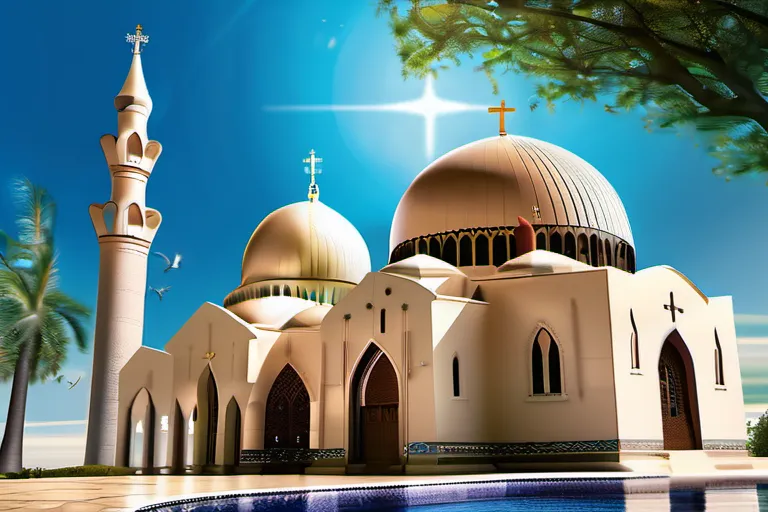
Christianity and Islam both teach belief in one creator, moral responsibility, prayer and a final judgment. Their deepest differences concern who Jesus is, how God is revealed and how salvation is understood. Most Christian churches confess Jesus as God incarnate, crucified and risen. Islam honours Jesus as the Messiah and a messenger of God while rejecting his divinity and the Trinity.
A useful comparison must hold shared commitments and real disagreements together. It must also distinguish the teachings of a tradition from the choices of every individual believer. Catholic, Orthodox and Protestant Christians do not agree on everything; neither do Sunni and Shi‘i Muslims.
Historical origins: the Jesus movement and Muhammad’s community
Christianity emerged in the first century CE among Jewish followers of Jesus in the eastern Roman world. Jesus and his earliest disciples belonged to a Jewish religious setting. The movement subsequently spread among non-Jewish communities, and its relationship with Judaism changed over time. Calling Christianity simply a European religion obscures these origins. Harvard’s Pluralism Project chronology places Paul’s letters to Mediterranean churches among the earliest Christian writings.
Islam’s formative community developed in seventh-century Arabia. According to Islamic belief, Muhammad received revelations from God through the angel Gabriel. His migration from Mecca to Medina in 622, the Hijra, became a defining event in Muslim communal history. Muhammad died in 632. The Pluralism Project’s account of Muhammad distinguishes the Meccan beginnings from the establishment of the Medinan community.
These historical dates do not exhaust either religion’s understanding of itself. Christians understand Christ through claims about God’s eternal Word; Muslims understand submission to God as the faith of earlier prophets, including Abraham. The emergence of identifiable historical communities and believers’ claims about eternal truth answer different questions.
One God: Trinity and tawhid
Christian Trinitarian teaching is belief in one God as Father, Son and Holy Spirit. It does not mean three independent gods. The Nicene Creed, widely shared across Christian churches, identifies Jesus with the divine life rather than treating him merely as a later messenger. Christian language about the Son concerns his relationship with the Father, not a physical act of reproduction.
Islamic tawhid affirms God’s unique oneness and rejects partners or equals to God. Qur’an 112 presents God as incomparable, neither begetting nor begotten. Qur’an 4:171 explicitly rejects speaking of God as three while honouring Jesus as a messenger. Consequently, Christians and Muslims can both affirm monotheism while disagreeing substantially about what divine oneness permits.
Recognising common reference does not erase those differences. In Nostra aetate, section 3, the Catholic Church describes Muslims as worshipping the one creator and immediately acknowledges their different understanding of Jesus. This is a stated Catholic position, rather than a declaration that every Christian and Muslim theologian explains the relationship identically.
Jesus: shared reverence, different identities
In mainstream Christian confession, Jesus is both truly divine and truly human. His life, death and resurrection are central to God’s saving action. 1 Corinthians 15:3–8 preserves an early Christian proclamation of Christ’s death for sins, burial, resurrection and appearances. Christianity therefore gives Jesus a role that extends beyond delivering moral instruction.
The Qur’an gives Jesus, or ‘Isa, an honoured place. Qur’an 3:45 calls him Messiah and son of Mary. Verse 3:47 describes Mary conceiving without a man having touched her. Verse 3:49 attributes healing and other extraordinary signs to Jesus, repeatedly making them dependent on God’s permission. These passages give him exceptional standing without identifying him as God incarnate.
The cross marks another major disagreement. Qur’an 4:157–158 denies that Jesus’ opponents killed or crucified him and says God raised him. The conventional Muslim understanding differs from the Christian confession of a saving crucifixion followed by resurrection. The Qur’anic wording does not itself supply a named substitute, so that detail should not be presented as though the verses explicitly identify one.
Scripture and revelation: Bible, Qur’an and tradition
The Christian Bible is a collection of writings: law, poetry, prophecy, Gospels, letters and other forms. Its Old and New Testaments connect the history of Israel with Christian testimony concerning Jesus. Christian traditions also differ over their Old Testament canons, as the American Bible Society’s comparison illustrates.
Muslims understand the Qur’an as God’s revelation to Muhammad, preserved and recited in Arabic. It has 114 surahs. Qur’an 2:97 names Gabriel as bringing revelation to the Prophet’s heart by God’s permission. The Pluralism Project’s account of recitation explains why hearing, memorising and accurately reciting the text matter alongside reading it.
Neither scripture fits a simple contrast between stories and rules. Biblical books contain commandments, while the Qur’an includes narratives, prayer and exhortation. Nor does Islamic recognition of earlier revelation make Christian and Muslim readings interchangeable: Qur’an 5:48 describes the Qur’an as confirming earlier scripture while also functioning as a criterion over it.
Salvation, good works and the afterlife
Christian teaching connects salvation with God’s grace and Christ. Ephesians 2:8–10 describes salvation through faith as God’s gift, then immediately speaks of a life of good works. The passage makes it misleading to portray Christian faith as permission to disregard conduct. Christian churches differ in how they explain justification, sacraments and the believer’s cooperation with grace.
It is equally misleading to reduce Islam to earning paradise through a numerical total of deeds. In Sahih al-Bukhari 6463, a major Sunni hadith collection, Muhammad says that deeds alone will not save a person: God’s mercy is necessary. The report nevertheless urges sincere and regular good action. This is a concrete example of mercy and responsibility appearing together in Muslim teaching.
Both religions contain teachings about resurrection, judgment, reward and punishment. The Nicene Creed anticipates resurrection and the coming world; Qur’anic descriptions include judgment and the hereafter. The claim that Islam has no teaching of everlasting punishment is contradicted, for example, by the language concerning hell in Qur’an 4:168–169. A careful comparison should identify particular texts and interpretations instead of assigning one simple destiny to everyone outside a religious label.
Prayer, communal worship and festivals
The Five Pillars, especially associated with Sunni formulations, are the testimony of faith, ritual prayer, prescribed almsgiving, Ramadan fasting and pilgrimage to Mecca. These practices are also important beyond Sunni Islam, although Shi‘i traditions organise religious obligations differently. Ritual prayer is performed five times daily; the special Friday gathering includes communal prayer and a sermon. It does not mean Muslims pray only on Fridays.
Christian worship commonly includes scripture, preaching, prayer and singing. Baptism and the Eucharist or Communion have major roles, though churches differ about their meaning and celebration. The Church of England’s explanation of the Eucharist, for example, connects thanksgiving and remembrance with communion in Christ. Describing every Christian understanding as merely symbolic conceals significant disagreement.
Christmas commemorates Jesus’ birth; Easter celebrates his resurrection. For Muslims, Eid al-Fitr marks Ramadan’s conclusion, while Eid al-Adha accompanies the pilgrimage season and recalls Abraham’s obedience to God. These festivals have distinct meanings, even when meals, generosity and family gatherings appear in both traditions.
Authority, culture and living alongside one another
Comparisons need to name the community being described. The pope’s role concerns Catholic Christianity; it cannot explain every Orthodox or Protestant church. Similarly, Sunni and Shi‘i understandings of authority developed around different accounts of leadership after Muhammad. Disagreement within a religion is part of its history and present life.
Culture also resists a single formula. The Metropolitan Museum’s study of figural representation distinguishes restrictions associated with religious settings from extensive human and animal imagery in other Islamic artistic contexts. Calligraphy and geometry are important, but they are not the entire artistic tradition.
Religious disagreement alone cannot explain every conflict between Christian and Muslim populations. Nor does shared belief in a creator guarantee peaceful relations. Nostra aetate offers one documented approach to dialogue: acknowledging disagreement while encouraging mutual understanding, justice, peace and freedom. Its value as an example lies in the specific commitments it states.
Conclusion
The main difference between Christianity and Islam centres on Jesus and revelation: Christians confess the incarnate, crucified and risen Christ; Muslims honour Jesus as Messiah and messenger while receiving the Qur’an as divine revelation to Muhammad. Their understandings of God, salvation and worship follow from these commitments.
Shared belief in a creator, judgment, prayer and moral responsibility provides substantial common ground. Understanding the relationship requires both recognition of that common ground and attention to genuine doctrinal differences, named sources and the diversity of actual communities.
Published by Ralf. About our editorial process.



