
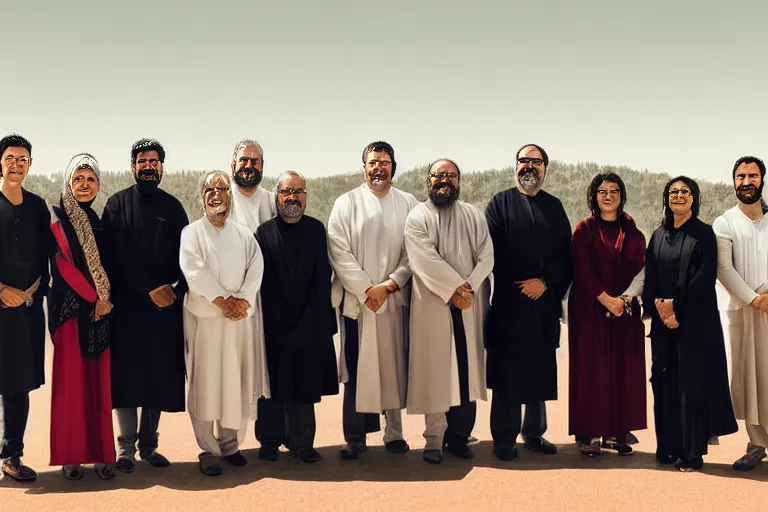
A person can feel connected to, learn from, and participate in more than one religious tradition. Whether that amounts to belonging to more than one religion depends on what belonging means and on the communities involved. Personal identification, cultural inheritance, participation, and recognized religious status are related but distinct.

There is therefore no single institutional answer applying to every combination of traditions. A person’s description of their experience matters, and so do the meanings and commitments of the communities they name. Understanding both is more useful than assuming either that all combinations are accepted or that every cross-tradition connection is impossible.
What kind of belonging is being described?
Personal identification concerns the words someone uses to describe their religious life. They may feel that more than one tradition has shaped their convictions or sense of belonging.
Participation concerns what someone does: attending a service, studying a text, sharing a family observance, or joining a community activity. The meaning of participation depends on the setting and the practice.
Cultural inheritance concerns family history, language, festivals, and relationships. A connection can remain important even when a person’s beliefs or formal affiliation change.
Recognized status or membership concerns the criteria a community applies. These may involve a profession of belief, initiation, conversion, ancestry, or another understanding of belonging. A personal description and a community’s recognition need to be examined separately.
Research can measure connection without measuring membership
A 2024 Pew Research Center report on East Asia and Vietnam distinguishes religious identification from a personal connection to a tradition’s way of life. In Japan, 4% of adults identified Shinto as their religion, while 27% said they felt a personal connection to the Shinto way of life.
The researchers deliberately used questions about connection and ways of life to capture attachments that a formal identity question might miss. The report also describes affinity for traditions beyond a respondent’s own.
Those findings make the distinction visible. They should not be reported as a count of people holding formally recognized membership in two religions. Nor do results from the places surveyed establish how everyone in Asia understands religion. The wording and scope of the questions are part of the finding.
Participation does not always require conversion
The Union for Reform Judaism’s “Choosing Judaism” guide explains that its introductory courses are open to people who want to learn, without an expectation that they will convert. It also describes ways interfaith families can participate in synagogue life.
This provides a concrete example of engagement without automatically acquiring a new religious status. Attending, learning, and supporting a family member can be meaningful activities in their own right. They do not need to be described as conversion in order to matter.
The guide concerns a particular religious movement and recognizes differences among communities. Its welcome should not be turned into a claim that every synagogue has identical rules for every ritual role or that participation establishes a person’s status everywhere.
Some community definitions include exclusive allegiance
Article 1 of the Sikh Rehat Maryada, published by the Shiromani Gurdwara Parbandhak Committee, defines a Sikh through specified commitments, including belief in one Immortal Being, the ten Gurus, and the Guru Granth Sahib. The definition includes owing allegiance to no other religion.
This is a specific example of an explicit boundary in a religious code. It shows why personal openness to another tradition does not automatically establish that every community recognizes simultaneous allegiance in the same way.
Describing the rule is different from deciding the religious status of a particular person. Such a decision would require the relevant community’s understanding of the person’s commitments and circumstances. An introductory article should explain the distinction rather than assign identities to people.
Religious status may also be understood as enduring
Chabad’s “What Is a Jew?” presents an Orthodox Jewish account in which Jewish status is acquired through birth to a Jewish mother or conversion according to Jewish law. It describes that status as enduring even when a person changes belief or enters another religion.
That account illustrates why religious belonging cannot always be reduced to a person’s current statement of belief. It should also be distinguished from endorsing the compatibility of every belief a person might adopt. The persistence of a status and approval of a theological position are separate claims.
This is Chabad’s account of Jewish law, not a determination of any reader’s identity or a summary of every Jewish movement’s criteria. The example shows the importance of identifying who is applying a definition and for what purpose.
Conversion and inherited relationships are different questions
The Reform Jewish guide also explains that conversion does not require cutting ties with one’s family of origin or erasing memories. That is a useful distinction between a change in religious commitment and the continuation of family relationships.
A person can therefore describe a previous tradition as part of their history without claiming to continue every commitment associated with it. Conversely, someone may describe a continuing connection as religiously important rather than merely cultural. The description should be understood in its own terms before a label is applied.
This is particularly relevant when people use the same word for different things. “I belong” might refer to belief, a family bond, a recognized status, or regular participation. Asking which meaning is intended can clarify a discussion without dismissing the experience.
Sharing practices does not erase differences in belief
Traditions can share ethical concerns or some forms of practice while differing about authority, worship, ultimate reality, or the meaning of initiation. Appreciating a shared value does not settle those differences.
Imagine someone attending a family celebration and also taking an introductory class in another tradition. To understand the situation, it would matter what the celebration involves, what the class asks of participants, and whether the person is making any profession of commitment. This is a hypothetical illustration, not the biography of a named individual.
The point is precision. Learning, visiting, and pledging allegiance are different actions. A thoughtful description can recognize meaningful overlap while remaining honest about commitments that require further consideration.
Avoid counting every difference as another religion
A branch, school, movement, or form of practice within a religion is not automatically a separate religion. Similarly, an interfaith relationship usually concerns people from different backgrounds; it does not by itself establish that each person has multiple affiliations.
Terms such as multireligious identity are most useful when they clarify what someone means. They become less useful when they assume that every influence, ritual, or family connection must count as a separate membership. A careful account describes the actual relationship before deciding how to categorize it.
Questions that clarify a real situation
Start with the activity or commitment being considered. Is it learning, joining a community, participating in a rite, or making a declaration? Then identify the expectations attached to it and the authority able to explain them.
It is also useful to distinguish personal freedom from institutional recognition. Someone may describe their own life through several traditions while a particular community uses narrower criteria for membership. Understanding that difference makes disagreement easier to describe accurately, even when it remains unresolved.
Respect works in both directions: taking a person’s account seriously and representing traditions’ teachings honestly. Neither requires pretending that every combination has the same meaning or receives the same recognition.
Conclusion
People can have meaningful connections with more than one religious tradition, and those connections take several forms. Personal identity, participation, inherited culture, and recognized status should be distinguished. The examples show both openness to participation and specific boundaries around belonging. A useful answer therefore explains the kind of connection involved, the commitments it carries, and how the relevant communities understand it.
Published by Ralf. About our editorial process.



