
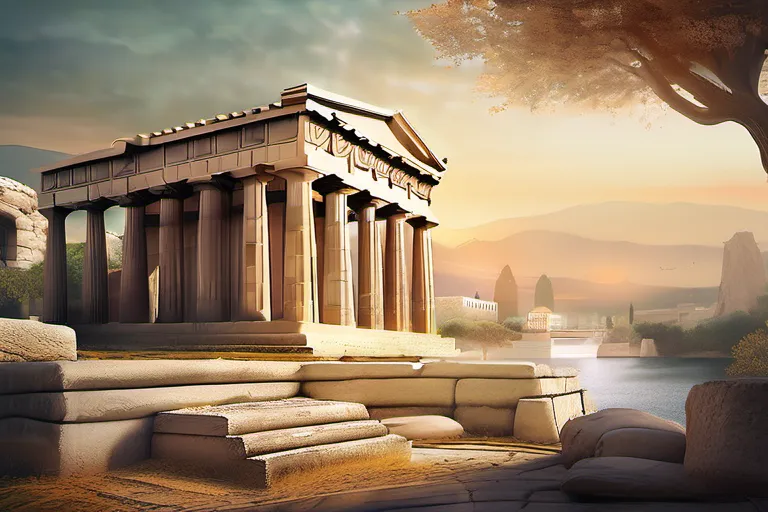
 Ancient Greek religion involved honouring many gods and goddesses through offerings, prayers and festivals. Cities, households and sanctuaries had their own observances. “Hellenic paganism” can also refer to present-day traditions that draw on ancient Greek religion. The ancient evidence shows how worship worked in particular places, while modern groups describe how they adapt it for their own communities. Metropolitan Museum of Art on Greek worship · Supreme Council of Ethnic Hellenes FAQ
Gods, offerings and sacred places
Greek communities honoured deities in particular roles and at particular sanctuaries. Athena received worship as a protector of Athens, while the sanctuary at Olympia was especially associated with Zeus. Worshippers approached gods with prayers and gifts, including offerings promised or given in thanks. Within a sanctuary, the altar was often outside the temple. The temple housed the image of a deity, and worshippers could gather around the altar for an offering or sacrifice. Metropolitan Museum of Art on Greek worship · Parthenon east frieze, block VI · History of the sanctuary and Games at Olympia
Offerings took several forms. A libation was a liquid offering poured in honour of a deity or the dead. An Attic terracotta bowl in the Metropolitan Museum of Art, dated to about 500 BCE, has a central hollow for the fingers and a rim that the thumb could steady. The object shows how the shape of a vessel helped the person performing the act. Animal sacrifice was another important public rite, with participants sometimes sharing the meat. Metropolitan Museum of Art on Greek worship · Attic terracotta phiale, ca. 500 BCE
Festivals for a city and for a wider Greek world
The Acropolis Museum interprets the Parthenon frieze as a representation of the procession of the Greater Panathenaia, the major Athenian festival for Athena. Participants brought a peplos, a garment for the cult image of Athena Polias. The procession included a major sacrifice at an outdoor altar. At Olympia, a festival in honour of Zeus included athletic competitions and drew participants from a wider Greek world. These festivals connected worship with civic life on different scales. Acropolis Museum on the Parthenon frieze · Parthenon east frieze, block VI · History of the sanctuary and Games at Olympia
What the hymn to Demeter reveals about Eleusis
The Homeric Hymn to Demeter tells how Hades takes Persephone and how Demeter, grieving for her daughter, withholds the growth of crops. At the end of the hymn, Demeter teaches the rites of Eleusis and the text forbids their disclosure. It distinguishes the fate of those who have seen the rites from that of the uninitiated. The hymn gives the mysteries a sacred origin and explains the importance of initiation. Its statement of secrecy also helps explain why the poem gives limited evidence for what happened during the rites themselves. Homeric Hymn to Demeter
One example of modern Hellenic worship
The Supreme Council of Ethnic Hellenes describes its practice as a modern renewal of Hellenic polytheistic religion. Its published account describes reciting hymns, marking the new moon and making offerings such as flowers, fruit and libations. It also describes a festival calendar set up for its community. This gives a documented example of how a present-day organisation uses ancient material in a contemporary setting. Supreme Council of Ethnic Hellenes FAQ
Conclusion
Ancient Greek religion took shape through relationships with deities expressed in prayer, offerings, festivals and initiation. A bowl for libations, the Athenian procession and the hymn about Eleusis each show a different part of that practice. Modern Hellenic worshippers draw on parts of this record in ways that can be understood through their own accounts.
Published by Ralf. About our editorial process.



