
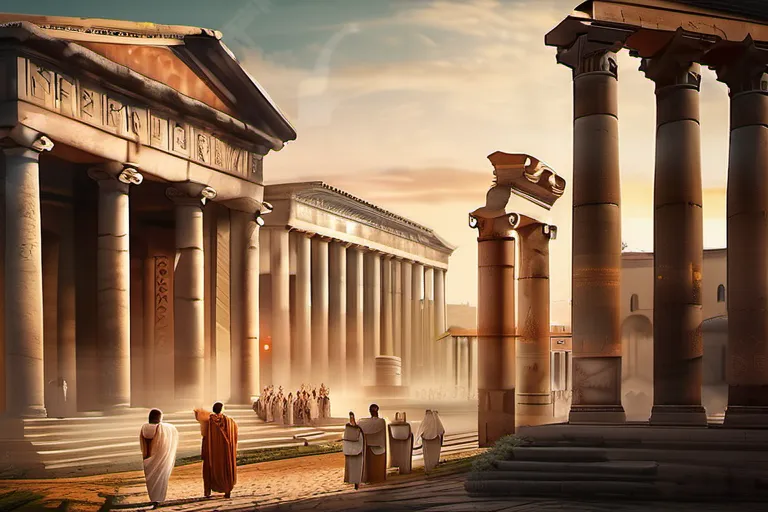

At a food shop in Pompeii, a shrine on the back wall brought the protectors of the household into the same space as the gods of trade and wine. A Roman farming manual gives words for a prayer to Mars over crops, herds and people. In Rome itself, the Senate ordered a recurring sacrifice at an altar dedicated to Augustan Peace. The three settings show how relationships with gods were expressed in the places where Romans worked, cared for households and exercised public authority.
Household gods in a Pompeian shop
A lararium was a shrine associated with the Lares, protective gods who could be honored in a household. The Metropolitan Museum of Art holds a Roman bronze of a Lar from the first or second century CE. The figure carries vessels associated with making offerings, including a shallow dish called a patera. The bronze shows how a deity responsible for a household’s well-being could be represented in a small object kept close at hand. See the Metropolitan Museum’s bronze Lar.
At the shop of Vetutius Placidus on Pompeii’s Via dell’Abbondanza, jars set into a masonry counter held food and drink. The house was connected to the shop at the rear. Pompeii’s archaeological park identifies the figures at the shrine as the Lares, the owner’s protective Genius, Mercury and Dionysus, also known to Romans as Bacchus. The last two fit the activities of a shop that traded in food and drink. The different figures show why treating all the occupants of a household shrine as ancestral spirits would obscure their particular roles. See the excavation guide’s entry for the house and shop.
A prayer for a Roman farm
In On Agriculture 141, Cato the Elder gives instructions for the ritual purification of farmland. He tells the reader to have the animals for a sacrifice led around the land and to make a preliminary invocation with wine to Janus and Jupiter. The main prayer asks Mars to protect the household, keep shepherds and livestock safe and allow crops to grow. In this text, the welfare of the people, the animals and the land belongs within the same petition. Read Cato’s Latin text with a vocabulary aid.
The sacrifice Cato names is a suovetaurilia, an offering involving a pig, a sheep and cattle. The same combination appears in a Roman marble relief in the Louvre, dated there to the second half of the second century BCE. It depicts a pig, a ram and a bull approaching a scene with an altar, Mars, musicians and ritual attendants. A census scene occupies part of the relief. The sculpture puts the animals in a civic setting, while Cato’s instructions put them on a farm. The grouping of animals gave the rite a recognizable form even when its setting and participants varied. See the Louvre’s catalogue of the census and sacrifice relief.
The Ara Pacis and public responsibility
Augustus describes the Senate’s decision to establish an altar in Rome’s Field of Mars after his return from Gaul and Spain. Dedicated to Augustan Peace, the Ara Pacis was completed and dedicated in 9 BCE. In Augustus’s account, the Senate assigned magistrates, priests and Vestal Virgins to perform a sacrifice at the altar each year. A political account of the ruler’s return acquired a place in the city and a recurring rite with designated participants. Read the museum’s monument guide and its excerpt from Augustus’s account.
Carved processions run along the enclosure. The museum identifies different kinds of participants, among them priests, officials and members of Augustus’s family, while noting uncertainty about the occasion represented. It may be his return or the ceremony marking out the altar’s site. The sculpture is evidence for the people and ceremonies the monument was designed to evoke. Augustus’s text is a separate source for the Senate’s order and the annual observance. See the museum’s explanation of the processional reliefs.
Conclusion
A Pompeian shopkeeper placed protective gods in a space shared by commerce and household life. Cato’s prayer gathered the needs of a farm into a request to Mars. The Ara Pacis gave an annual civic rite a permanent setting. These examples show the range of ancient Roman religion through the objects, words and responsibilities that made worship part of life in each place.
Published by Ralf. About our editorial process.



