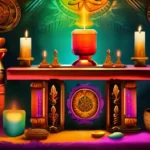
In Guanabacoa, on the outskirts of Havana, the anthropologist Todd Ramón Ochoa learned about Palo in a house where people gathered around vessels their teachers kept and tended. The vessels were part of an ongoing relationship with the dead. The house belonged to Palo Briyumba, one of several related Afro-Cuban traditions. Its example helps explain why the words Palo and Palo Monte can refer both to a wider religious inheritance and to particular communities with their own ways of practicing it.
How Palo took shape in Cuba
Palo draws on traditions from the Kongo region of Central Africa. People from this region were forcibly transported across the Atlantic under slavery. In Cuba, their descendants and other participants developed religious communities that carried forward and adapted knowledge about ritual objects, language and relations with the dead. The collective name Regla de Congo reflects this Kongo association. The Spanish word palo can mean a stick or piece of wood, and Ochoa describes practitioners’ attention to the trees and woods from which such pieces come. Read Ochoa’s field account in Changing Cuba/Changing World.
The terminology depends on who is using it. Palo Monte can serve as a broad name for these traditions. In the Havana communities Ochoa studied, practitioners also spoke of distinct branches, or ramas, including Briyumba, Mayombe, Monte and Kimbisa. The branches could differ in the language and music used in ceremonies. Another Afro-Cuban tradition, known as Ocha or Lukumí, draws especially on Yoruba heritage. Some people Ochoa met practiced both Ocha and Palo, keeping responsibilities in more than one religious community.
What happens in a ritual house?
Ochoa’s fieldwork in 1999 and 2000 included a temple house in Guanabacoa called Munanso Nkita Mana Nkita Briyumba Congo. Such a house could also be a teacher’s home. Its life centered on the people who gathered there and the vessels the teacher attended to over time. Membership in a house therefore involved learning from people who knew its ceremonies and had responsibilities toward those already associated with it.
A vessel may be called a prenda, nganga or enquiso in the settings Ochoa describes. The terms do more than name a container. His account of learning from his teacher Isidra follows the care given to these vessels and the relationships with the dead that practitioners understood them to sustain. People might seek protection or help in a difficult situation through those relationships. The time and attention given to a prenda also bound living participants to a teacher and to the other people of the house. Read Ochoa’s account of the vessels and their care.
What a Kongo object can tell us
The term enquiso is related to the Kikongo word nkisi. A nineteenth-century Kongo power figure catalogued by the Metropolitan Museum of Art offers a Central African example of how that vocabulary could be connected to a physical object. The wooden figure has a mirror-covered compartment in its abdomen and iron pieces attached to its body. The museum explains that a ritual specialist, or nganga, worked with the sculptor and that iron pieces could mark occasions when the figure was called upon, including in disputes or for protection.
The museum figure is from Central Africa. Ochoa’s Cuban account describes vessels that could take the form of cauldrons or urns, and the word nganga there can name the vessel itself. Putting the examples side by side makes it possible to recognize a historical relationship while seeing how forms and terms acquired particular meanings in Cuba. See the Metropolitan Museum’s catalogue for the Kongo figure.
What ritual speech preserves
Language is another place where this history is visible. The researcher Ana Stela de Almeida Cunha studied ritual speech during fieldwork in Havana, Pinar del Río and Cienfuegos. Her study examines words and expressions used alongside Spanish in particular Palo Monte settings. A word remembered and used in a ceremony can carry religious knowledge across generations, even as the community that uses it speaks Spanish in everyday life. The ceremonies also give that vocabulary a setting in which its significance can be learned. Read Cunha’s summary of her field research.
Conclusion
Palo Monte’s Kongo connections are visible in Cuban ritual vocabulary and in the importance practitioners give to material objects. The Guanabacoa example shows what it takes to sustain those connections over time. A teacher cares for vessels, people gather in a house and participants learn how their community relates to the dead. These practices help explain both the inheritance shared across branches of Palo and the distinctive character of an individual house.
Published by Ralf. About our editorial process.