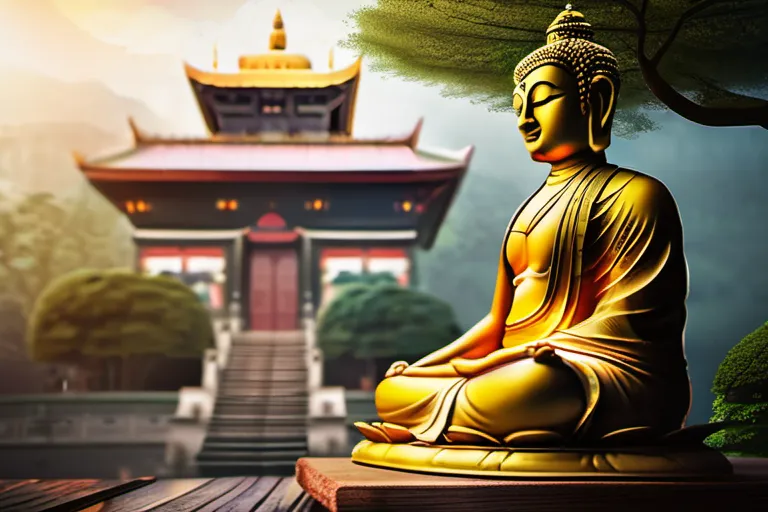
Nagarjuna’s Madhyamaka, or Middle Way, is a Buddhist philosophical tradition best understood through its relationship between emptiness and dependent arising. It challenges the idea that things possess a self-sufficient nature that establishes them independently. That challenge belongs within a Buddhist concern with suffering, attachment, and liberation.
“Nagarjuna Buddhism” can therefore be misleading if it suggests a separate religion founded around a new object of worship. Madhyamaka developed within Mahayana Buddhism. Its distinctive contribution lies in how it examines the assumptions behind claims about causes, persons, knowledge, and reality.
Nagarjuna: A Philosopher with an Uncertain Biography
The Stanford Encyclopedia of Philosophy’s account of Nagarjuna places the Buddhist monk approximately between 150 and 250 CE, probably mainly in southern India. Beyond that outline, biographical certainty is limited. Traditional narratives need to be distinguished from evidence that securely establishes a date or event.
His best-known work is the Mulamadhyamakakarika, commonly translated as Fundamental Verses on the Middle Way. It became a central subject of later commentary. Studying a particular argument in that text gives firmer ground for understanding his philosophy than reconstructing a detailed childhood or political setting from legend.
Emptiness: What Is Supposed to Be Absent?
Shunyata, or emptiness, requires identifying what things are empty of. The target is svabhava, often rendered as inherent existence or intrinsic nature. In this context, it concerns existence established independently, rather than simply the observable characteristics by which we distinguish one thing from another. The Stanford discussion of svabhava makes that distinction explicit.
Consider an ordinary cup as an illustration. It depends on materials, manufacture, parts, and the ways people identify and use it. Calling it a cup remains useful. Analysis asks whether, beyond those dependencies, there is a self-sufficient cup that establishes itself. This illustration introduces the question; it is not a substitute for Nagarjuna’s detailed arguments.
Likewise, noticing that an object changes does not complete the analysis. A theory could acknowledge changing objects while treating their ultimate constituents as independently established. Madhyamaka’s inquiry reaches that deeper proposal as well. The issue is what sort of existence the explanation assumes at its foundation.
Dependent Arising and the Middle Way
In Jamyang Khyentse Wangpo’s Seed of Reasoning, Nagarjuna’s verse 24.18 is cited to connect dependent arising, emptiness, dependent designation, and the Middle Way. The relationship is central: dependence is the reason to question inherent existence.
The same teaching text examines four proposed modes of production: from itself, from something other, from both, or without a cause. These alternatives test how production could work if the things involved possessed the independent nature under examination. They should be read in that philosophical setting. Ordinary dependence on conditions remains the subject that the analysis seeks to explain.
A seed-and-plant example makes the distinction easier to approach. Cultivation relies on conditions and practical differences between viable and damaged seeds. The philosophical question concerns how seed, conditions, and result could be independently established while also entering a productive relationship. Calling them dependent opens an inquiry into their relation; it does not make planting irrelevant.
The Stanford account of Madhyamaka describes its Middle Way as avoiding both an eternal intrinsic foundation and the annihilation of such a foundation. The central proposal is that inherent natures were never present in the first place.
The Two Truths and the Value of Ordinary Explanation
The two truths distinguish conventional truth and ultimate truth. Conventional discussion concerns the world of experience, language, and practical activity. Ultimate analysis concerns the emptiness of inherent existence. Their relationship is a central topic of interpretation within Madhyamaka.
The Stanford study of the two truths discusses verses 24.8–10 of Nagarjuna’s text. There, explaining the ultimate depends on convention, while understanding the ultimate is connected with liberation. Ordinary words and distinctions therefore have a role in teaching, even as analysis questions what people take those words to establish.
Return to the cup. In everyday circumstances, saying that it holds water can be an accurate statement. Examining whether it exists independently addresses another question. Its emptiness does not make a cracked cup hold water or make every description equally accurate. This is an explanatory example of why practical discrimination and analysis need to be kept in view together.
Later thinkers debated the precise relationship between the two truths. An introductory explanation should preserve that debate instead of treating them as two separate worlds, one disposable and the other hiding behind it.
Emptiness and the Continuity of Persons
A short text traditionally attributed to Nagarjuna, The Heart of Dependent Origination, connects the twelve links of dependent origination with affliction, karma, and suffering. It describes continuity through causes and effects while denying a separately established owner of that process.
The text uses analogies including a candle and a seed to discuss continuity without the transfer of an unchanged entity. It also rejects a nihilistic misunderstanding of conditioned arising. These are religious and philosophical explanations of samsara and liberation, rather than evidence from a modern scientific experiment.
A useful introductory question is how change and continuity can coexist. A person’s experiences and actions have consequences, while an inquiry into the person need not discover a permanent, independent core. Understanding that distinction takes more work than repeating that the self is an illusion. The text’s causal framework is part of that work.
Reasoning, Ethical Conduct, and Meditation
Madhyamaka is pursued within Buddhist practice. In Khenchen Pema Tsewang Rinpoche’s meditation teaching, non-harming, compassion, bodhicitta, study, and contemplation accompany investigation of selflessness. Bodhicitta is the aspiration to awakening for the benefit of beings. The teaching places philosophical inquiry within that ethical and contemplative purpose.
Its sequence is a concrete example of how one Tibetan Buddhist presentation brings reasoning and practice together. A reader studies what selflessness means and examines it through contemplation, within a wider discipline of conduct and motivation. It is not simply an exercise in winning an argument.
This also explains why emptiness should not become an excuse to dismiss another person’s suffering. In the teaching’s own framework, concern for beings belongs to the purpose of the path. That religious intention should be distinguished from a claim that reading philosophy automatically produces compassion or a measurable psychological benefit.
A Tradition of Commentary and Debate
Madhyamaka continued through interpreters who disagreed about method and explanation. Khenchen Namdrol Rinpoche’s introduction to the Collection of Reasoning identifies Nagarjuna’s root text and Candrakirti’s Introduction to the Middle Way as distinct works. It also records differing Tibetan accounts of which writings belong in the collection. A living interpretive tradition can preserve disagreements about its own textual organization.
Relations with Yogacara likewise require specific historical attribution. The Stanford survey describes criticism and accommodation of Yogacara among Madhyamaka thinkers, including Candrakirti’s criticism. Such later debates should be studied through the authors involved. They cannot all be assigned directly to Nagarjuna.
Comparisons with Daoism or modern Western philosophy can raise interesting questions, but resemblance alone does not establish influence. A useful comparison identifies a particular claim in each text and then examines the reasons behind it. Broad language about shared openness or interconnectedness often leaves the philosophical differences unexplained.
Conclusion

Nagarjuna’s distinctive contribution is a sustained challenge to inherent existence, developed through reasoning about dependence. Emptiness, the two truths, and the analysis of persons belong to a Buddhist project concerned with liberation from suffering.
To study the Middle Way carefully, choose a concrete case and ask what depends on what, what ordinary description accomplishes, and what ultimate analysis challenges. Then examine an actual argument and its interpretation. This approach keeps everyday responsibility in view while making the depth of Nagarjuna’s philosophical question easier to grasp.
Published by Ralf. About our editorial process.