
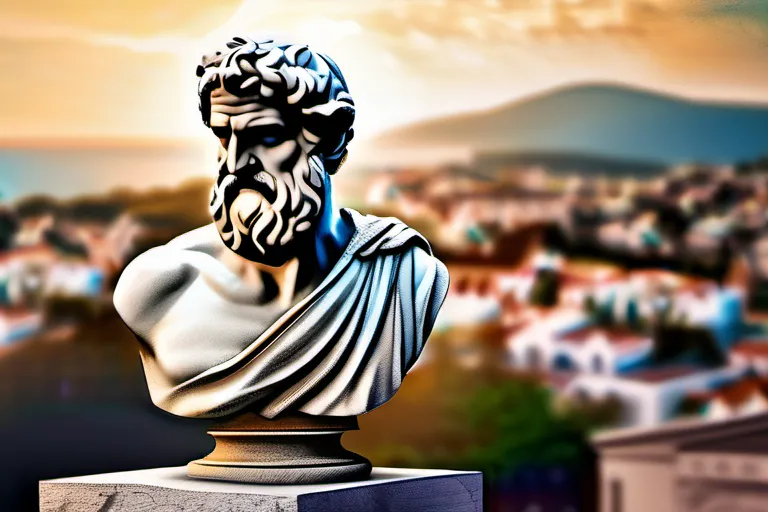
Hellenism matters to religious history because Greek language, education, worship and philosophy became part of the settings in which many communities lived and argued about the divine. Its influence can be traced through particular encounters: Egyptian and Greek religious imagery in Alexandria, Jewish scripture in Greek, Christian preaching in Athens and the translation of philosophical texts into Arabic.
These encounters involved different periods and purposes. Understanding them requires distinguishing ancient Greek religion, the Hellenistic world and the later use of Greek philosophy. Today, Hellenism can also name a modern practice of worshipping the Greek gods.
What does Hellenism mean?
In cultural history, Hellenism refers broadly to Greek culture and its reception beyond Greece. The more specific Hellenistic period is conventionally dated 323–31 BCE. Athens remained an important philosophical centre, while Alexandria and other royal capitals supported scholarship. The Metropolitan Museum’s account of Hellenistic intellectual life describes libraries, schools and rulers’ patronage as institutions through which learning circulated.
Ancient Greek religion reaches further back than this period. Christianity emerged later, under Roman rule; medieval Arabic philosophy belongs to a much later setting again. Greek cultural influence connects these histories, but it does not turn them into one continuous religious movement. A philosophical text translated centuries after Alexander can transmit Greek ideas without transmitting the worship of Zeus.
Greek religion was lived through worship and community
Ancient Greeks honoured many deities, including Athena, Apollo, Poseidon and Demeter. Religious life included sanctuaries, offerings, festivals and relationships with particular places. Athena’s association with Athens and Apollo’s sanctuary at Delphi illustrate how divine identity, locality and public life could belong together.
As the Met’s overview of Greek religious practices explains, votive objects expressed gratitude, libations offered liquids to the gods, and animal sacrifice could lead to shared meals. These activities established relationships between worshippers, deities and fellow participants. Homer’s poems were influential, but there was no single scriptural work governing every community’s religion.
This practical setting matters when comparing religion with philosophy. An account of the universe or the soul addresses a different question from a festival calendar or the duties associated with a sanctuary. People could participate in inherited rites while also exploring philosophical arguments; the two activities need not have formed competing memberships.
Alexandria: interaction without the disappearance of older traditions
Ptolemaic Egypt offers a concrete example of cultural encounter. Greek-speaking rulers governed a country with longstanding Egyptian temples and priestly traditions. Alexandria contained institutions shaped by Greek urban culture, while the dynasty also presented itself through Egyptian forms of kingship.
The god Serapis makes this interaction visible. In Marsha Hill’s study of Ptolemaic Egypt, Serapis combines aspects of Egyptian deities, including Osiris and Apis, in a Hellenistic presentation. His temples belonged to a landscape that also retained Egyptian gods, monuments and ritual practices.
Such combinations are often called syncretism. The term is useful when it identifies a particular connection between traditions. Here, divine imagery and royal patronage helped organise religious life in a mixed cultural setting. Egyptian religion nevertheless continued to develop within its own institutions. Interaction could produce new forms alongside substantial continuity.
Mysteries and hopes for the afterlife
Mystery cults offered forms of participation involving initiation and privileged ritual knowledge. At Eleusis, Demeter and Persephone were central to the sacred story. Public processions and the initiates’ restricted rites belonged to the same religious setting, linking a widely visible festival with experiences reserved for participants.
Kiki Karoglou’s museum study also discusses Bacchic-Orphic evidence, including inscribed gold leaves placed with the dead. Such objects illuminate expectations about the soul and the afterlife. They do not supply a complete manual shared by every group associated with Orpheus or Dionysos.
The surviving evidence varies greatly between cults and periods. Some mysteries predate the Hellenistic age, and their histories extend into Roman times. Their significance lies partly in the particular bonds and hopes they offered initiates. Similar language about salvation in another religion does not, by itself, establish that one community borrowed its beliefs from another.
Judaism: Greek language and Jewish interpretation
The Septuagint provides a particularly clear form of Greek cultural influence: Jewish scriptures became available in Greek. The Greek Orthodox Archdiocese and Hellenic Bible Society’s Septuagint project identifies this Greek scriptural tradition and its continuing use in Orthodox worship. Translation made Jewish sacred texts accessible within a Greek-speaking world and later shaped Christian reading of scripture.
Translation also creates interpretive choices. Greek words had to express ideas arising from Hebrew texts and Jewish religious life. As Jan Joosten explains in his study of biblical Greek, Greek forms could carry Hebrew meanings. Using Greek therefore did not require accepting Greek polytheism.
Philo of Alexandria, who lived around the turn of the era, offers another example. He interpreted Jewish scripture using extensive Greek philosophical learning. The Stanford study of Philo emphasises the centrality of revelation and the Law in his thought. His work illustrates an active Jewish use of philosophical categories, shaped by his own religious commitments.
Christianity: engagement, disagreement and reinterpretation
In Acts 17, Paul addresses an Athenian audience that includes Epicurean and Stoic philosophers. He refers to an altar dedicated to an unknown god and draws on the audience’s own poetic language. The speech then challenges the idea that the creator depends on temples or human provision and concludes with judgment and resurrection.
The passage presents both connection and disagreement. Familiar language creates a point of contact, while the message gives it a particular Christian direction. The mixed response also matters: some listeners mock the resurrection, while others want to hear more. Cultural exchange did not guarantee agreement.
This is more informative than imagining Christianity as simply adopting a complete Greek system. Greek language and intellectual discussion provided resources through which Christians could express and debate claims rooted in their scriptures and worship.
Arabic philosophy: transmission also meant transformation
Greek philosophical influence on Muslim thinkers often travelled through later translation and commentary. A striking example is the work known as the Theology of Aristotle. Despite its title, it draws on Plotinus, a philosopher of late antiquity, rather than being an authentic theological treatise by Aristotle.
Peter Adamson’s study of the text places the Arabic version in the ninth-century circle of al-Kindi. Its translator, Ibn Na‘ima al-Himsi, was a Syrian Christian. The resulting work paraphrased and reworked its Greek material, introducing changes rather than merely replacing Greek words with Arabic ones.
This example shows why the history involves translators, religiously diverse scholarly networks and new intellectual projects. Greek ideas became resources for fresh questions. Their reception was a process of selection and interpretation, not evidence that Islamic belief as a whole derived from ancient Greek religion.
Modern Hellenic polytheism
Hellenism also has a living devotional meaning. In an introductory essay published by Hellenion, Hellenismos is described as ancient Greek polytheistic religion reconstructed and adapted for modern life. The account discusses prayer, offerings, festivals, hospitality and the use of historical research alongside personal religious experience.
This is one community’s account of contemporary practice. Its purpose differs from studying how Greek philosophy influenced another religion. Both belong to the wider history of Hellenic reception, but one concerns worship of the gods and the other may concern language, interpretation or philosophical reasoning.
Conclusion
The religious significance of Hellenism becomes clearest through specific relationships. Serapis illustrates interaction in a temple and royal setting; the Septuagint illustrates translation; Philo illustrates scriptural interpretation; Acts presents an encounter involving persuasion and disagreement; Arabic Plotinus shows philosophical transformation through translation.
These examples reveal communities making choices within shared cultural worlds. Studying those choices explains both religious change and continuity: traditions could adopt a language, adapt an argument or develop a new form of worship while preserving commitments that gave the encounter its distinctive direction.
Published by Ralf. About our editorial process.



