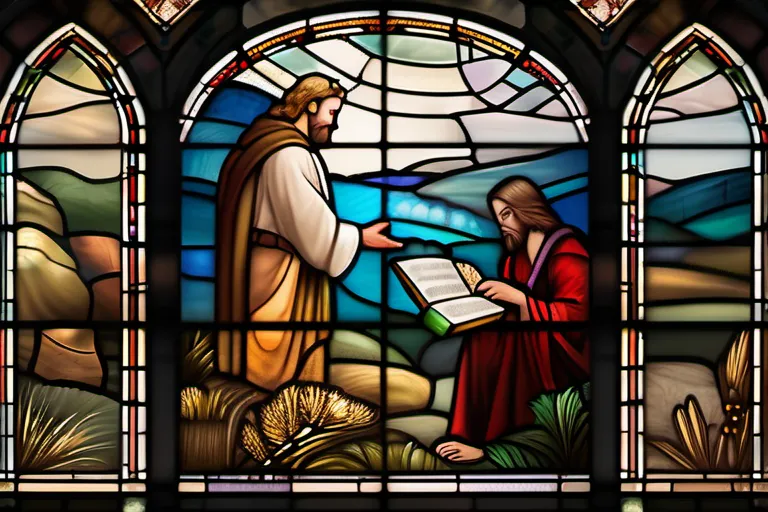
Christianity began as a movement around Jesus of Nazareth in the Jewish world of the first century. After his execution under the Roman governor Pontius Pilate, his followers proclaimed that God had raised him from the dead. The movement spread as communities formed across the Roman Empire and beyond it. Letters, buildings and inscriptions show how Christians worked out who could join, how to worship and what it meant to confess Jesus as Christ.

Jesus in his Jewish setting
The Gospels tell the story of Jesus from the perspective of communities that believed in him. Matthew’s birth account, for example, interprets the conception of Jesus as an act of the Holy Spirit and connects it with a passage from the prophets. The account gives a theological explanation of Jesus’s identity. In Mark, the public ministry begins with John baptizing Jesus in the Jordan and Jesus subsequently announcing God’s kingdom in Galilee. Matthew 1:18–25 · Mark 1
Luke gives another view of that ministry. In Nazareth, Jesus reads from Isaiah in a synagogue on the Sabbath, including words about good news for the poor and release for captives. He tells the listeners that the passage is being fulfilled as they hear it. Luke presents Jesus’s mission through a Jewish scripture being read in a Jewish setting. That context helps explain why arguments over how to interpret scripture remained important as the movement grew. Luke 4:14–22
Execution and the proclamation of resurrection
Mark describes Jesus being handed over by Pilate and crucified by Roman soldiers. The Roman historian Tacitus, writing later about Nero’s treatment of Christians in Rome, also associates the execution with Pilate during the reign of Tiberius. The sources have different aims. Mark tells the story of Jesus’s suffering, while Tacitus explains whom Nero punished after the fire of Rome. Their accounts give evidence for the execution and for the existence of communities identified with Christ. Mark 15:15–25 · Tacitus, Annals 15.44
Paul’s First Letter to the Corinthians preserves an early proclamation that he says he received and passed on. It connects Jesus’s death with forgiveness of sins, says that he was buried and raised, and names Cephas, James and others among those said to have seen him afterward. Paul includes himself in the list. The letter lets us see what early Christians were already teaching about Jesus’s death and resurrection and how Paul linked that proclamation to salvation. 1 Corinthians 15:1–8
How Gentiles joined the movement
As the message reached people outside Jewish communities, a practical question arose. Would Gentiles, people who were not Jewish, have to be circumcised to join? In Galatians, Paul recalls traveling to Jerusalem with Barnabas and Titus. He says that Titus, who was Greek, was not required to be circumcised. Acts 15 tells of a Jerusalem meeting at which leaders agreed to admit Gentile believers without requiring circumcision. The letter in Acts still asks them to observe certain restrictions, including on food offered to idols. Paul’s account and the narrative in Acts both show how concrete decisions about membership were part of the movement’s expansion. Galatians 2:1–10 and Acts 15
From local congregations to imperial recognition
In the early second century, Pliny the Younger wrote to Emperor Trajan for guidance on handling accusations against Christians in the province he governed. According to Pliny, people he questioned described meeting before dawn on an appointed day and singing to Christ. The same exchange shows how a Roman official could turn those gatherings into a matter of investigation and punishment. It records the practices attributed to one group and the response of one provincial administration. Pliny and Trajan, Letters 10.96–97
A third-century building at Dura-Europos in present-day Syria gives physical evidence of a community organizing its worship. Researchers Camille Leon Angelo and Joshua Silver describe how a room was altered to install a baptismal basin and a canopy. The renovators lowered its ceiling and painted its walls with scenes. The changes gave baptism a distinct setting within a building that had begun as a domestic structure. They show what one congregation invested in making a space for the rite. Angelo and Silver’s study of the Christian building
In 313, Constantine and Licinius granted religious freedom to Christians and others and ordered the return of Christian community property. In 325, Constantine convened bishops at Nicaea. The creed reported by Eusebius of Caesarea describes the Son as sharing the Father’s divine essence and rejects the claim that he was created. The agreement of 313 concerned what communities could do under Roman rule. The creed concerned what bishops agreed to profess about Jesus. By then, Christian communities had been meeting and debating for generations. The imperial agreement of 313 · World Council of Churches on the council’s date and setting · Eusebius’s letter on the Council of Nicaea
Christian traditions across regions and languages
A stone erected in 781 at the Tang capital, now Xi’an, records a Christian presence in China. The inscription uses Chinese and includes Syriac, with names recorded in both languages. An Armenian Gospel leaf from the Lake Van region, dated to around 1290–1330, places the four evangelists together in a composition that the Met identifies as an earlier practice retained in parts of medieval Armenia. Each object shows a community transmitting a shared religious inheritance through its own language or visual conventions. California State University catalogue of a rubbing of the Xi’an stone · Pitts Theology Library’s record of the bilingual names · The Met’s Armenian Gospel leaf
In central Africa, King Nzinga Nkuwu of Kongo was baptized in 1491. A seventeenth-century brass crucifix made by Kongo artists incorporates small praying figures represented by heads at the arms of the cross. The Met describes such additions as characteristic of the way Kongo artists developed local forms from European models. In sixteenth-century Europe, meanwhile, disputes over indulgences, church authority and the teaching of salvation helped give rise to Protestant churches. These were separate developments within a history that already reached across continents. The Met’s essay on Kongo Christianity · The Met’s Kongo crucifix · Religion24’s article on Martin Luther and the Reformation
In Pew Research Center’s estimates for 2020, Christians were the world’s largest religious group, with about 2.3 billion people. About 31% of the world’s Christians lived in sub-Saharan Africa, 24% in Latin America and the Caribbean and 22% in Europe. The figures describe religious affiliation in a particular year. They give a sense of the geographical reach of a movement whose earliest sources come from the eastern Mediterranean. Pew’s 2025 report on Christian population change
Conclusion
Christianity’s origins lie in Jesus’s Jewish setting and in the proclamation of his resurrection by his followers. The first generations made decisions about membership and created settings for worship. Later councils, artists and translators gave those communities forms that could be carried into new places. The surviving evidence traces several developments at once, from the beliefs repeated in an early letter to the ways Christians expressed them in buildings, images and languages of their own.
Published by Ralf. About our editorial process.