
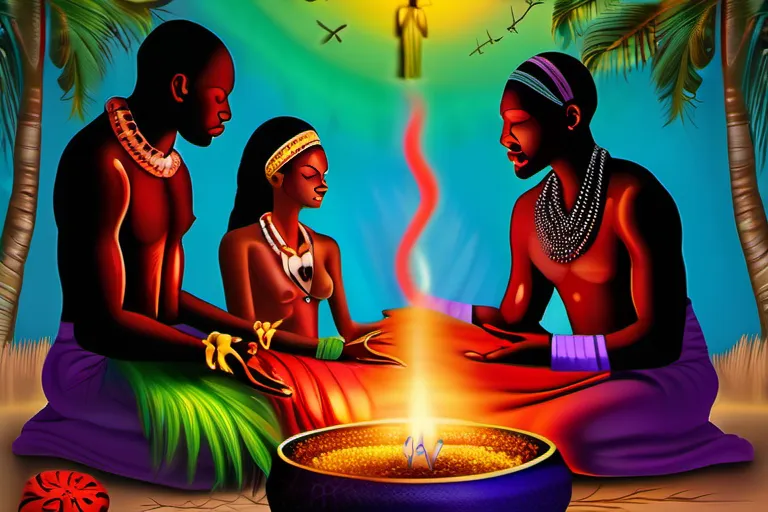
Haitian Vodou developed through the religious lives of people of African descent in colonial Saint-Domingue and independent Haiti. Its history connects West and Central African traditions, the violence of Atlantic slavery, encounters with Catholicism and the creation of communities under changing political conditions.
It is therefore best understood as a Haitian religious tradition formed through continuity and transformation. It was neither carried across the Atlantic as one completely uniform system nor assembled at a single founding ceremony. Its origins belong to the experiences and religious creativity of people who sustained and reshaped traditions under coercive circumstances.
West and Central African roots
Harvard’s Pluralism Project identifies Fon, Kongo and Yoruba traditions among Vodou’s African sources. These refer to different cultural and religious histories, not one interchangeable “African religion.” Historical regions also do not map neatly onto the borders of present-day states.
Enslaved people carried knowledge, languages, ritual practices and relationships to spirits into new settings. Under plantation slavery, individuals from different backgrounds encountered one another and developed forms of shared religious life. Understanding those processes requires attention to both what continued and what changed.
The name itself has West African connections. Forms such as Vodou and Vodun are associated with terms for spirit or sacred power in Fon and Ewe contexts. The name’s history does not mean that every practice in Haiti can be assigned to a single African source.
Colonial Saint-Domingue and religious coercion
Before independence, the French colony of Saint-Domingue occupied the western part of Hispaniola, where Haiti is located today. Its plantation economy depended on enslaved labour. The movement of people across the Atlantic was forced transportation, not simply a voluntary exchange of spiritual traditions.
The 1685 Code Noir, transcribed and translated by the US National Park Service, provides direct evidence of colonial religious policy. Article II requires enslaved people to be baptised and instructed in Roman Catholicism. The document records registration in Saint-Domingue in 1687.
That requirement helps explain why the encounter with Catholic practice must be understood within unequal power relations. The existence of a colonial command does not tell us exactly what every person believed or how consistently officials and enslavers enforced it. It does establish that religious life developed under coercive legal expectations.
Catholic connections were more complex than disguise
Historian Hein Vanhee’s study of Central African popular Christianity and Haitian Vodou challenges the idea that Catholic elements entered only through a later encounter in Haiti. Christian practices had already developed in Kongo over centuries, including through African lay teachers and local religious leadership.
Some people transported to Saint-Domingue therefore brought experience of Christianity as well as other Central African traditions. Catholic prayers, objects and ritual language could be reworked within a history more complex than “European religion outside, African religion hidden underneath.” This does not remove colonial coercion; it recognises the range of religious knowledge carried by the people involved.
Revolution changed the setting, but did not create the religion overnight
The US Office of the Historian’s account describes the uprising beginning in 1791 and the complex conflict that led to Haitian independence in 1804. The end of slavery and the creation of an independent state transformed the setting in which religious communities lived.
The ceremony remembered as Bois Caïman has an important place in accounts of the revolution. Vanhee, discussing the historical debate, cautions against treating later versions of its story as a complete contemporary record or making one ceremony the sole cause of the uprising. Religious memory and the reconstruction of events from surviving sources are related but different tasks.
Vodou’s history continued after independence. A religion’s political significance can change without all its practices acquiring one uniform national form.
Serving the lwa
Practitioners often describe their religious activity as serving the spirits. The Fowler Museum’s educational material on Haitian art and Vodou describes the lwa as intermediaries between people and Bondye, the supreme God. This is a religious account of the relationship between human and divine life.
The lwa have names, associations and forms of recognition. The Canadian Museum of History’s Vodou glossary, for example, identifies Agwe with the sea, Danbala with the serpent and the Gede family with the relationship between death and renewed life.
These examples show why reducing every spirit to a single abstract label is inadequate. The beings described belong to relationships, stories and ritual settings. Statements about their powers express practitioners’ religious understanding; they should not be converted into independently demonstrated claims about health, protection or material success.
Ritual, leadership and possession
Vodou religious life involves organised activity, leadership and participation. The museum glossary identifies oungan and manbo as religious specialists and describes the ason, a sacred rattle associated with their ritual role. Such terms provide more precise language than treating every participant as an unnamed performer in a spectacle.
The Canadian Museum of History’s exhibition account explains possession from the practitioner’s perspective: a person temporarily becomes a vehicle through whom a lwa communicates. The words and gestures are understood within that relationship. The account also makes clear that practitioners are not in a permanent state of possession.
The episode also has a communal dimension: communication is interpreted by those present and understood within the surrounding ritual. Attention to that setting helps explain why the experience has a religious meaning for participants, rather than treating it only as an unusual movement or sound.
Arts and objects make religious relationships visible
Ritual life also has material and artistic forms. The Fowler Museum’s publication Sacred Arts of Haitian Vodou documents altar installations, sequined flags and bottles, paintings and other works, bringing together scholars, artists and ritual experts.
These objects are evidence of particular artistic and religious practices. They also show why Vodou should not be represented only through commercial images of pins and dolls. A flag or altar object belongs to a setting of recognition, devotion and relationships; its appearance alone does not explain everything participants understand by it.
The publication includes the work of Brooklyn priestess Mama Lola alongside material from Haiti. This provides a concrete reminder that the tradition’s life extends into diaspora communities as well as the country of its formation.
Continuity without uniformity
Vodou’s origins help explain its diversity. African inheritances, Catholic connections, local religious specialists, family traditions and changing social conditions have interacted across time. A single summary cannot specify the practice of every house or community.
That diversity does not make its history unknowable. Colonial documents, historical research, material objects and practitioners’ accounts each offer evidence. They answer different questions: what authorities required, how religious life developed, what people made and how participants understood what they did. Bringing those sources into conversation produces a fuller account than either a story of an unchanged ancient survival or a claim that Vodou appeared fully formed at one moment.
Conclusion
Haitian Vodou emerged through the survival and transformation of African religious traditions within the conditions of Saint-Domingue and independent Haiti. Catholic connections formed part of that history, including through Central African experiences that preceded forced transportation across the Atlantic.
Its origins remain visible in service to the lwa, religious leadership, ritual and sacred arts. Understanding these relationships requires taking practitioners seriously while distinguishing religious claims, historical evidence and later representations. That approach reveals a living Haitian tradition with a complex history.
Published by Ralf. About our editorial process.




1 thought on “The Origins of Haitian Vodou: African Roots, Slavery and Religious Life”