
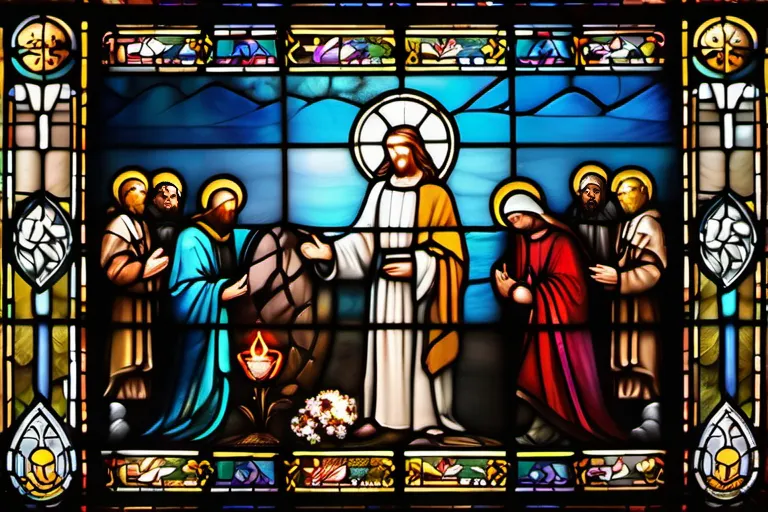
Christianity is a family of religious traditions centered on Jesus Christ: his life and teaching, his death, and the conviction that God raised him from the dead. Christians understand their relationship with God through Jesus, read the Bible as sacred Scripture, and gather for worship, prayer, and communal life. These shared reference points connect churches that can differ substantially in doctrine, authority, ritual, and everyday practice.
A useful introduction therefore needs both a common framework and concrete distinctions. What does it mean to call Jesus the Christ? Why do Christians speak of one God as Father, Son, and Holy Spirit? Why might two Christian congregations baptize differently or explain Communion in different ways? The answers begin with Christianity’s Jewish setting and develop through its Scriptures, historical divisions, and living communities.
Jesus and Christianity’s Jewish beginnings
Christianity emerged in the first century CE among followers of Jesus within a Jewish setting. Its earliest scriptural vocabulary—creation, covenant, prophecy, Messiah, and resurrection—cannot be understood apart from Jewish traditions. “Christ” is a title meaning Messiah or anointed one, rather than Jesus’ surname.
The biblical texts also require careful reading. Mark 1:9 associates Jesus with Nazareth in Galilee; Matthew 2:1 locates his birth in Bethlehem in Judea. These are statements within the Gospel narratives. Simply describing Nazareth as his birthplace confuses those distinct references, while treating a Gospel birth narrative as an independently verified modern birth record would overstate the evidence.
The movement came to include people outside the Jewish community. Acts 11:19–26 portrays preaching beyond its earlier audience and identifies Antioch as the place where disciples were first called Christians. This is the book’s account of early Christian expansion, rather than a complete history of every community. Christianity’s development did not mean that Judaism disappeared or became merely an obsolete preliminary stage: Judaism continued as a living religious tradition.
What Christians believe about Jesus and salvation
For Christians, Jesus is more than a memorable moral teacher. The widely shared Nicene tradition confesses him as God’s Son, truly divine and truly human. His incarnation means that the Son became human; it does not mean that an ordinary person simply acquired admirable spiritual qualities.
The cross and resurrection stand at the center of this faith. In 1 Corinthians 15:1–8, Paul recounts a message he had received concerning Christ’s death, burial, resurrection, and appearances. This passage provides evidence of the proclamation preserved in an early Christian letter. Believing that the resurrection actually occurred as God’s saving act is a religious commitment; quoting Paul’s account does not independently verify each reported appearance.
Salvation concerns deliverance from sin and death and restored relationship with God. Christian explanations give different emphases to forgiveness, reconciliation, participation in divine life, and the renewal of creation. They should not be reduced to a ladder of good deeds that earns God’s approval. The Catholic catechism describes grace as God’s free and undeserved help, while the Lutheran Augsburg Confession, Article VI, connects faith with the good works it should produce without making those works a way to purchase justification. Differences remain, but “Catholics earn salvation while Protestants need no ethical response” misrepresents both positions.
One God, the Trinity, and the creeds
Most Christian churches confess one God in three persons: Father, Son, and Holy Spirit. In this doctrine, the persons are distinct without being three separate gods or three pieces of a larger divine whole. Nor are they merely three temporary roles played by one person. Simple comparisons with the sides of a cube or successive states of water can therefore mislead more than they explain.
The Nicene-Constantinopolitan Creed gives a concise framework: God as creator; Jesus Christ’s incarnation, crucifixion, and resurrection; the Holy Spirit; the church; baptism; and the hope of resurrection. The council at Nicaea in 325 and the expanded creed associated with Constantinople in 381 belong to its history. The familiar longer text should not simply be assigned in its entirety to 325.
This framework crosses many denominational boundaries, although wording and interpretation differ. Christian identity is also broader than agreement with every Nicene formulation. For example, the United Pentecostal Church International expresses a Oneness understanding of God that differs from the Nicene distinction of persons. That example does not make all Pentecostals non-Trinitarian; it shows why a particular church’s teaching matters.
The Bible: a shared foundation with different canons and interpretations
The Christian Bible comprises the Old and New Testaments. The Old Testament contains Scriptures Christians inherited from Jewish tradition; it includes law, narrative, poetry, prophecy, and wisdom. The New Testament contains the Gospels, Acts, letters, and Revelation. These genres invite different kinds of reading: a lament is not a legal code, and a parable is not a statistical report.
Christians do not all use an identical Old Testament collection. As the US bishops’ introduction to the Bible explains, the common Protestant count is 39 Old Testament books and the Catholic count 46; both count 27 in the New Testament. Orthodox collections are generally longer, with differences among traditions. Counting books is therefore a useful starting point, but it does not settle how a church interprets them.
Authority also involves more than owning a Bible. Catholic teaching connects Scripture, apostolic Tradition, and the church’s teaching office, which it understands as serving God’s word. Protestant communities give Scripture distinctive authority while differing over confessions, church government, and interpretive methods. Asking how a congregation reads a difficult passage is often more informative than assuming that “biblical” means the same method everywhere.
Major Christian families and historical divisions
Christianity has no single administrative structure governing every church. Several major families provide a practical map:
- Catholic churches form a communion with the bishop of Rome, the pope. That communion includes the Latin Church and Eastern Catholic churches with their own liturgical traditions.
- Eastern Orthodox churches include churches such as the Greek and Russian Orthodox churches. Their organization should not be confused with universal jurisdiction by the pope.
- Oriental Orthodox churches include Coptic, Armenian, Ethiopian, Eritrean, Syriac, and Indian traditions. The World Council of Churches distinguishes this family from Eastern Orthodoxy and identifies the Council of Chalcedon in 451 as a major point of separation.
- Protestant traditions include Lutheran, Reformed, Anglican, Baptist, Methodist, and many other communities. They differ in sacraments, ministry, church government, and confessional commitments; “Protestant” does not describe one centrally governed church.
The separation of Eastern and Western churches developed through theological, political, linguistic, and institutional tensions. The events of 1054 became an important marker, but they did not instantly create two wholly new religions. In their 1965 common declaration, Pope Paul VI and Patriarch Athenagoras addressed the personal censures of 1054 while acknowledging that wider differences remained. Removing those censures did not establish full communion.
The sixteenth-century Reformation brought further divisions and reforms. Luther’s 1517 Ninety-Five Theses concerned indulgences; the Library of Congress’s description of an early edition explains their intended academic dispute and rapid circulation through printing. Their significance does not depend on presenting the familiar door-posting scene as an undisputed eyewitness event. The resulting Protestant traditions developed through more than one reformer and more than one controversy.
Worship and everyday Christian practice
Christian worship commonly combines Scripture, prayer, preaching, music, and communal participation. A Catholic Mass, an Orthodox liturgy, and a Baptist service can nevertheless have markedly different structures. Set prayers and spontaneous prayer also coexist within Christianity rather than defining separate levels of sincerity.
Baptism and the Lord’s Supper, also called Communion or the Eucharist, illustrate both common ground and real disagreement. Catholic teaching describes baptism as sacramental rebirth and incorporation into the church; infant baptism is part of its practice. The Southern Baptist Baptist Faith and Message, Article VII, describes baptism as a believer’s immersion and an act of obedience with symbolic meaning. That is a specific Baptist statement, not a description of every Protestant church.
At Communion, Catholic doctrine affirms Christ’s real presence under the appearances of bread and wine. The same Baptist statement presents the Lord’s Supper as a symbolic act commemorating Christ’s death and anticipating his return. Other traditions offer further accounts of presence and participation. Saying that all Christians believe bread and wine “turn into symbols” erases these differences.
Beyond services, practice can include personal prayer, Bible reading, fasting, care for neighbors, and observance of the church year. Christmas concerns the incarnation and birth of Jesus; Easter celebrates the resurrection. The prominence, calendar, and form of particular observances vary. A visitor should therefore check a congregation’s own explanation of worship and participation rather than assume that every church follows one universal order.
Ethics, culture, and the responsibility of institutions
Jesus’ teaching on love of God and neighbor is a central Christian ethical reference. In Matthew 22:34–40, he draws on commands already present in Deuteronomy 6:5 and Leviticus 19:18. Christian love should consequently not be presented as an invention that replaced an allegedly loveless Jewish religion. The practical challenge is how inherited teachings become habits of honesty, generosity, forgiveness, and responsibility toward others.
Christian traditions have also shaped specific works of art and institutions. The Vatican Museums’ account of Michelangelo’s Sistine Chapel ceiling identifies nine central scenes from Genesis. This is a concrete example of biblical interpretation through visual art, rather than evidence that all Christian communities approve the same religious imagery.
Service can likewise be described precisely. Catholic Relief Services traces its establishment by US bishops to 1943 and describes assistance without regard to recipients’ religion. That is an institutional statement of purpose, not an independent assessment of every project’s results. Christian affiliation alone cannot guarantee good conduct: Australia’s Royal Commission’s 2017 findings concerning Catholic authorities in Ballarat documented serious failures in responses to child sexual abuse. A responsible account can recognize service while assessing institutions by their actions and accountability.
A worldwide religion, with dated demographic evidence
Christianity is practiced in many languages and cultural settings. Pew Research Center’s report published in June 2025 estimated 2.3 billion Christians in 2020, drawing on more than 2,700 censuses and surveys. The figure describes the report’s 2020 reference year; it is not a real-time population count. Religious identification also does not establish that every person counted attends services regularly or holds identical beliefs.
Conclusion
Christianity is best understood through the relationship between its center and its diversity. Jesus Christ, Scripture, worship, and the hope of salvation connect its traditions; disputes over authority, sacraments, and doctrine help explain their differences. Studying one congregation closely can make those distinctions concrete: ask what it teaches about Jesus, how it reads the Bible, whom it baptizes, and what Communion means there.
The same care applies to broader claims. A creed expresses faith, a biblical passage bears witness within a religious text, a demographic report estimates a population for a stated year, and an investigation evaluates particular institutional actions. Keeping those kinds of evidence clear allows a deeper understanding of Christianity without flattening its history or treating its ideals as automatic proof of its institutions’ conduct.
Published by Ralf. About our editorial process.



